
 Will Jones
The Filipina-Canadian actor, singer, dancer, and pianist has turned science labs, television sets, cruise stages, and musical theatre into one wide-ranging artistic life.

The chemistry homework came with Brianna Clark to set.
It sat in her trailer while cameras rolled on SEE, the Apple TV series where she made her television debut. Outside the trailer, she was working in the orbit of Alfre Woodard, Jason Momoa, Hera Hilmar, and director Francis Lawrence. Inside, she was still studying for a Bachelor of Science and holding onto the idea that genetic engineering might be the safer future.
Clark had performed since she was 8. She knew what it felt like to sing, act, dance, play piano, and disappear into a story. Still, she had absorbed the warnings that often follow young artists around: be practical, pick something stable, keep performance close but not too close.
Then Woodard asked why she had never considered drama school.
“It sounds simple, but it shook something loose,” Clark says. “I was on a professional set, surrounded by people whose work I respected so much, and I was still treating acting like a dream I had to keep apologizing for.”
That question did not make the decision to pursue acting easy, just harder to ignore. Clark applied to theatre schools in the United States, was accepted into NYU Tisch, and left a full-ride scholarship in the sciences to train as an actor. For a young woman who had been taught to value security, it was a frightening exchange. It was also the first time she fully chose the life she had been circling for years.

“I knew science could give me a steady path,” she says. “But performing was the place where I felt most like myself. I knew I needed to try acting as my real career before it was too late.”
At 26, Clark has worked across Canada, the United States, London, and Scotland. Her resume moves through television, musical theatre, cruise ship performance, and originating roles in exciting new works. She is a multidisciplinary performer, but the word “performer” only covers part of it. She is also a working artist who has had to become adaptable enough to survive a profession that does not hand anyone a clean map.
The uncertainty in this field once arrived in the cruelest possible way.
Immediately after graduating from NYU Tisch, Clark booked the kind of role many young musical theatre actors spend years chasing. She was offered the Zoe and Alana swing track for the Tony Award-winning musical Dear Evan Hansen. The production knew she was Canadian and tried to help with the paperwork, but the timing collapsed. Rehearsals needed to begin two weeks after graduation. The documents could not move that quickly.
On her 22nd birthday, the contract offer was pulled.
“I had spent years auditioning, flying to callbacks, hoping for that kind of yes,” Clark says. “Then it came, and I lost it before I could even share it properly. It was heartbreaking because it proved I could do it but it was taken away at the same time.”
The loss was more than professional disappointment. It rearranged how she understood herself. She had booked the job. She had been wanted for the room. Still, she could not step into the role. That left her with a strange kind of grief, one mixed with proof.
For a while, it was hard to imagine where the joy would come from again. Then other stages opened.
Clark performed internationally at the Edinburgh Fringe Festival. She became a featured singer for Royal Caribbean Cruises, stepping into large-scale productions that demanded stamina, versatility, and confidence. Onboard, she found herself singing at the center of polished entertainment built for audiences from around the world. The scale was thrilling. It also tested her.
“There were moments when I was surrounded by dancers who were so technically strong, and I could feel imposter syndrome creeping in,” she says. “Then I had to remind myself that no one had accidentally put me there. I had the job because I could do it.”
That realization became part of her growth. Confidence, Clark has learned, is not always a personality trait. Sometimes it is a choice made under stage lights or after a rejection that still stings.
A friend once gave her a question that stayed with her: why give yourself the first no? Clark carries that into auditions now. Some disappointments are not easy, but she has stopped believing that fear deserves the first vote.
“So much of this career asks you to keep walking back into rooms where the answer might be no,” she says. “If I decide against myself before anyone else has a chance, I have already lost something.”
For Clark, that lesson carries extra weight because she grew up understanding how quickly other people could narrow a performer’s future. As a mixed Filipina-Canadian artist, she remembers being young and hearing an educator speak about her acting prospects with blunt limitations. The message was that her ethnicity would decide where she could work.
She never forgot it.
“That kind of comment stays with you,” Clark says. “At the time, I did not have many examples in front of me that proved it wrong. That is why representation matters so much. It gives you evidence before you have enough of your own lived experiences.”
Musical theatre has changed since then, and Clark is watching closely. Broadway is making more room for stories and performers who were once pushed to the edges. Here Lies Love, the first all-Filipino Broadway musical, was especially meaningful for Filipino artists and audiences. At the same time, contemporary scores, pop and rock influences, and reimagined historical figures are shifting what a musical can sound like and who gets to stand at the center.
Clark does not see those changes as passing trends. She sees them as doors.
“When a community finally sees itself on a major stage, it is not just exciting,” she says. “It changes what young performers believe is possible. It tells them they are not asking for too much by wanting to belong.”
She has put that belief into her own work. Clark was an originating cast member of Breathe: A Filipinx Musical and later performed material from the show at the Tony Award-winning venue 54 Below. The project connected her with artists including OBIE-winning director Orlando Pabotoy and Jonathan Larson Grant winner J Oconer Navarro, the musical director of Broadway’s Here Lies Love.
“That was the kind of work that reminded me why I do this,” Clark says. “You are not only performing. You are helping carry a story that belongs to your community.”
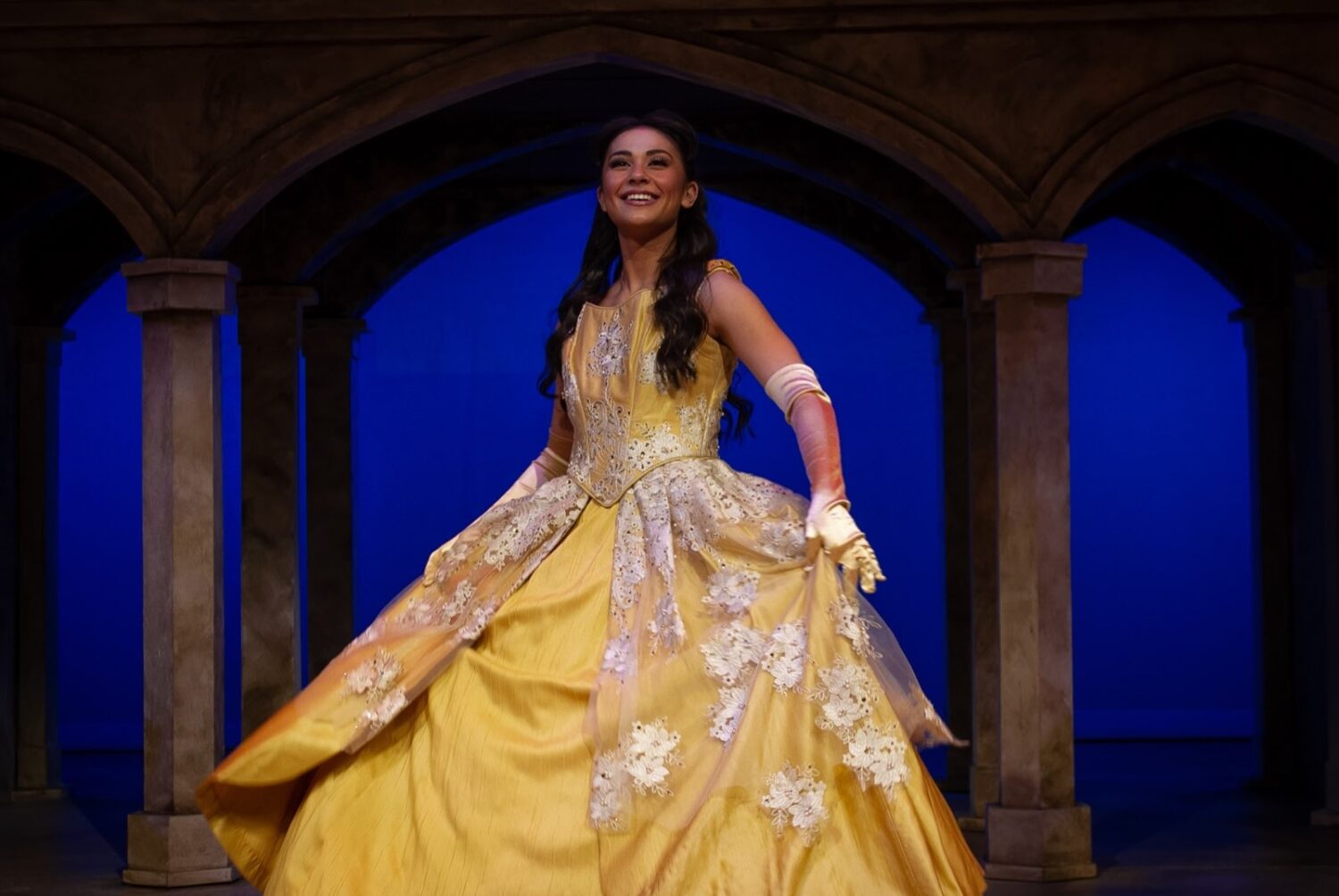
Her casting history also reflects her interest in pushing past narrow assumptions. Clark has played Belle in Beauty and the Beast and Cinderella in Cinderella, roles that allow audiences to see familiar characters through a broader lens. Her stage work has earned recognition, including a BroadwayWorld Award nomination for Best Actress in Once On This Island, an Ovation Award nomination for Best Actress in Once On This Island, and an Ovation Award nomination for Best Newcomer in Cinderella.
The polished credits, though, only show part of the job. Clark has become increasingly vocal online about what performing actually requires. Her recent social media posts have been gaining traction, with one reaching 1 million views, and others drawing tens or hundreds of thousands. The posts challenge the idea that acting is not serious work or that performers live an effortless life.
The reality is far less glamorous than people assume. Contracts can take artists away from home for months. Workdays can run 8 to 12 hours, often 6 days a week. Auditions may require hours of waiting with no guarantee of being seen. Training is expensive. The industry’s expectations around women’s bodies and appearance can be brutal.

“People see the final performance,” Clark says. “They do not always see the travel, the cost, the discipline, the waiting, or the emotional energy it takes to keep choosing this career.”
Still, she is excited to keep choosing it.
Clark’s next goal is clear. She wants to return to New York, audition for large-scale musical theatre productions, and step back toward Broadway or a Broadway national tour. The old Dear Evan Hansen heartbreak remains part of the story, but it no longer controls the ending.
“I feel ready now in a way I could not have been before,” she says. “I have worked, traveled, lost things, rebuilt myself, and learned that my career can be bigger than one missed moment.”
What she wants most is not only the role, the stage, or the credit. She wants to become visible in the way she once needed someone else to be visible.
“I want little girls like me to see that a mixed Filipina girl from Canada can have a real, joyful, sustainable career as a performer,” Clark says. “I want them to know this life can belong to them too.”