
 Michael Atkinson
As cantankerously mysterious as it is fastidiously sensorial, Mark Jenkin’s new film, Rose of Nevada, practically comes with its own scratch-n-sniff card — you come away with the rank flavors of sea salt, seaweed, musty boat rot, and docked fish stinging your nostrils. It’s a modest, weird Twilight Zone-ish narrative when you sum it up, but meanwhile the assault of authentic textures — the grime, rust, and brine of a decrepit Cornish fishing village and the surrounding Atlantic — commands Jenkin’s attention, which doesn’t quite rhyme with the MO of any other contemporary filmmaker.
His brand is resolutely analog: As with his previous features, Bait (2019) and Enys Men (2022), Jenkin makes films using a hand-wound Bolex 16mm camera, the kind film students all over the world learned to use in the postwar era, and the manufacture of which was discontinued in the early ’80s. Like old-school student films, his movies are therefore composed of short shots, have entirely post-produced soundtracks, and sport a distinctive retro grain — they’re crazy blasts of predigital time travel, devoted to the handmade reality-capture of yesteryear moviemaking. He even leaves in the orangey light flares that mark reel ends, as if insisting on documentary realism over seamless illusion. Jenkin (born 1976) teaches at Falmouth University, in Cornwall (his students help crew his shoots), and you can’t help but see his stubbornly anachronistic methods as his way to honor all beginners’ wily first attempts at the craft, perhaps in his classes now but also certainly in bygone decades.
Rose of Nevada is a concerto of wind-swept Cornish details, coalescing rather elliptically into an elegy for the decline of working villages in 21st-century Britain. Like Enys Men, the thrust is subjective dislocation. This particular village is a shadow of its once bustling self, partly due to the tragedy of a single lost fishing vessel, the Rose of Nevada, 30 years earlier — lost because it was shorthanded, compelling the errant crewhand to jump off a cliff afterward. Today, the pub is desolate, and the local post office is now a food bank, which is where we meet jobless young dad Nick (George MacKay), returning home in the rain with a box of donations. You have to piece together the village’s other relationships, including the dementia-beset mother of the long-ago suicide and the widow (Rosalind Eleazar) of one of the lost crewmen, bankrupt and struggling with her grown daughter (Yana Penrose).
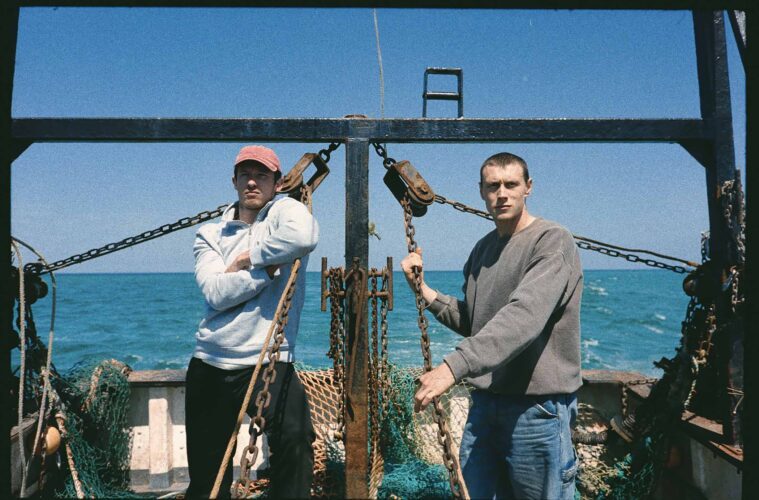
History comes back to haunt in the form of the lost trawler, magically moored at the empty dock out of nowhere. The spooked villagers nevertheless decide to crew it and send it out, recruiting the penniless and inexperienced Nick and young homeless layabout Liam (Callum Turner), under the command of an elliptically manifested captain, Murgey (Francis Magee), who is an irascible old salt straight out of maritime folklore. Nothing is quite what it seems, of course, and when they return to moor full of fish, the village has been restored to its previous self, and the two lads are taken for the Rose of Nevada’s earlier crew members. This is no comfort for Nick, who alone becomes aware that the boat has somehow brought him back to 1993, and who is embraced by the now younger neighbor family (including Jenkin vet Mary Woodvine) as the boy who would kill himself. But would he now?
Jenkin isn’t interested in metaphysics, but in reverb: The fates of Nick, his real family in the present, the dead fisherman he now represents, and the entire village itself back then and right now, are all tangled in questions of communal responsibility and private guilt. (Every fisherman, Murgey bellows at one point onboard, has five villagers depending on him.) Rose of Nevada fairly seethes with portent and folk-horror anxiety, but Jenkin also spends serious time with the boys on the boat learning the arduous process of catching, cutting, sorting, and icing ocean fish for a living — you sense that these were the hardest working days these actors ever put in, with MacKay’s startled bug eyes put to particularly effective use in Jenkin’s granular, weather-beaten biodome. The filmmaker’s artisanal approach never fails to make its own kind of statement, but that doesn’t mean it’s not dazzling; anyone who’s ever shot old-style MOS (silent) 16mm film will find their eyebrows singed off by some of Jenkin’s saturated imagery, especially at night on the sea. In a moviescape carpeted entirely in homogeneously glossy and digitally tweaked HD imagery, it’s a bit like the hit of a fresh oyster after a year of eating Fruit Loops.
Jenkin clearly conceived of his movie as a folktale-ish parable, with the Biblical idea of one small boat of fish nurturing a whole village. But Rose of Nevada never feels less than authentic to its place, to the idea of regional filmmaking, and to a clear-eyed distress with the state of blue-collar life in the U.K., in the social-issue Ken Loach tradition. Look around you: Authenticity is more than enough.