

 Michele Stueven
The Los Angeles County Metropolitan Transportation Authority (Metro) celebrated the official opening of the LAX/Metro Transit Center station last month. Metro is now ready to welcome global fans headed to Los Angeles for major events, like the FIFA World Cup 26, Super Bowl LVI, and the 2028 Olympic and Paralympic Games.
The grand opening of this station marks the eighth project completed in Metro’s ambitious Twenty-Eight by ’28 initiative, a comprehensive plan to enhance the region’s transit infrastructure in time for the 2028 Olympic and Paralympic Games.
The state-of-the-art transit center is a large-scale open station concept, with continuous swooping canopies guiding users’ views through large open spaces and includes walking access to buses and light rail trains, and the soon-to-be-opened Los Angeles World Airports Automated People Mover.
Located at Aviation Blvd./96th St., the LAX/Metro Transit Center Station signifies that the K line is a fully functional connection in Metro’s network. Connecting Metro’s C and K rail lines, six Metro bus lines, and eight municipal bus lines, including Beach Cities, Big Blue Bus, Culver City Bus, GTrans, Torrance Transit, and LAWA shuttles to and from the terminals.
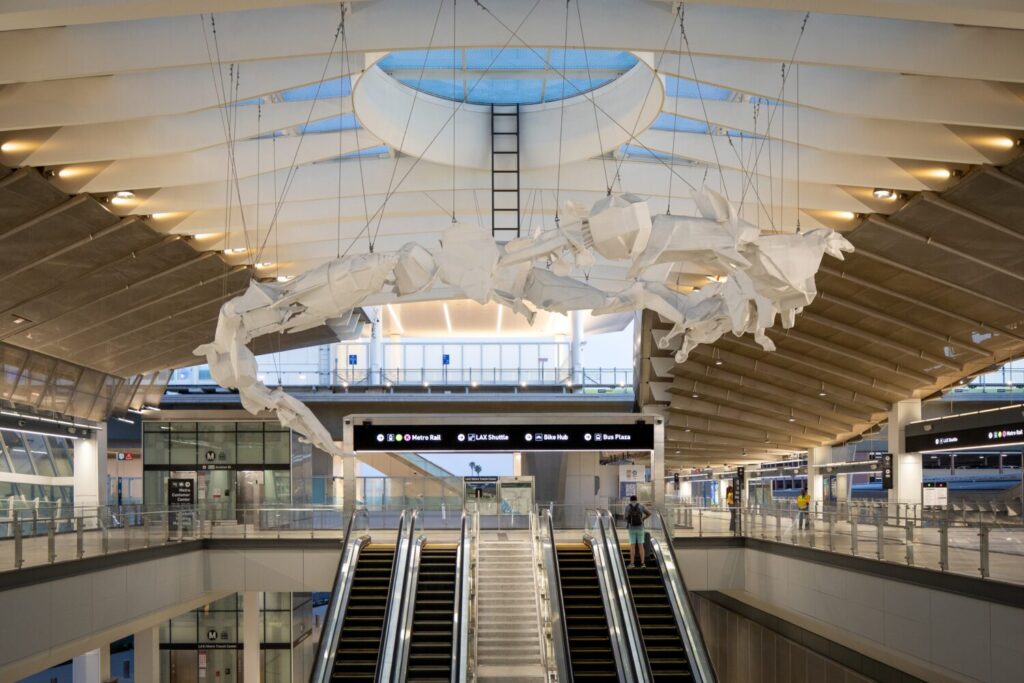
LAX/Metro Transit Center Station (Courtesy LA Metro)
This station features towering artwork at the center of the station, by Los Angeles native artist Glenn Kaino, The Distance of the Sun. Commissioned by Metro Art, the suspended sculpture is made up of a series of vessels for travel, both real and imagined, rafted together in increasing size to create a spiral pathway towards the sky above. The work is a meditation on collective ambitions and shared hope, acting as a bridge to the future created from the designs of the past
All Metro Art commissioned artists are selected through an open, competitive selection process following the recommendation of a panel of LA-based arts professionals. Kaino was selected from 44 artists who were considered for this opportunity.
“This particular artwork comes from the vein of connectivity,” the East LA native tells LA Weekly. “Two stories collided together to make it become a sculpture. For a long time, I’ve been a fan of writer Italo Calvino. There’s a short fiction story he wrote, The Distance To The Moon. In the story, the moon orbited the Earth with such tight gravity that you could row a boat into the ocean, and with a ladder, you could harvest moon goods. As the gravity weakened, the moon drifted away, leaving friends and lovers further apart, which is why we gaze at the moon so longingly
“During the eclipse years ago, I was walking up the hill to Griffith Park from my home in Los Feliz and like a bad dad, I forgot to order the special glasses ahead of time,” says Kaino, who has an unending fascination with space travel. “One thing you cannot do on the day of an eclipse in Los Angeles is find a pair of eclipse glasses at Target. In the end, Griffith Park had them, and we joined the crowd at the observatory. I turned back and saw thousands of people of every race and gender already on the grass, looking up, and it was hours before the eclipse. It was humbling. The capacity of this moment when we’re all together reminded me of everyone looking at the sun, and I thought of connecting those two stories. What does it look like for us to imagine that moment when we can just climb up and touch the sun?”
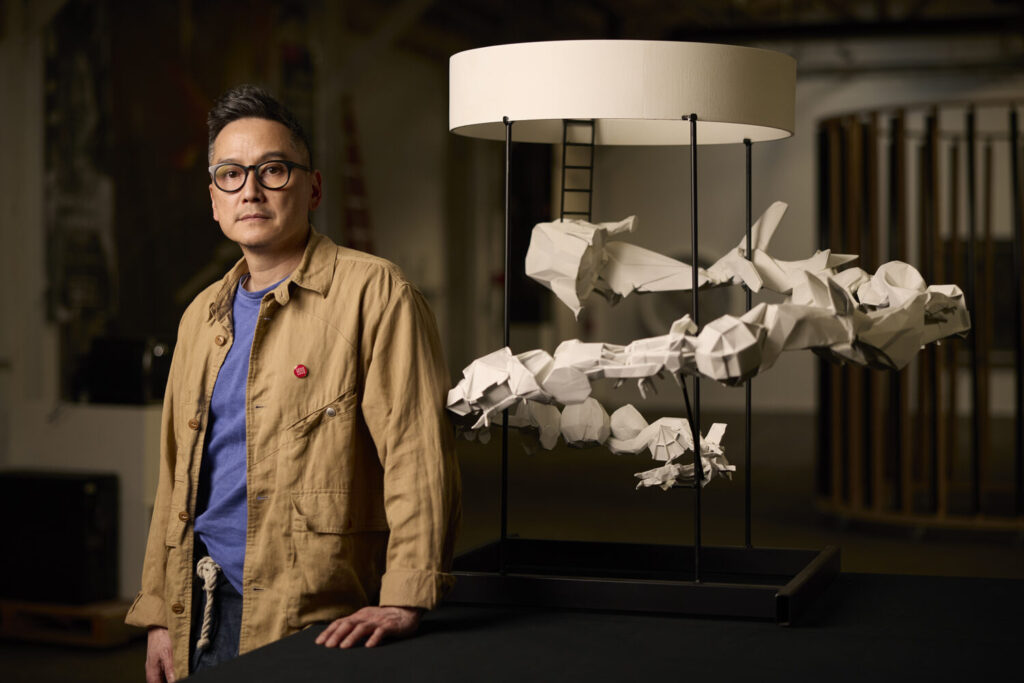
Glenn Kaino (Courtesy LA Metro)
The artwork theme is a series of ships that are moored together and connecting to build a ladder that can metaphorically touch the sun. The sculpture is meant to evoke a remnant of one’s cultural past, childhood memories, and dreams of space flights of people represented across history up until the current moment. The first one is the lunar lander, which sets the story off and ends with a cyclops and a backpack.
It was designed in partnership with world-famous origami master Robert Lang, who works in the space program designing satellites at NASA, taking one-dimensional drawings and turning them into three-dimensional objects.
“That building and that moment represent one of the highest moments of collision of demographics around the city and will likely represent that for many decades to come,” says Kaino. “There are so many travelers across classes and destinations. Thousands of workers work there. Everything from the first-class traveler to the worker and everything in between to every destination, it’s all about us looking up together.”
The station also features a bus plaza, bike hub, customer service center, and spans more than 1,100 feet from north to south, and has security coverage monitored 24/7 by security operations staff.
As part of Metro’s commitment to sustainable urban planning, the station also includes environmentally friendly features like energy-efficient lighting, landscaping with native plants, and plans for further expansion to accommodate future growth.