
 Will Jones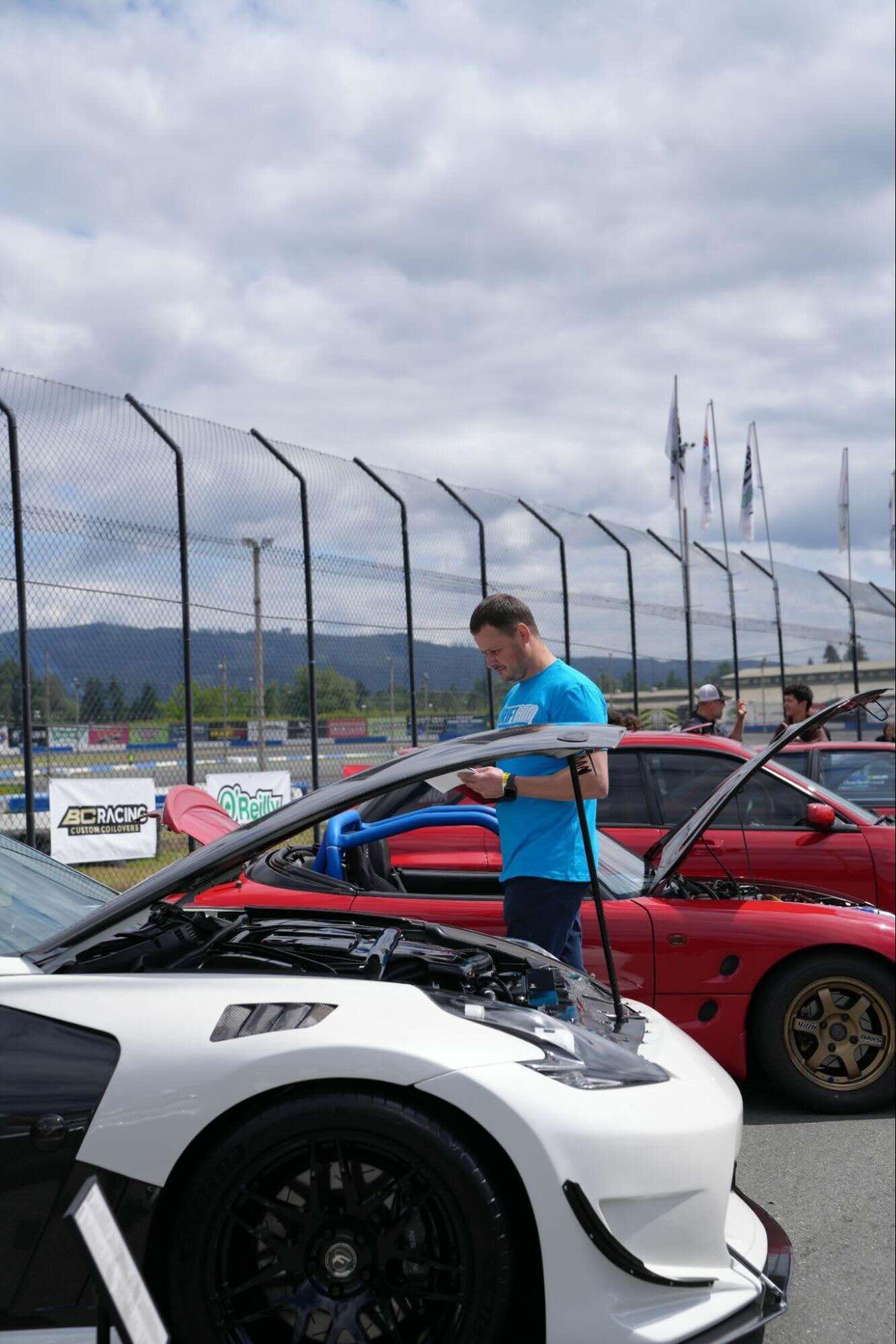
Photo Courtesy of Yurii Nadtochii
The BMW M3 GTR from Need for Speed: Most Wanted was never designed to exist outside a screen. Its proportions are stretched for visual drama rather than structural feasibility. Body panels thinned to suit rendering engines, wheelbases extended beyond real-world tolerances, geometries that would be unmoldable under standard fabrication constraints. It was built for spectacle on a monitor. Building it in fiberglass and steel, at full scale, with a running drivetrain, was a different engineering problem entirely.
Yurii Nadtochii led every phase of the project personally, from initial concept through final execution, backed by years of deep work in automotive design and custom vehicle development.
What he completed was not a show-only display or a tribute prop. The car is road-capable. And the process he used to build it, developed without a playbook because the custom automotive industry had no established framework for this kind of work, is what distinguishes the project beyond its cultural reference point.
Working from a design that shouldn’t exist
The central fabrication problem with digitally designed vehicles is geometry. Game designers operate without manufacturing constraints. They extend body panels, exaggerate angles, and remove structural considerations that real vehicles require. When Nadtochii began working on the M3 GTR, he had no mold, no precedent, and no industry template to draw from.
His approach centered on custom fiberglass fabrication. Unlike metal bodywork, which depends on standardized tooling, fiberglass allows a builder to construct molds outward from a base structure, shaping the surface iteratively toward a target profile. Nadtochii built those molds himself, scaling proportions by hand against reference images of the original game asset. The result captured the M3 GTR’s distinctive silhouette while meeting the structural requirements of a vehicle that would actually be driven.
“He translated a fictional digital vehicle into a functional, road-ready engineering project,” as documentation from his practice describes: “a process not standardized in the automotive industry.”
That distinction matters. This was not a cosmetic modification of an existing BMW. Nadtochii worked at the level of full body reconstruction, developing fabrication approaches that had no established playbook in the field.
What happened when the project became visible
The car’s debut on Instagram produced outcomes that extended well beyond social engagement. Within months, builders internationally began producing their own M3 GTR replicas, and a significant portion cited Nadtochii’s work as their primary technical reference. The fabrication choices he made became a kind of standard: proportion decisions, mold approach, finishing tolerances.
That kind of adoption within a specialized community is hard to manufacture. It generally means a reference build was executed well enough that other practitioners treat it as worth replicating rather than merely admiring. His Most Wanted Auto Sales & Customs Garage in Lynnwood began receiving requests for similar work, a demand that grew directly from the project’s visibility.
The BMW Museum in Germany exhibited the car. Roads Untraveled, an automotive YouTube channel with international distribution, documented the build. Nadtochii has also become a recognized presence within the Pacific Northwest car culture that helped shape his work. On May 30th, 2026, he served as a judge at the ImportMeet Trackside Car Show at DriftCon, a Pacific Northwest drifting and car show series held alongside the Evergreen Drift NW Drift Series at Evergreen Speedway. The role placed him among what organizers describe as two of the most respected car builders in the PNW community, selected to evaluate a curated field of sixty entries competing for awards at one of the region’s premier automotive events. He has also participated in multiple ImportExpo events across North America, where the M3 GTR was assessed competitively alongside professional-grade builds.
An industry gap this work began to address
Demand for digital-to-physical vehicle reconstruction has grown as gaming culture and automotive culture have continued sharing audiences. The interest in seeing iconic digital designs realized in physical form is real. The engineering barriers have historically been considerable: structural adaptation, fabrication accuracy, material selection, and the near-total absence of any standardized methodology.
Nadtochii’s project treated those barriers as engineering problems rather than reasons to abandon the work. His approach, built on custom molds, fiberglass fabrication, proportion scaling, and functional integration of automotive systems into a non-standard body, produced a build that other practitioners have since treated as a repeatable framework.
Whether that produces a formalized industry discipline or remains a specialized niche is a question time will answer. The record shows that before Nadtochii built this car, it had not been done this way. After he did it, others followed.