
 Victoria Gonchar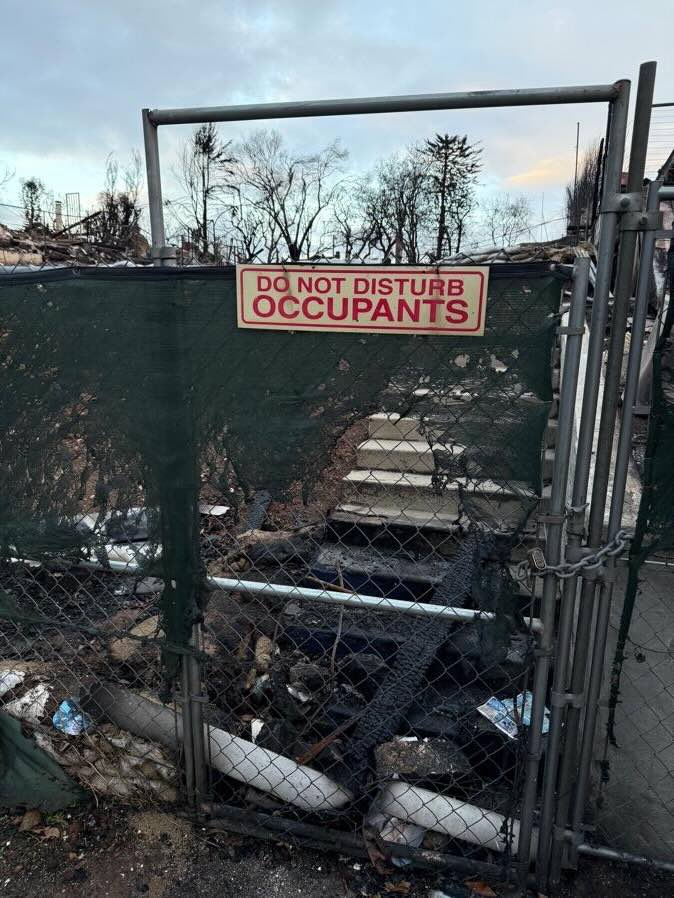
Image credit: Victoria Gonchar
There are few things more painful than watching a community dissolve—scattering like embers from the fires that forced their hands. The Pacific Palisades, once a bastion of California coastal living where residents treasured the “hometown feel in the big city,” now exists primarily in memory and insurance claims.
As the ashes settle on streets that once held multimillion-dollar views, a sobering reality emerges. Most residents won’t be coming back—at least not anytime soon.
The Impossible Math of Return
“Of course, they want to go back there… They’re not going to return because it’s simple math,” explained former “Million Dollar Listing” star Josh Altman with brutal frankness. The numbers tell a crushing tale—rebuilding costs in the Pacific Palisades hover around $1,000 per square foot, a figure that turns modest reconstruction dreams into financial nightmares.
While the Palisades had a reputation as a rich neighborhood, many residents were not wealthy. In fact, many lack the amount of wealth required to rebuild. For many longer-term residents, their wealth was almost entirely tied up in their burned-down homes. Many were only considered wealthy because of the value of those homes, which skyrocketed over the course of recent decades. Some couldn’t even obtain insurance on their homes following insurance companies’ choices to cancel many California policies last July.
To make matters worse, those residents who inherited their homes paid lower property taxes via Proposition 13. If the property sells, the new inflated property tax rate is applied.
The fires that swept through Southern California since January 7 have scorched over 50,000 acres, claimed 28 lives, and decimated upwards of 16,000 homes and buildings. Early financial estimates put the catastrophic damage at around $50 billion—a staggering sum that insurance companies, many of which had already begun fleeing the Golden State before the disaster, are now confronting with trepidation. Many companies already felt the area was too expensive to insure before the fires of 2025; recent events may have made that decision permanent, and may even seal the fates of some insurance companies.
The Insurance Nightmare
Kent Steffes, who has lived in the Pacific Palisades since 1973, when his engineer father purchased a five-bedroom home for $75,000 (about $533,000 in today’s dollars), articulates the insurance conundrum many face.
“A lot of insurance plans cover only the house’s value as it is, not the cost to rebuild according to modern building codes,” Steffes explains. “So they’ll say, ‘Hey, your house is worth $300,000,’ but it’ll cost you $1 million to rebuild that same thing.”
Nancy Wallace, a real estate professor who lost her home in the 1991 Oakland Hills fire, offers a stark assessment: “Insurance adjusters are not your friends. They’re not there to sympathize. They’re there to minimize the payout of their company.”
This harsh reality—coupled with State Farm’s recent cancellation of tens of thousands of California policies and Allstate’s pause on new homeowners insurance since 2022—creates a perfect storm for those contemplating rebuilding.
The Human Cost
Behind every property loss statistic lies a story. Adele Heydenrich’s Gray Dragon toy store on Marquez Avenue—where her 9-year-old son Grayson proudly worked—now exists only as “a heap of concrete ash, rusty metal with upturned nails, and a set of burnt metal stairs leading nowhere.”
Their close-knit commercial community has been erased, including Gerry Blanck’s Martial Arts Center, Paws n’ Claws Grooming Salon, and Vittorio Ristorante & Pizzeria. “I think we’re kind of mourning the loss of that community,” Heydenrich reflected, “almost more than anything.”
Vultures Circling: Newsom’s Firewall Against Predatory Buyers
In January 2025, Governor Gavin Newsom issued an executive order prohibiting unsolicited offers to buy property in fire-damaged areas—including Pacific Palisades—after reports emerged of real estate speculators approaching devastated homeowners with low-ball offers while some properties were still actively burning. The three-month emergency measure creates a desperately needed buffer for shell-shocked victims facing the particular breed of opportunists who view catastrophe as merely an exciting market inefficiency, with some offering as little as a quarter of a property’s pre-fire value under the calculated assumption that grief temporarily inhibits financial decision-making.
While Newsom’s intervention can’t prevent all predatory behavior, it establishes a cooling-off period during which residents might regain their emotional equilibrium before making decisions that could haunt them long after the smell of smoke has faded—placing a temporary shield around those who’ve already lost more than enough in a rare moment of bureaucracy functioning as it should.
The Newport Migration
Displaced Pacific Palisades residents have begun gravitating toward familiar surroundings—specifically, Newport Beach in Orange County. This migration makes perfect sense for the affluent community seeking to replicate what they’ve lost: safety, seaside luxury, excellent schools, and a certain socioeconomic familiarity.
“We basically wanted somewhere that wouldn’t feel completely foreign,” shared one displaced homeowner who requested anonymity while signing a lease in Newport Beach. “Somewhere our kids wouldn’t feel like aliens when they mentioned their old street address.”
With its cliff side mansions, idyllic coastline, and comparable home values, Newport Beach offers a ready-made substitute for the Palisades lifestyle. But this poses a problem for housing prices and housing supply. Longtime Orange County residents are now watching their already tight housing market tighten further under this influx of fire refugees with deep pockets and urgent needs.
The Rental Scramble
For those unable or unwilling to purchase new homes while their fate in the Pacific Palisades remains uncertain, rental properties have become as scarce as firefighters’ rest days during the January blazes. Virtually all two-bedroom rentals from Santa Monica to Manhattan Beach have now been occupied. At the same time, nearby affluent enclaves like Brentwood, Bel Air, and Beverly Hills have seen rental inquiries spike.
The numbers tell a disturbing tale: Los Angeles County’s apartment vacancy rate is a measly 5.2%—the third lowest nationwide and well below the 8% national average. Orange County’s situation is even more dire at 4.1%, with Newport Beach offering a nearly impossible 2.1% vacancy rate.
It’s a landlord’s market—and they know it.
Land Value Reset
The Pacific Palisades community is facing a decline in land values due to the fires, with projections indicating a potential 30% decrease. This anticipated decrease has led to a surge in property listings as homeowners grapple with the decision to rebuild or sell. The lost property value amounts to hundreds of millions of dollars wiped out as numerous lots that once hosted multimillion dollar homes are sold as scorched earth.
The property at 17126 Avenida De La Herradura, listed at $999,000, is the first land sale since the fires. This sale is expected to set a new benchmark for post-fire property valuations, which may reset market prices and influence future transactions.
Real estate experts caution homeowners against selling their properties at reduced prices. They advise waiting, allowing values to recover as the community rebuilds. The rebuilding process will likely span five to seven years, during which property values may gradually return to pre-fire levels.
The Long Road Ahead
Despite Governor Gavin Newsom’s executive order to expedite rebuilding, Los Angeles construction typically progresses at nearly half the national pace. And that is the average without the unprecedented demand for contractors that the area may experience as hundreds of lots seek to rebuild from scratch.
The sobering consensus among experts is that realistic construction timelines may stretch as long as five years. Five years is long enough for children to complete high school, for marriages to dissolve, and for careers to change course entirely.For those who return to the Palisades, it won’t be a matter of simply picking up life where they left off.
For many, what began as temporary displacement is morphing into permanent resettlement. Orange County’s already hot real estate market—seeing median home prices rise 12% year over year—will likely heat further as Pacific Palisades refugees put down more permanent roots.
The wealthy will rebuild—eventually. The area will rise again—different, perhaps more exclusive than before. But for now, an entire community has been forced to scatter. Each family tries to reassemble some semblance of the life they once knew, one temporary address at a time.