
 Kaitlyn Gomez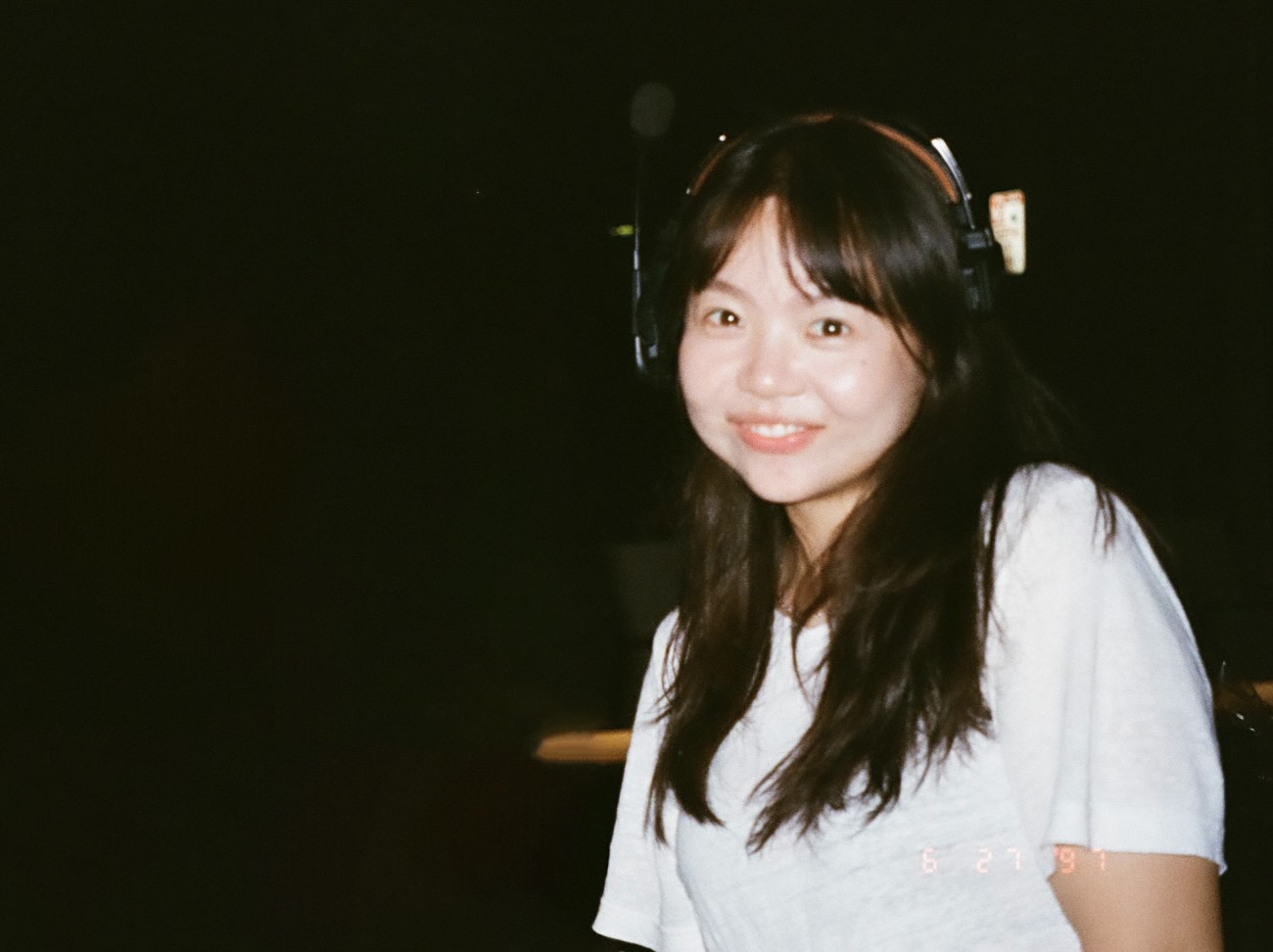
Production Designer Cheryl Wenjing Xia is a LA based Production Designer and graduate of ArtCenter College of Design. Xia is drawn to interiors that carry emotion. Her most intricate work often lives in the rooms women occupy, the rituals they repeat, and the selves they reveal only when no one is looking. Her design practice is not only about visual control; it is also about giving female characters a physical environment where they are allowed to be complicated, unpolished, contradictory, and alive.
Two recent short films — Miss Mary Mack, directed by Taytum Blake, and Ligeia, directed by Viola Mai — illustrate how Xia’s spaces are built to hold female interior life rather than simply frame it.
Miss Mary Mack follows teen pageant queen Mary McCormack as her life unravels over what becomes the worst day of her life, pushing her to confront her beliefs about faith, love, and competition. On the surface, it risks looking like a familiar world — tiaras, glitter, rehearsed smiles. But Xia entered the project from a place of admitted distance. Beauty pageant culture was not something she had firsthand access to, outside of seeing fragments in television, film, and media. That distance became part of her approach.
To close that gap, director Taytum Blake physically attended real teen pageant events as an observer, recorded the environment, and shared video with Xia. What emerged from those references wasn’t just stage craft; it was a rhythm of pressure. The pageant, as Xia came to understand it, is not only what’s lit for the judges. It’s also the unglamorous waiting and self-sorting that happens offstage. And importantly, Miss Mary Mack is not a film about idealized girls under perfect light. It is a film about how those girls negotiate themselves when the light is off.
In production design terms, that meant building two very different emotional geographies.
Onstage, Xia designed the pageant environment to be deliberately dazzling. The stage is symmetrical, polished, almost hyper-ideal. The palette is clean, aspirational, “camera ready.” It represents not just performance, but the expectation to be coherent — to present a version of femininity that is legible, acceptable, and palatable to adults.
Backstage, she did the opposite.
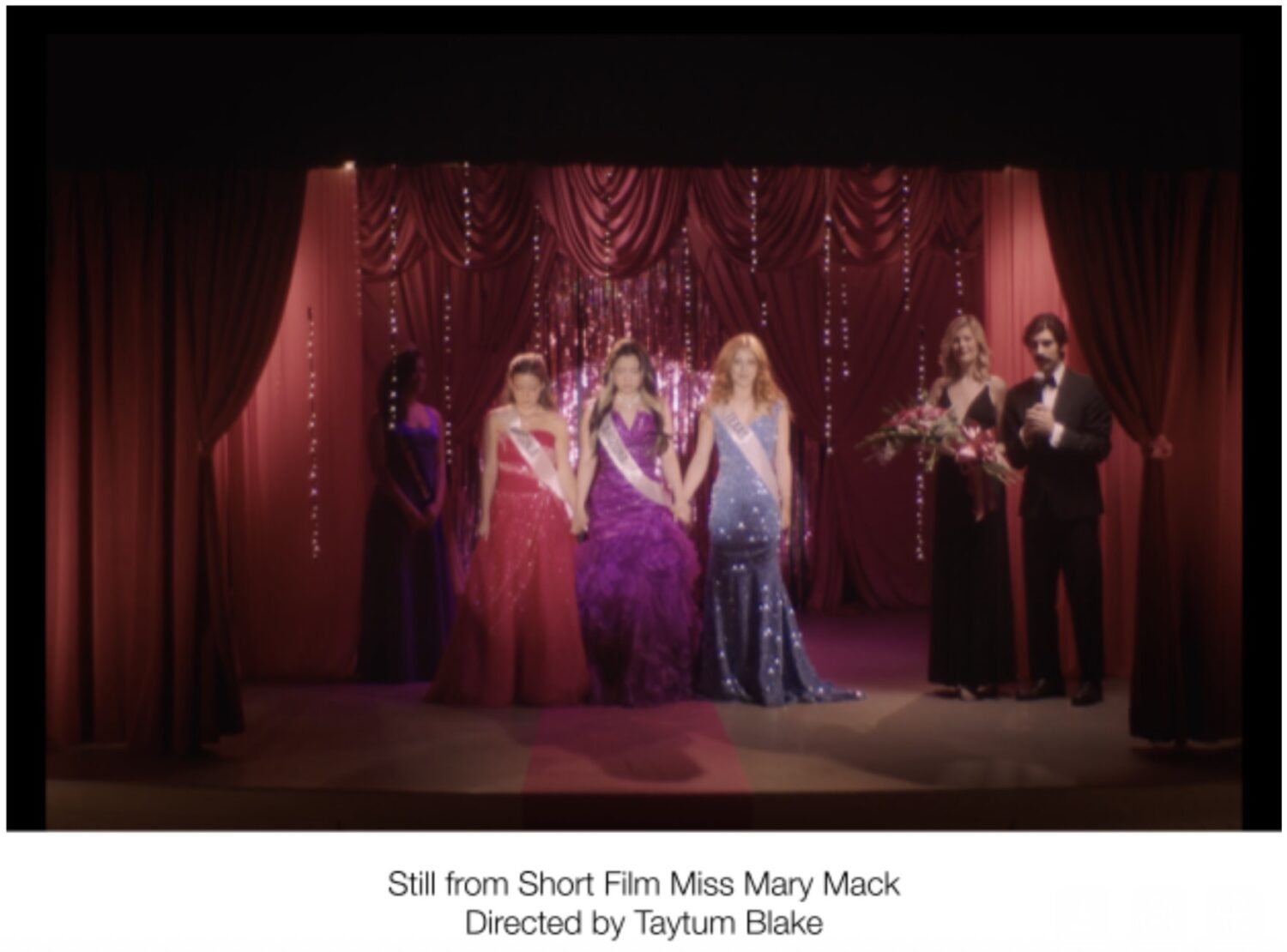
The dressing area and prep zones were designed as crowded, chaotic, a little desperate in their energy. Vanities are overloaded. Makeup kits spill open. Jewelry, faith tokens, hair spray, mascara wands, snacks, half-zipped bags — nothing sits in clean order. The mirrors aren’t romantic; they’re harsh, too close, too honest. The mess is not careless. It’s intentional. Xia uses it to reflect where the girls actually are: in between identities, in between beliefs, in between versions of themselves. The lack of order becomes a visual stand-in for the instability of adolescence — ambition without certainty, confidence without full conviction.
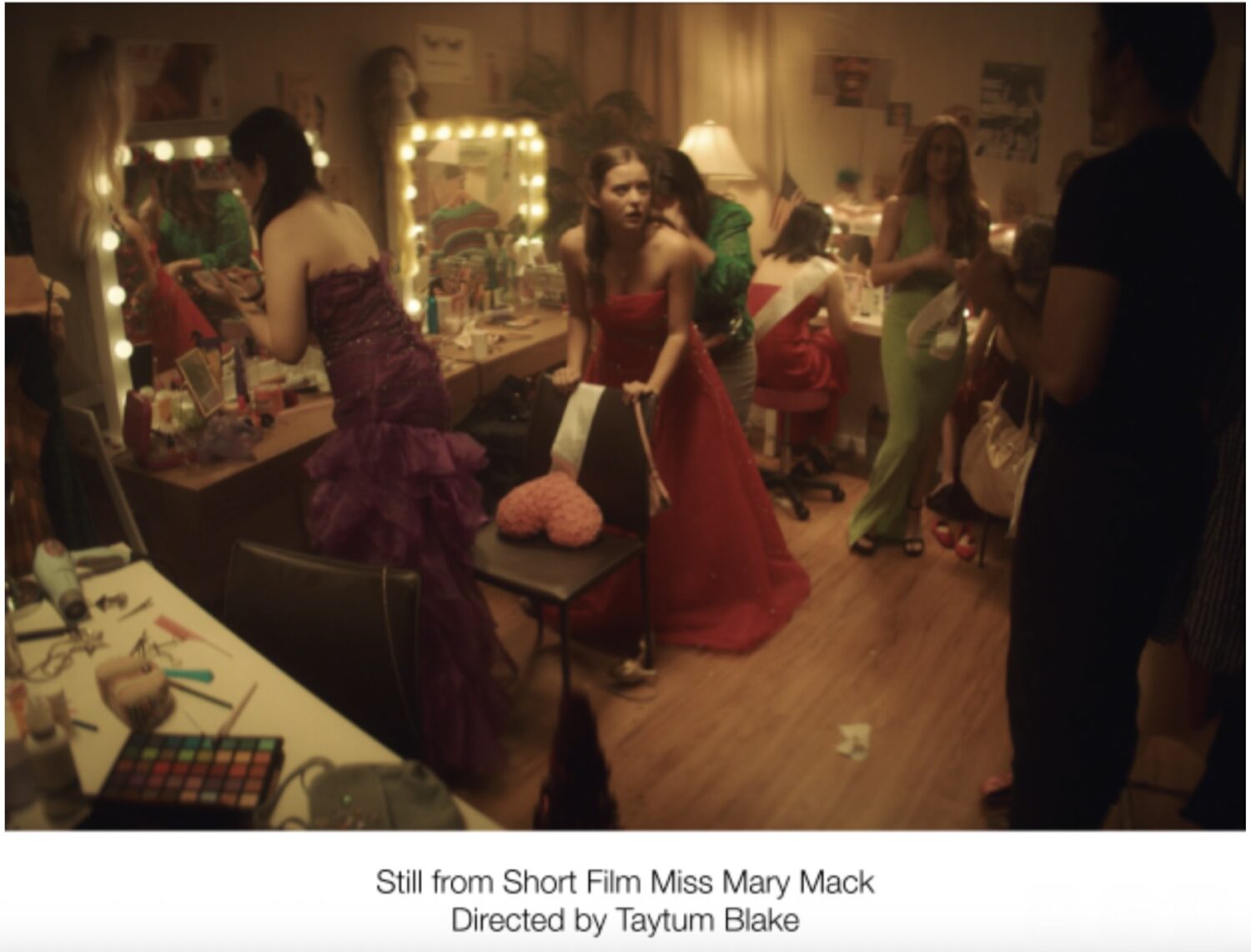
In this layout, the stage and the backstage are not just two locations. They’re two states of self. One represents the way the girls are taught to present themselves to the world; the other records the way they’re quietly negotiating what that actually means. The film is not arguing that pageantry is purely oppressive, nor is it romanticizing rebellion. Instead, it observes the tension: faith, beauty, competitiveness, insecurity, and tenderness all colliding in a single night.
Xia’s choices echo a line often attributed to Virginia Woolf: No need to hurry. No need to sparkle. No need to be anybody but oneself. The point is not that the girls have already reached that freedom. The point is that they’re reaching for it, even while standing inside a system that rewards them for doing the opposite.
If Miss Mary Mack studies girls under pressure from institutions that want them polished, Ligeia approaches female agency from the opposite direction — fury.
Directed by Viola Mai, Ligeia is a horror-comedy that tells the story of a woman who returns from the dead to confront, and take revenge on, the husband who murdered her. It’s camp, it’s grotesque, it’s funny, and at the same time it’s in conversation with much older ideas about women, ownership, and obedience. The tone nods to Gothic and Victorian language — candlelight, drapery, ornament, controlled darkness — but the emotional stance is modern. The film asks: what happens when a woman who was expected to be submissive refuses to stay erased?
For Xia, that question became spatial.
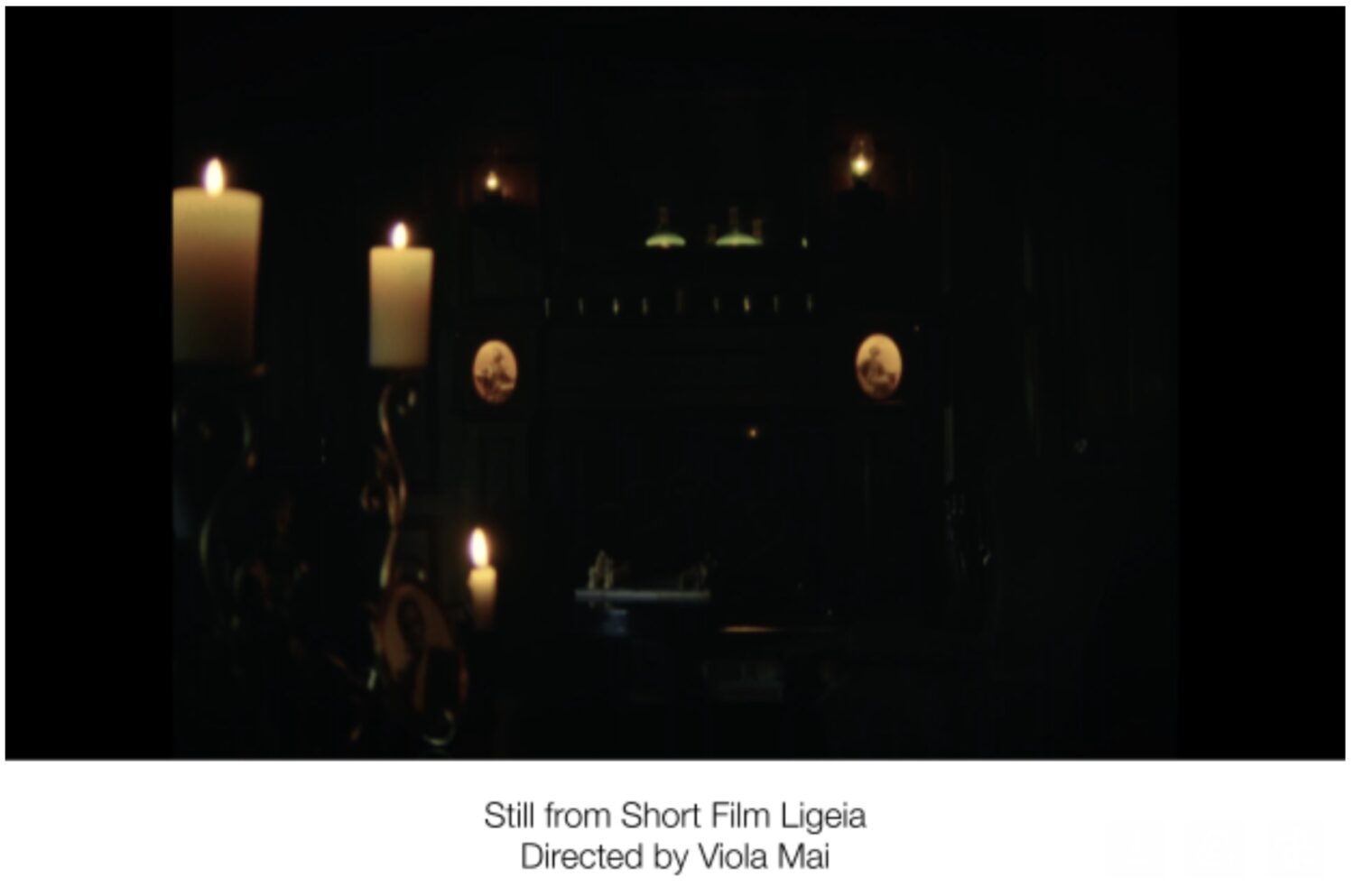
She leaned into a Victorian vocabulary — rich fabrics, carved wood, heavy silhouettes, layered candle stands and candelabra — but resisted treating those objects as purely decorative. The rooms aren’t just set-dressed “period drama” spaces; they feel like chambers of containment. The light sits low. Corners hold secrets. Surfaces seem to have absorbed years of silence. There is a sense that the woman who once lived here had to be contained, softened, managed. And then, when she returns from the dead, that same space becomes the site of her refusal.
Xia describes the design logic as a kind of corrosion-with-memory: the world is still ornate, but it’s not pristine. Metal is tarnished. Edges carry wear. Nothing is fully polished back into male fantasy. The environment suggests that even if a woman has been controlled, that control was never total. There is always an edge, a grit, a holdover of will. The film gives that will a body, then lets it strike back.
What’s quietly present in both films is an interest in how women endure — not only loudly and heroically, but privately, structurally, spatially. In Miss Mary Mack, endurance looks like a teenager holding herself together under stage lighting she didn’t design. In Ligeia, endurance looks like a Victorian woman who would rather return as an instrument of vengeance than disappear as someone else’s casualty.
As a female production designer working in an industry that still often leans male in decision-making roles, Xia is aware that authorship and authority are not always evenly distributed. She also notes that this landscape is changing, and part of that shift is communal. “Girls help girls” is not just a slogan in her orbit — it’s a working model. Her involvement with initiatives like Women in Film reflects that: learning from other women creators, sharing strategies, and building rooms — literally and structurally — where female point of view is not an afterthought.
Her sets, in that sense, are not only visual environments. They are arguments for the interior lives of women as worthy of cinematic space. They are places built so that a girl, or a ghost, can finally breathe.
Contact info: [email protected]
Website: xia2rt.com