
 Michele Stueven
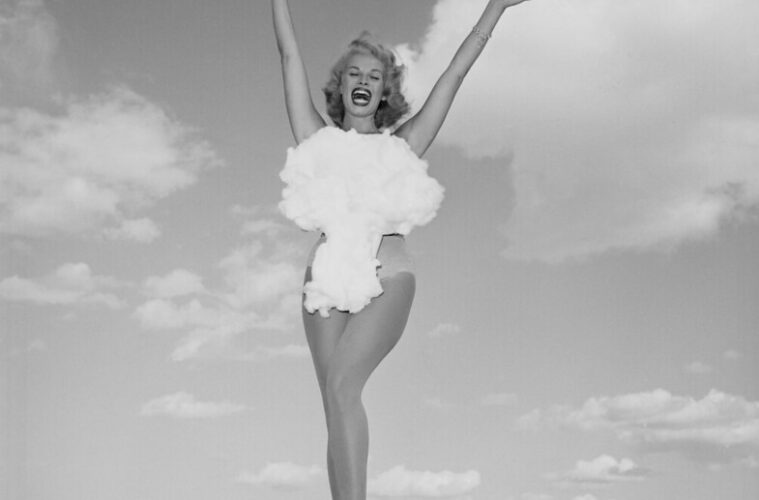
After 25 years of exhaustive research and investigative effort, historian and founding Atomic Museum member Robert Friedrichs has uncovered the true identity of the woman behind one of the most iconic photographs of the Atomic Age, Miss Atomic Bomb.
The unforgettable image, captured by Las Vegas News Bureau photographer Don English and released on May 24, 1957, coincided with Operation Plumbbob at the Nevada Test Site. The photo features a beaming Copa showgirl in the Nevada desert wearing a mushroom cloud swimsuit, her arms stretched triumphantly toward the sky.
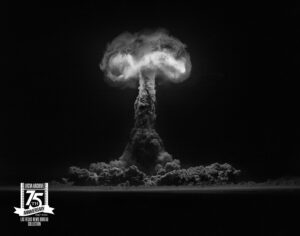
A mushroom cloud from the Hood Test, which was part of Operation Plumbbob at the Nevada Test Site on July 5, 1957. The test, sponsored by Lawrence Livermore National Laboratories, was the largest test ever conducted at the site with a yield of 74 kilotons. (Courtesy LVCVA)
The mushroom cloud had become the defining visual symbol of the atomic bomb, a striking and dramatic representation of nuclear power. From the earliest tests at Enewetak Atoll to the Nevada Test Site, the sight of the billowing cloud became synonymous with the era’s scientific and military advancements. Recognizing the power of this imagery, English’s team crafted a cotton mushroom cloud and attached it to the front of the showgirl’s swimsuit, transforming her into Miss Atomic Bomb.
“Las Vegas played a vibrant and unique role in the Atomic Age, and Miss Atomic Bomb has always been a symbol of that era’s colorful history,” says Joseph Kent, Chief Community Officer and Curator at the Atomic Museum
The photograph symbolizes the convergence of Cold War culture, science, and the burgeoning entertainment industry of Las Vegas. Recognized in hundreds of publications worldwide, the photo helped cement Las Vegas as a cultural epicenter of the Atomic Age. For 70 years, the image of Anna Lee Mahoney of the Bronx, New York, circulated the world, drawing millions to the Nevada desert.
Although the subject of the photograph was long identified as Lee A. Merlin her true identity has long been shrouded in mystery. Through the assistance of a professional detective agency, Friedrichs uncovered conclusive evidence linking two names to a single Social Security number. This evidence, supported by birth records and communication with a living relative, revealed that Lee A. Merlin was a stage name for Mahoney.
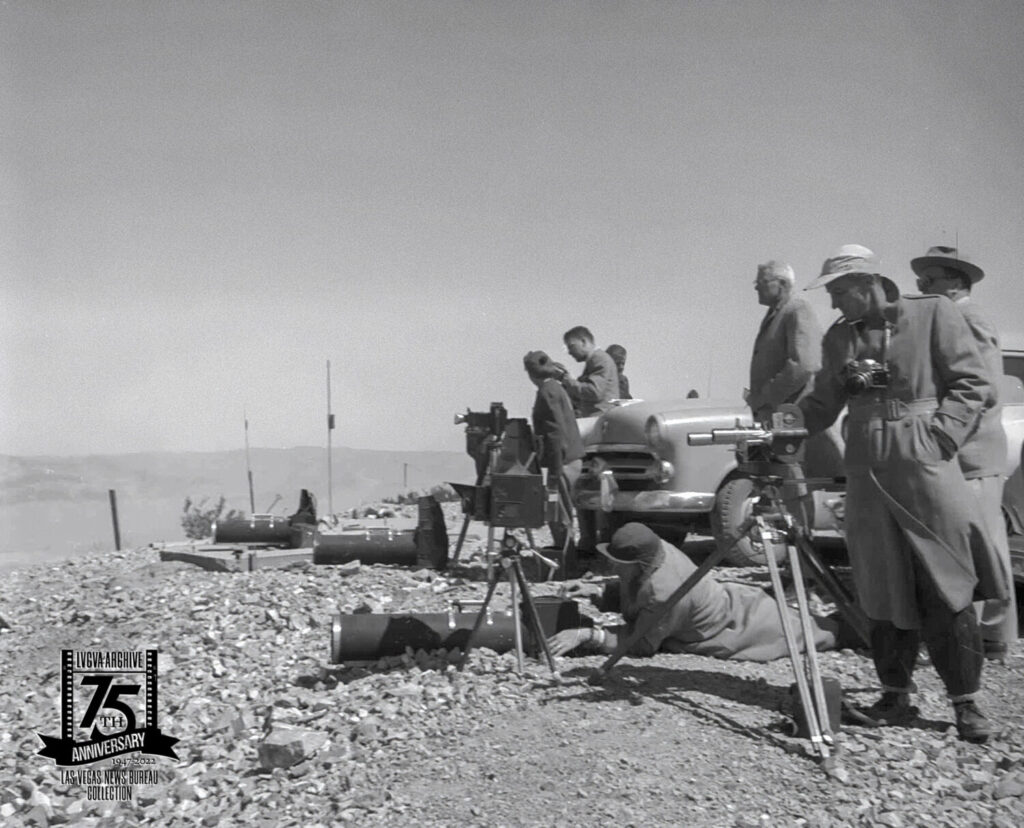
Photographers gathered outside of the Nevada Test Site at News Nob (which was only ten miles from ground zero), to shoot the atomic blast from the ESS Test, part of Operation Teapot, which was sponsored by the Los Alamos National Laboratory on March 23, 1955 (Courtesy LVCVA)
“She was selected at random to be in one of the series of publicity pictures they were taking at the time, nobody knew the names of these strip regulars,” the Vegas-born Friedrichs, who grew up with the nuclear programs in Las Vegas and the media hypes that were used to market the desert town, tells LA Weekly. “She was using a stage name, which was common practice at the time,” he says. “It took years to work through that and find a family member who knew her real name. They had no idea that she was Miss Atomic Bomb and had never seen the photo before. In discussions, the distant cousins provided her maiden name, so I had something to work with there. She had no children. I felt it was important for other family members to know what her contribution was to the city of Las Vegas.”
Mahoney, born Aug. 14, 1927, trained in ballet and modern dance under Madame Bronislava Nijinska in Los Angeles before performing in various shows and musicals under the stage name Lee Merlin. By 1957, she performed as lead dancer at the Sands Hotel Copa showroom in Las Vegas, where she participated in the now-iconic Las Vegas News Bureau photoshoot. In 1962, she married and later moved to Hawaii, where she worked as a mental health counselor. In the late 1990s, she relocated to Santa Cruz, California, and worked for the Cabrillo College Foundation, raising funds for student scholarships. She passed away in 2001 after battling cancer.
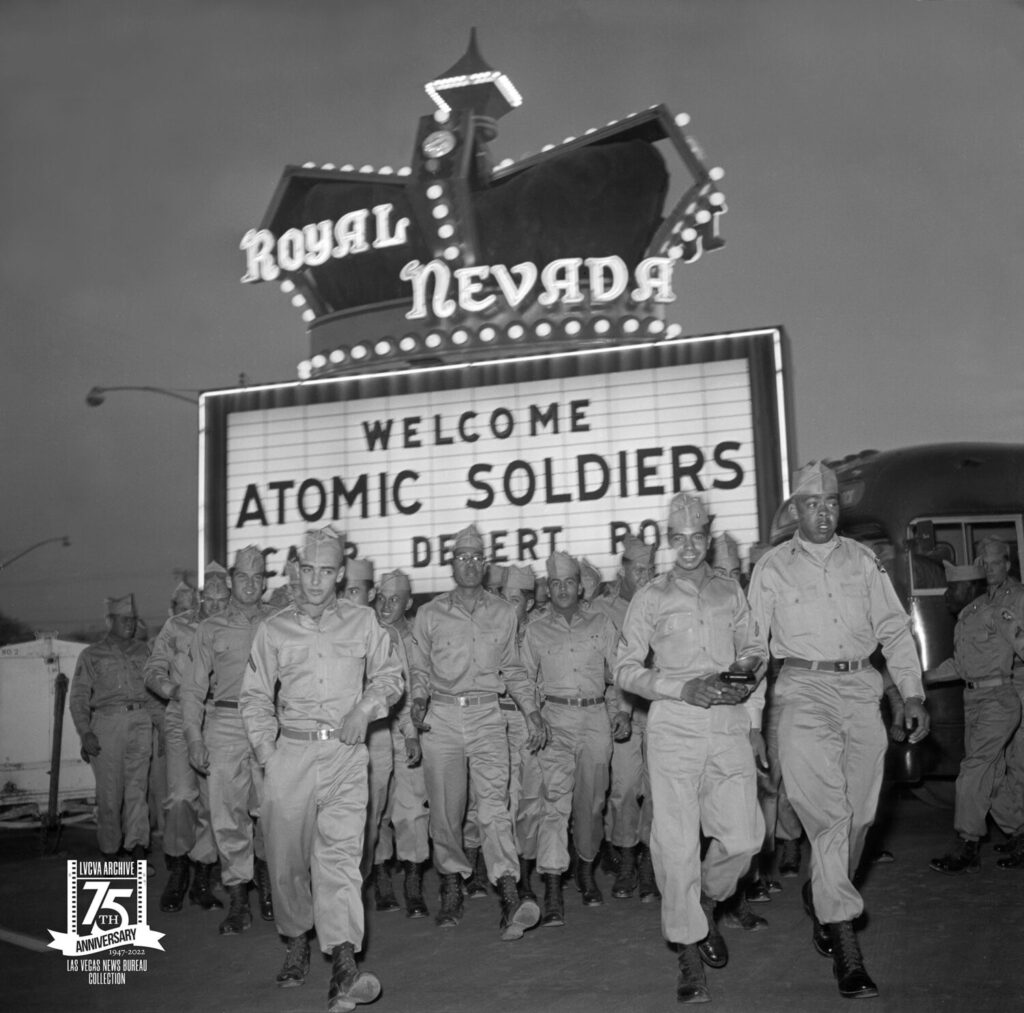
Atomic soldiers arrived at the Royal Nevada in Las Vegas on April 18, 1955. The soldiers were in Las Vegas for Operation Teapot, which was part of the atmospheric tests at the Nevada Test Site, northwest of Las Vegas. (Courtesy LVCVA)
“I had started the search, hoping that she would still be alive and interested in coming to the grand opening of the museum,” says Friedrichs, “ but unfortunately, she had just passed, which we didn’t know until last year. She had no idea of the impact she had on the marketing of Las Vegas.”
To honor the discovery and its 20th anniversary, the Smithsonian-affiliated museum will display a temporary exhibit dedicated to Friedrich’s search and ultimate discovery of the iconic figure’s real identity, as well as the image’s evolution through the years. Organized in collaboration with the Las Vegas Archives, which today maintains the Las Vegas News Bureau’s collection in conjunction with the Las Vegas Convention and Visitors Authority, the exhibit is planned for a June debut.
For more information on the Atomic Museum, click here.
Additional reporting by Andrea Drake
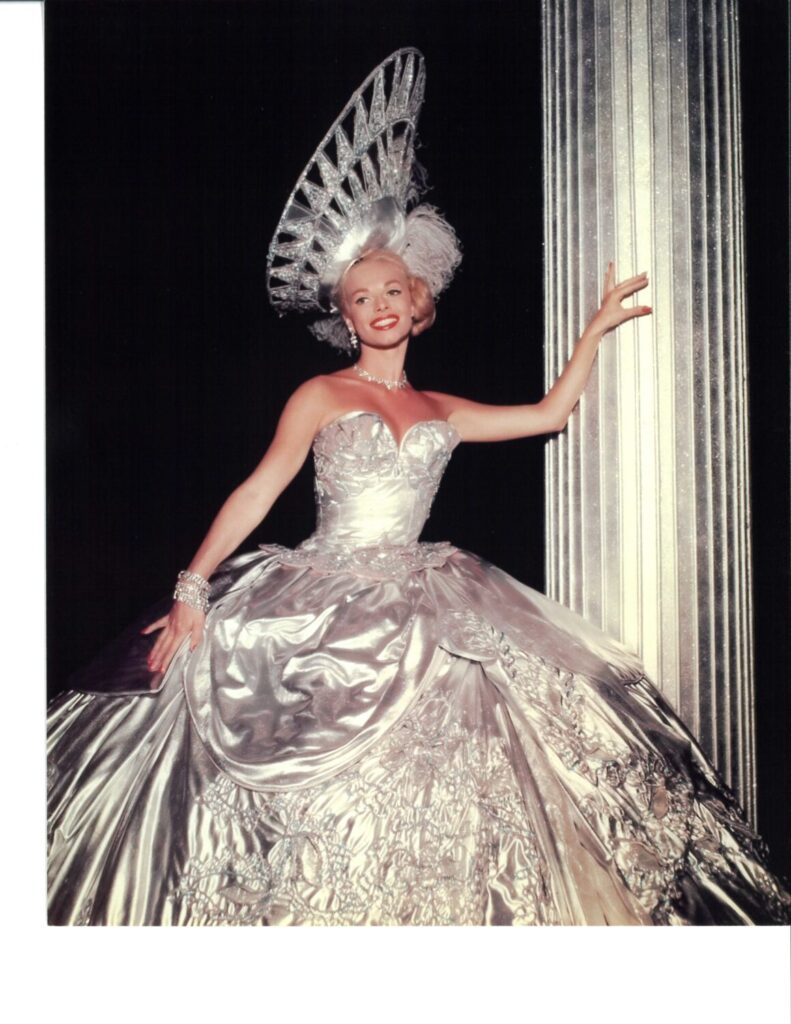
Anna Lee Mahoney, Miss Atomic Bomb (Courtesy Special Collections, UNLV Libraries)