
 Nicholas White
Warning: Don’t try this. LA Weekly does not condone breaking the law or risking your safety.
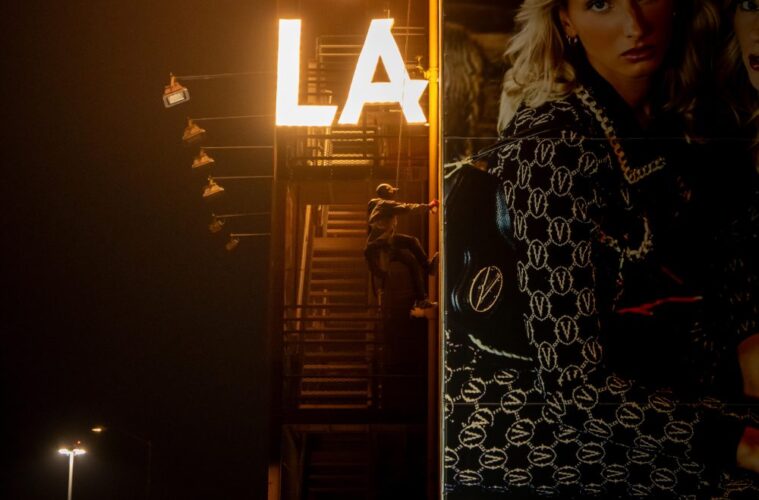
Commuters on Wilshire Blvd. saw for the first time on a January morning an aerial graffiti spectacle that was, at its imposing height, unavoidable, perched above the historic 12-story Art Deco E. Clem Wilson Building, smack dab in the middle of Miracle Mile, something of an anomaly in this area. The names EXR, ENDEM and SKEAM loomed above in giant letters like Batman standing in the cold light of day, looking over the city, painted vividly on a plain light blue sign occupied for years by Samsung, Asahi and Mutual of Omaha.
Sharp drop-offs surrounded all sides. While high-roller graffiti pieces and billboard pieces are common methods to attract attention above the ground, a platform usually exists on which to stand. No such platform was to be found here. The tags remained in place until mid-March, seemingly untouchable because of the pieces’ inconvenient placement, after more than six weeks on display in a sign spot usually reserved for billion-dollar-plus corporations.
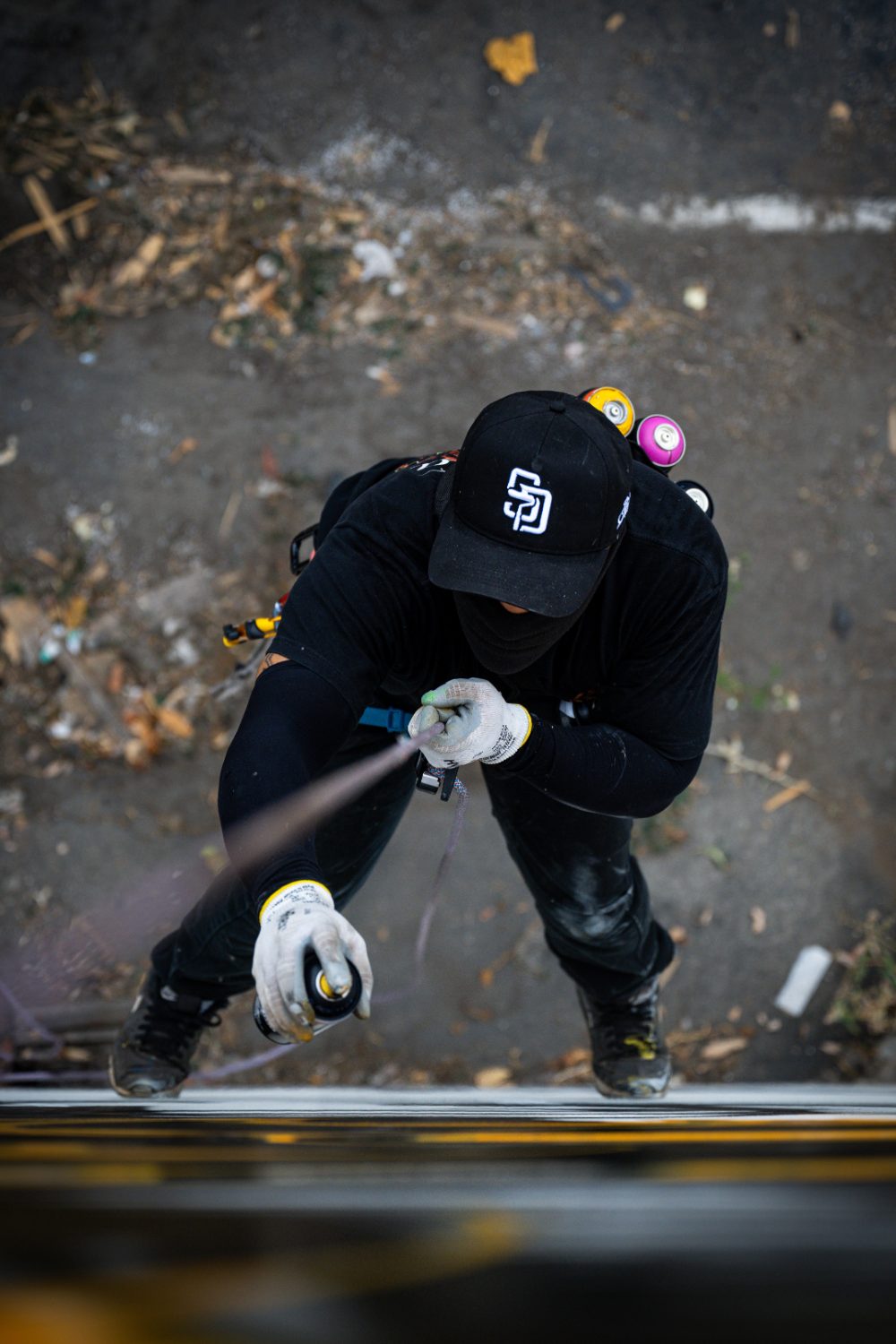
DSABL (Photo: Greg Martinez @theoffroadhippie)
“Going over the edge, it really never gets old,” ENDEM, one of the piece’s writers, tells LA Weekly of doing rappel graffiti. “No two buildings are the same. No two rappels are the same. Once you go over the edge and the GriGri [a braking belay device] has you, it’s always a very, very good feeling and a humbling feeling knowing, holy shit, your whole life is in the hands of this one little device. We have the element of surprise. No one is expecting someone to be hanging multiple stories up off the side of a building.”
The Wilson Building graffiti was an explosive work that helped catapult ENDEM from relative upstart to prominence in the past several years with well-placed rappel pieces, fueled by his experience in rigging. His rappel spots range from buildings to silos, freeways, dams and bridges. Often lined next to ENDEM on structures are a group of rappelers including EXR, SKEAM, REWTS, DSABL, SKIE and DOMES.
“Once I saw the process, not one negative thought about it came into my head. Nothing but positive things. I said to myself, ‘Oh, I can definitely do that,’” ENDEM, who estimates he’s done more than 100 rappel pieces, including work in Mexico during the cartel wars, says, “I’ve done pieces in very, very, very hot spots in less than 15 minutes. That was some real quick shit. If it’s a really hot spot, I just want to get that shit done, because I’m not trying to get caught. I’m more super focused, super ninja-mode, not even talking, setting it up, getting the job done.”
Says EXR, a rappel killer with a background in design and military mountaineering, of making that piece, “That mission was legendary. The coordinated teamwork involved to get that spot felt like a special forces mission.”
We spoke with six active rappel graffiti writers about the highly dangerous artistic activity and captured an infectious sense of energy and existential commitment to boldness that is catching many classically practiced or old school graffiti artists off guard. Miles of Downtown and South LA have been blizzarded with decades of graffiti, tricked out with 3D designs and graffiti styles indigenous to the hoods. The rappelers avert everyone’s eyes skyward.

Graffiti by ENDEM @gotnoends (Photo: Greg Martinez @theoffroadhippie)
“In a place like LA, [rappel graffiti] is definitely adding the new generation of writers,” DSABL says. “LA’s always been known for graffiti. But now, there are people who are standing out above others. It’s a new generation coming up that’s leaving their mark now for the future. It’s still graffiti, like the stuff that’s on the ground. But it’s just at another level, at a different height. It might last a little longer and look definitely a little different, but we’re adding the same graffiti that’s always been added to the city.”
Rappel graffiti works with the writer attaching the rappel rope to the most reliable available rooftop hooks or objects. The placement can have life-or-death consequences if the object buckles. To get to the roof, a nuanced (Editor’s note: and often illegal, which we do not condone) process exists of getting past barriers. Choosing buildings can be a thoughtful or happenstance process, writers say, and often by word of mouth. A GriGri is attached to the rope and keeps the rope stable. Writers generally have some rappelling experience. As artists, they know how to work with large proportions. They must plan the operation in advance, move quickly, and wait prudently given changing variables.
This is a good time to note that graffiti doesn’t always stir appreciation from community members and is usually considered vandalism by law enforcement tasked with combating it and property owners who must foot the cleanup bill. The height or inaccessibility of rappel pieces makes the writing challenging, but also creates a massive difficulty and headache for its removal.
Rappel graffiti is also dangerous. A list of injuries and deaths from falls while doing graffiti on freeway overpasses and rooftops has its own Wikipedia page, highlighted by a rappel graffiti death in Sacramento in 2013. According to news reports, a man brought paint cans to a building rooftop overnight and tied a rope around his waist in an apparent effort to tag the 18-story building side. He was found dead the next morning, hanging in the ropes, in what appeared to be unintentional suffocation.
The rappel graffiti writers we interviewed each had a mental notebook of close calls, such as equipment malfunctioning while ascending and descending the wall, ropes tied incorrectly, too much slack in the ropes, caffeine-fueled panic attacks, and a strong rainstorm taking out equipment. More than once, rappelers reported being helped by a fellow rappeler with a lifesaving hand or equipment when they saw something was wrong.
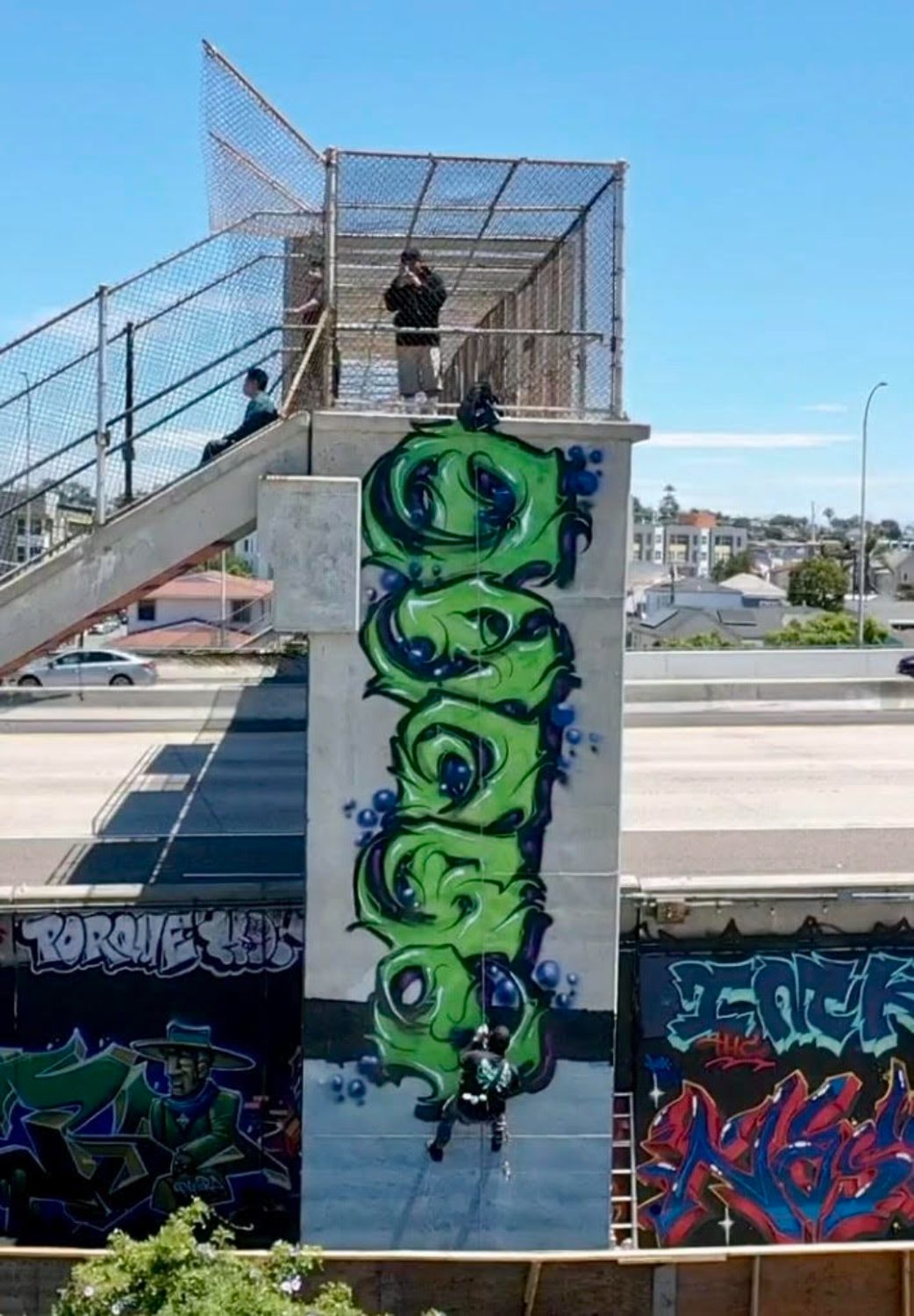
Graffiti by DSABL @disablen_ (Photo: Greg Martinez @theoffroadhippie)
“I do not recommend anyone to rappel if they don’t know what they are doing,” well-known writer ZWON says. “It’s a dangerous activity and it could cost your life. Having the right system doing it is very important. In the beginning, you check everything twice. Later, you get too comfortable and make a mistake. Having a system and sticking to it prevents you from making these crucial mistakes. I personally know two people who ended up falling. They made it out somehow okay. They were lucky.”
Beyond the extremeness of the making of rappel graffiti art, is how stylistically tight and effective it can be on a large scale — and particularly respected by the graffiti community for this reason. Letters can span 20-plus feet against the uninteresting tan canvases of building sides. Done incorrectly, the pieces can reveal to many people a big swing and a miss with disproportioned letters and a messy color scheme. When a rappel piece works, the detail, creativity and pop rival the impact of high-priced, professionally made building-side ads in Hollywood.
“If they are done correctly, they look amazing,” says globetrotting rappel specialist ZONER, of the talented BAMC crew. “It’s a good way for writers to showcase their above-the-ground work. I do see a lot of pretty sloppy, unstructured work being done on ropes. Everyone should have their fun, and we are always learning, but from a standpoint and belief in quality, I think putting time and effort into planning and practicing before you risk your life for a rappel would be my best advice.”
ZWON brings conceptual depth to his rappel pieces, creating detailed miniature worlds inside the letters of his name. In other pieces, ZWON uses a full-building-sized contemporary cursive style that looks like a giant bent down to autograph the walls. Asked about his inspiration, ZWON says it comes from photos he’s taken.
“It feels like there is almost no limit to finding new shapes and forms that can create your next letter,” ZWON says. “I really enjoy this process of bending and sculpting letters out of everyday things you see in the world. These more intricate pieces tend to take longer than my regular classic graffiti, therefore picking the right spot is very important … Rappelling gives writers the power to paint the building from the very bottom to the very top. It’s an evolution. You paint the street side first, then you bring a ladder to go above it, you do a roller even higher and so on. I want every inch of the wall covered. You wouldn’t leave a bunch of negative space on the top of a canvas either.”
Some graffiti observers and specialty press have noticed the embedded artistry beyond the danger hits in the way rappel artists intended.
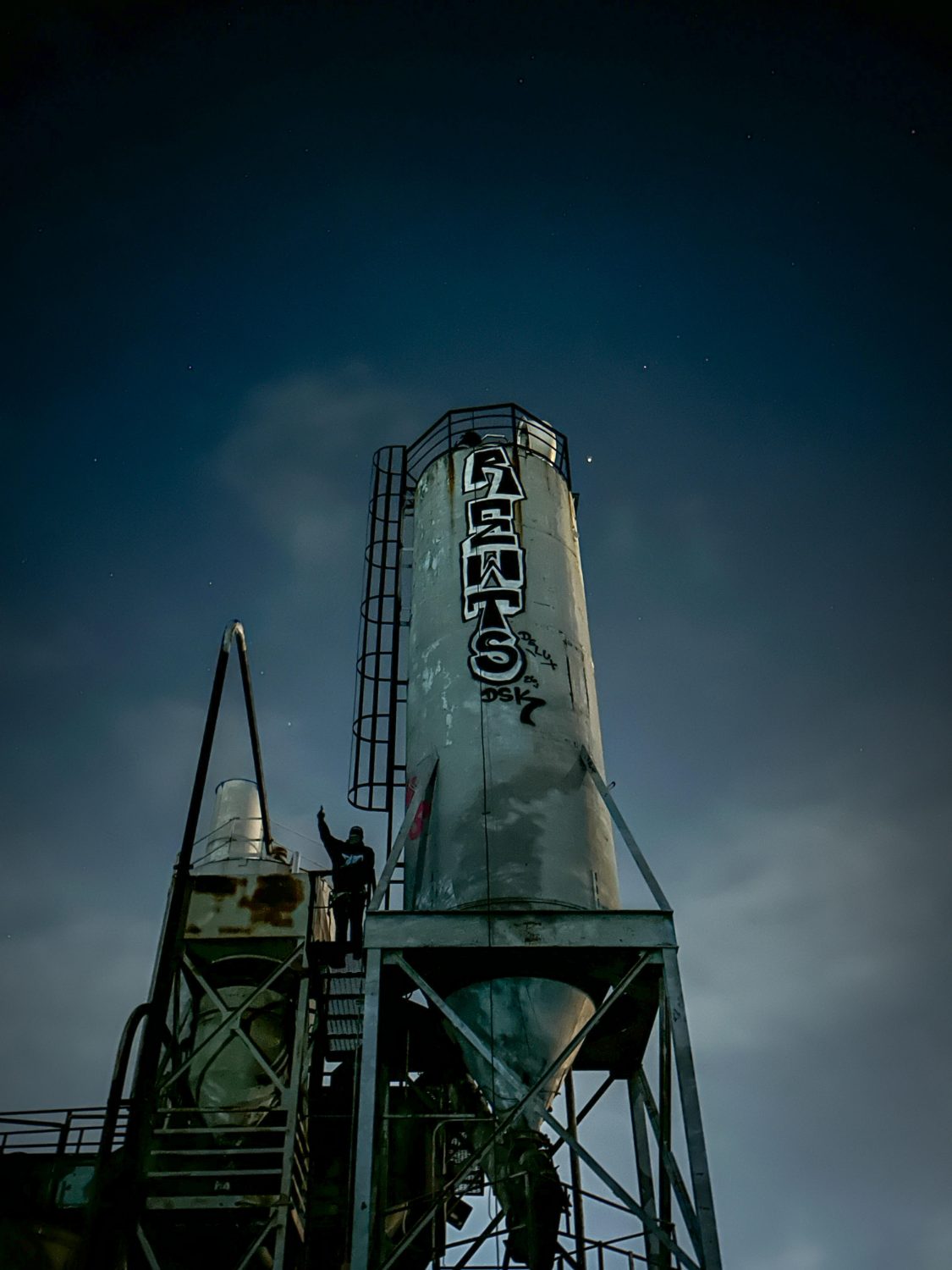
Graffiti by REWTS @aerosolpapi (Photo: Greg Martinez @theoffroadhippie)
“It’s not just that they’re rappelling and doing graffiti, they’re incredible artists,” old school graffiti writer MISTER 1987, whose straightforward “1987” and “87” tags have popped up around town since the 1980s, tells us. “It comes out looking great. It looks almost like an advertising agency paid them to do it.”
MISTER 1987 quips, “I have a difficult time doing a graffiti piece in my backyard. It’s hard to make something look good. It’s difficult to be good at graffiti at all. Some people can’t draw a circle.”
Rappel graffiti has attracted newcomers — and even long-established writers — to the craft. REWTS, of DSK Crew, has a respected decade-plus career in LA graffiti art, simple tags, and even slap tags. Now, with a side bag, a background in non-graffiti rappelling, and five successful rappel missions, REWTS has picked up on-the-job lessons like having all the necessary equipment on hand and preparing to make adjustments as obstacles arise.
“I was a big spectator and critic,” REWTS says of rappel graffiti. “I would see some pretty questionable pieces being done with rappelling and kept telling myself, ‘Why don’t these guys do better? I bet I could do it better.’ It wasn’t until I started to do it myself that I quickly realized it’s not so easy to do those crazy pieces. The set-up is a different beast. It tests everything — your planning, your control, your composure. I don’t consider myself a daredevil. I just know that I can push myself to new limits to do what others only said they would.”
REWTS explains, “Every movement costs energy. Nothing is relaxed about it. It’s controlled chaos. Your body is in a heightened state from stress, adrenaline, and anxiety. On top of that, the physical aspect requires a lot of overtime strength from your core and arms. [There can be] loss of circulation in your legs from the harness.”
Rappel graffiti has roots in South America and 1980s New York City, and it has exploded in recent years with the extreme, skyscraper type of tag. The rappel style is finding its footing in LA, and things move fast here. While the rappel phenomenon originally fit vertical cities like NYC, LA is more horizontal. But the style’s big swaths of undeniable boldness match LA like fast friends, and rappel was bound to hit one of America’s graffiti meccas, says Steve Grody, author of 2007’s Graffiti L.A.: Street Styles and Art and the “Steve Grody’s Graffiti File” Substack.
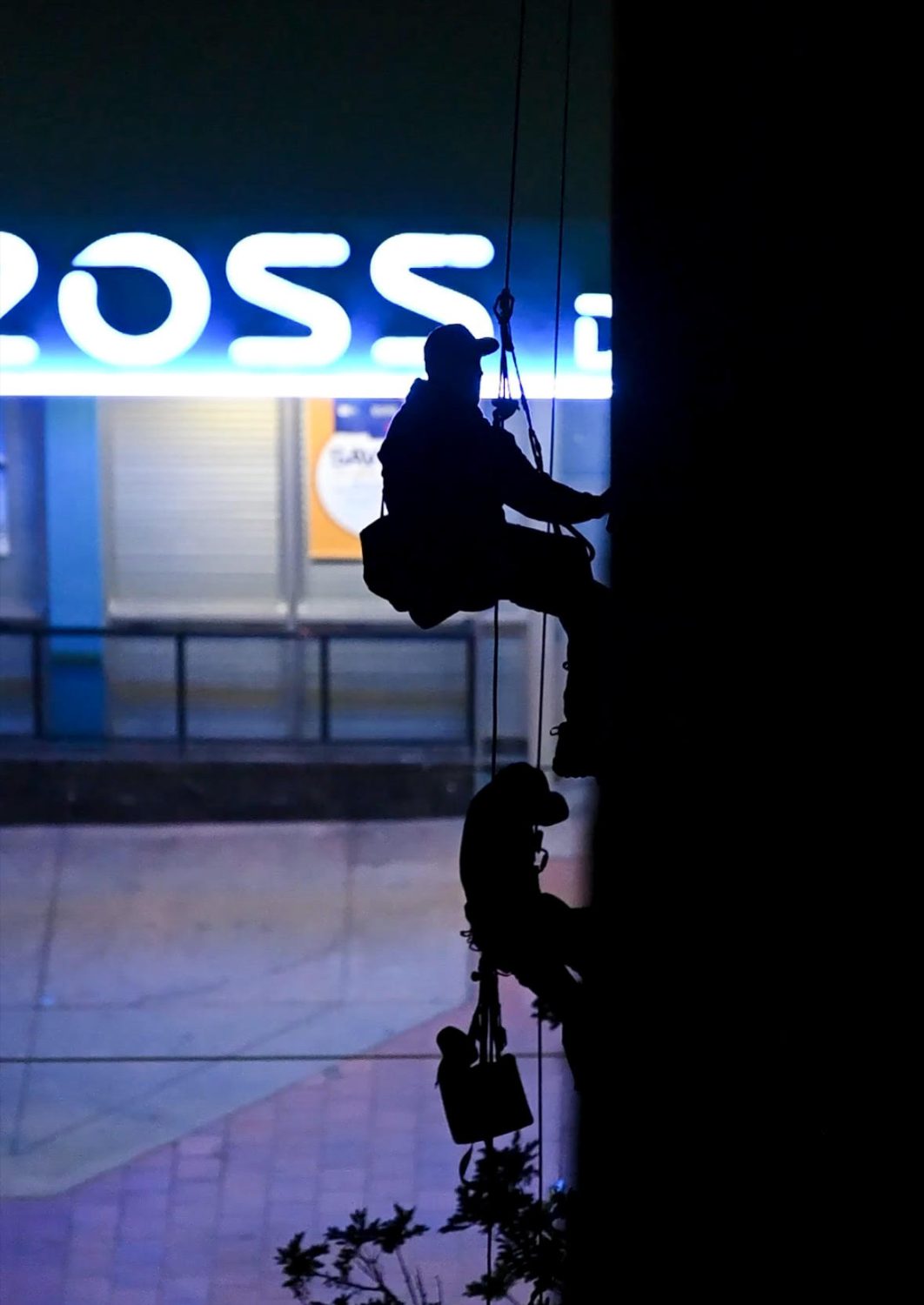
ENDEM and SKIE @skie_nct_sdv (Photo: Greg Martinez @theoffroadhippie)
“For the majority of the graffiti community, if you are not at least taking legal risk, you will not get respect, and the more risk you take, from falls or getting shot at by gangs, the more respect,” Grody says. “When I think of graffiti and boldness, rappelling is certainly that. The physical danger and exposure are very bold. It’s not like you’re on a freeway and can easily run and jump a wall to get back on the city streets. It’s a commitment to boldness.”
Grody adds, “I think we have seen a burgeoning of [rappel graffiti]. I hope that nobody falls … It takes time to do those [pieces]. You are out there and so visible. I hope everybody stays safe. It’s certainly happening now.”
Part of the new generation’s vertical perspective on graffiti and its appeal is documentation-based, particularly with drone photography. Drone footage of pieces creates a full-picture perspective that feels more interactive and compelling than still photos or even video of a finished billboard piece, amplifying the sense of scale. On social media, rappel work can leapfrog over the impressive, yet geographically linear, ground graffiti. The frenetic energy of the rappel documentation is captured with drones and handheld videos, set to an alluring and infectious production style that looks like a real-life mission. Nighttime shots are bathed in shadows and twinkly city lights. One writer bends down to say a prayer before descending the wall.
“Documenting the whole thing with the drone lets everybody see the process of it, and not even fooling, a little glimpse into it — from climbing up, to tying off, to going over the edge, to in process, to when the cops or fire department are going [by], or people are yelling,” DSABL tells us. “Definitely man, the drone thing is fucking badass. I love it. I don’t always get to have them, but if people are wanting to and willing to [record] it, I’ll accept it. You know how they say a picture says a thousand words? A video does much more than that. The documentation does way more than a picture. It supersedes that saying of ‘a picture is worth a thousand words.’”
ZONER, who has more than 50 rappel pieces from Taiwan to Germany to New York City, adds, “My favorite part of rappelling is documenting it with the drone properly, having a concept, executing it, and getting footage. It’s rewarding and leaves room for you to criticize your own work and do better for the next one. Make sure you get multiple angles and don’t crash [the drone]. A while back with ZWON, we waited for the sunrise in New York to get a shot of a billboard I just did.”
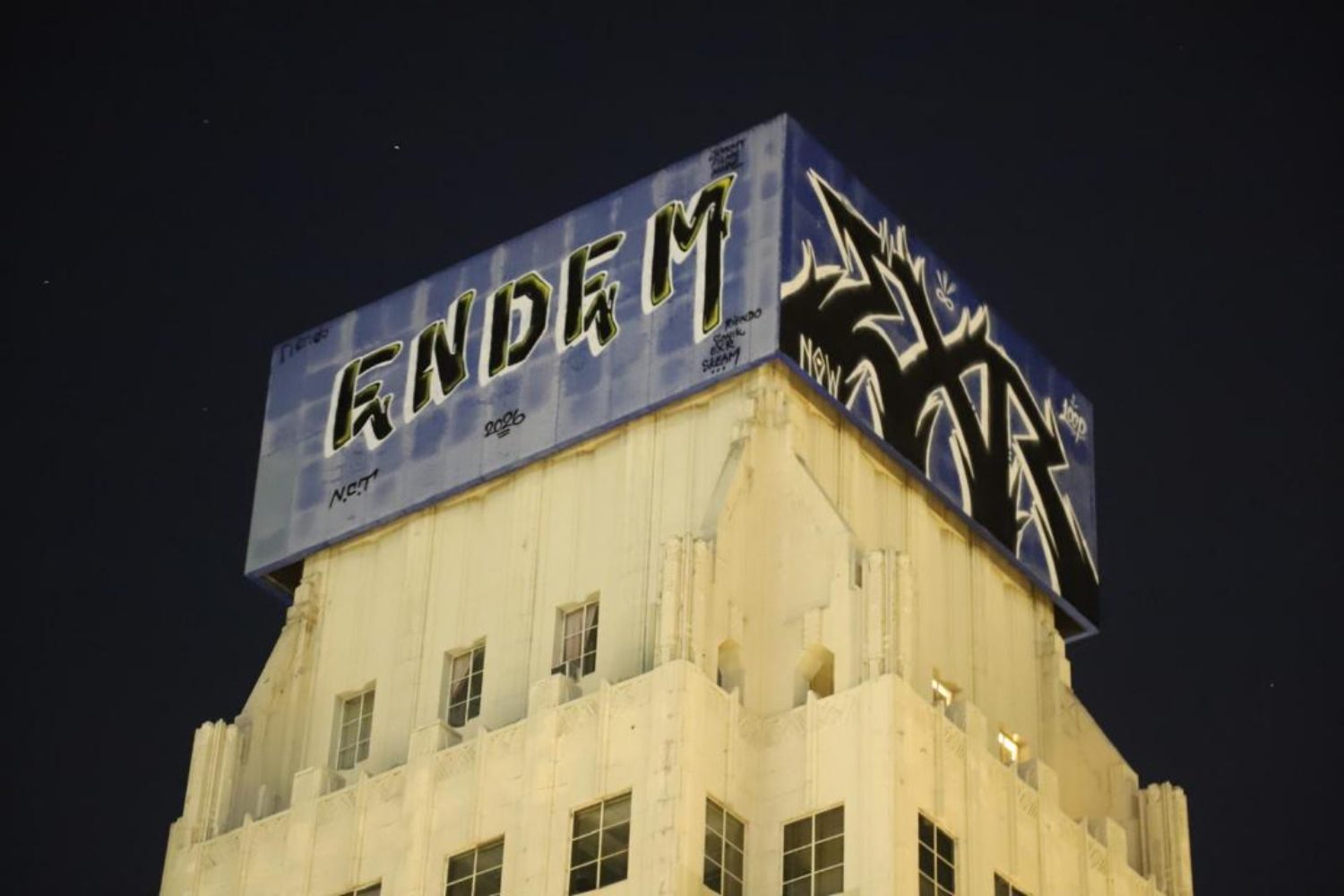
Graffiti by ENDEM and EXR (Photo: Riendo @riendoarts)
Old timers (we’ll call that anyone born before 1985) might know the graffiti concept of the “heavens,” defined as a risk-taking proposition to go high with tag placement, towards the “heavens.” This style took the form of 1990s tags on freeway signs, placed in impossible spots. Cars raced below with likely fatal consequences should a fall occur. Billboard pieces are part of the graffiti heavens tradition that continues to this day. Prolific roller graffiti artist HOPES, one of LA’s most recognizable graffiti names, has helped define a heavens style of placing his blocky, meta “HOPES” tag high above the city, from pedestrian bridges to bank rooftops.
The “heavens” concept blossomed in 2024 with Downtown’s Graffiti Towers (formally known as Oceanwide Plaza), painted head to toe over three towers and 25-plus stories each, with a highly visible roll call of writers from around the city resourceful enough to get onsite and go skyward. News media highlighted the Graffiti Towers as a symbol of LA urban decay. From the “heavens” perspective, the towers symbolized taking graffiti to higher elevations.
“The early ‘90s — ’91, ’92, ‘93 — was the first time I saw something called ‘the heavens.’ Some of the guys doing rappelling now weren’t alive then,” says MISTER 1987. “These people were the predecessors to rappelling.
“The heavens were a big deal.”
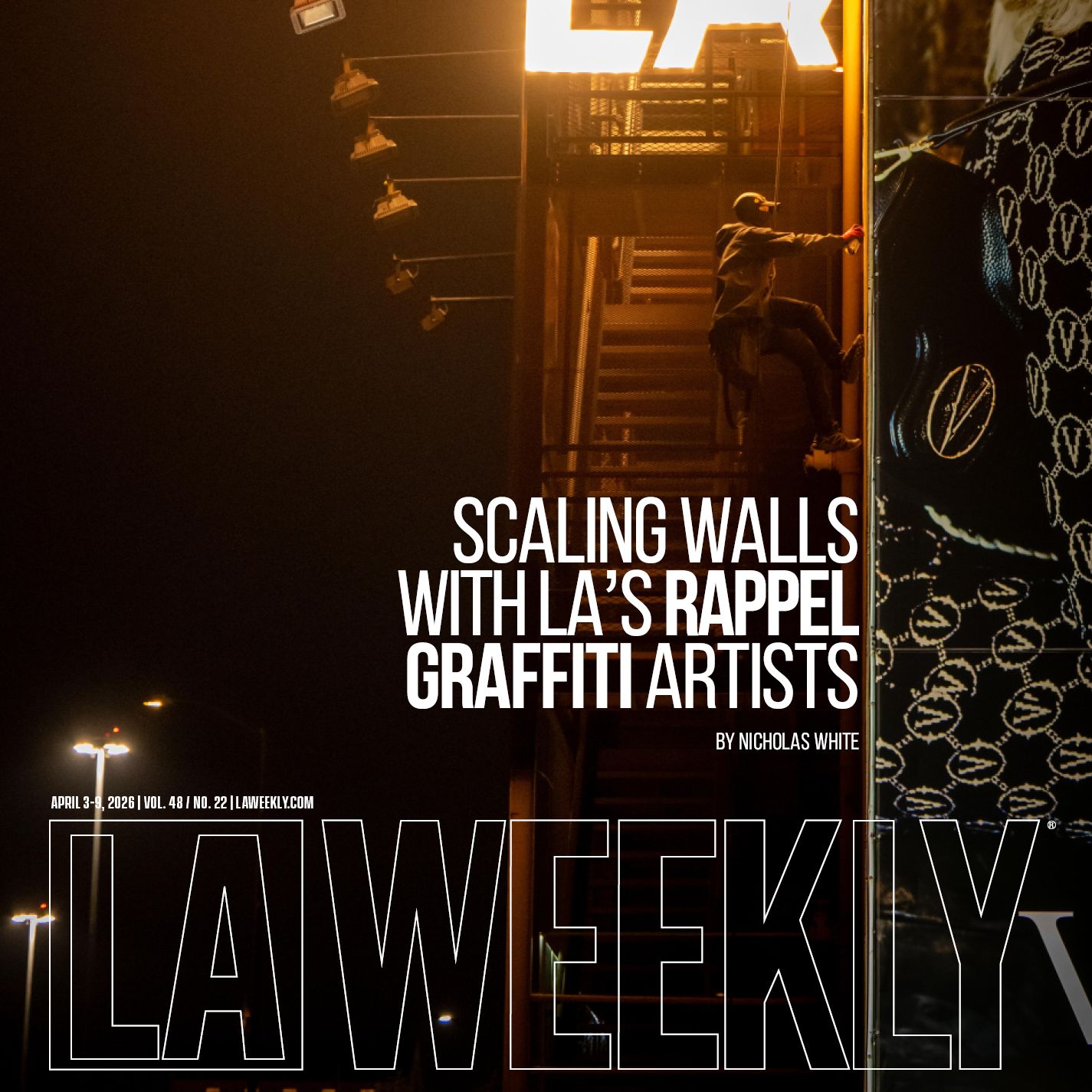
EXR @_exrnow on the cover of the April 3, 2026 issue of LA Weekly (Photo: Greg Martinez @theoffroadhippie; cover design: Mark Stefanos)