
 Matt Emma
Oleksandr Kostrikov is a quiet disruptor in the American interior design industry, redefining materials and techniques and walls’ emotional and environmental roles in everyday life.
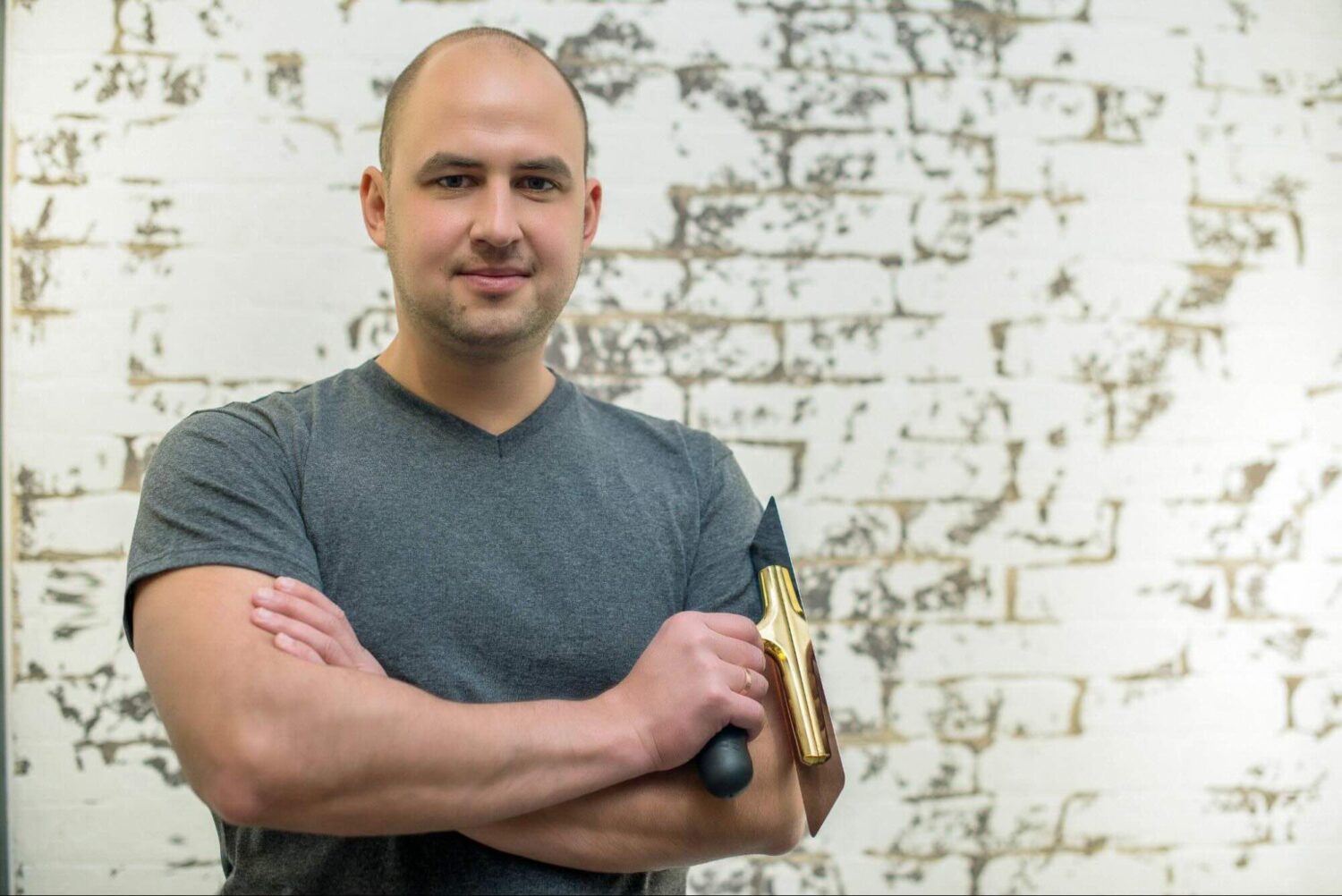
His journey in the trade began in 2006. By 2014, he had opened his first showroom, followed by a second in 2016. In 2017, his most significant project, Dekos Style, a showroom that combined materials, furniture, and training, was launched. It quickly became one of the most innovative design hubs in southern Ukraine.
Since relocating to Southern California in 2023, Kostrikov has completed over one hundred projects, founded Kostrikov Art LLC in early 2024, and launched Flutomania Inc. the following year, producing innovative 3D-printed tools for decorative wall textures.
In his projects, Kostrikov collaborates with a diverse range of finishes, including limewash, Roman clay, Marmorino/Venetian plaster, rock-like reliefs, microcement, and fluted and ridged textures, solutions that are rapidly gaining popularity in the US.
Walls as Emotional Architecture
Kostrikov’s finishes, like microcement and fluted textures, shift a space’s psychological dynamics from sterile to serene or from chaotic to calming.
He details that “Design is not just about how a room looks. It’s about how it feels.”
Microcement reduces visual noise, making spaces feel larger and calmer. Fluted walls interact with light and invite touch. When you walk into a microcement bathroom, the feeling it elicits within you is measurably different. Kostrikov finds that his clients feel more grounded, more at ease, even if they can’t explain why.
“That’s the power of texture,” he surmises.
Luxury hotels, spas, and residences increasingly use these finishes for precisely this reason. They transform walls from passive surfaces into active elements of experience. The difference is that Kostrikov is applying this kind of artistry and meticulous attention to detail well beyond the traditional realms of its use.
He further details, “Microcement and fluted textures change the atmosphere of a space. Microcement gives you continuity. Imagine a bathroom without a single grout line; it feels calm, clean, whole. Fluted textures bring rhythm. The light moves across them, and the wall is never the same twice.”
A New American Minimalism
Kostrikov has played an integral role in popularizing seamless, grout-free, texture-rich interiors that reflect a distinctly modern Californian aesthetic focused on warmth, tactility, and sustainability. He was inspired to chase this artistic ambition by the demands that he saw present, which were going unfulfilled in the area.
“In California, I saw a strong demand for tactility and authenticity. Clients respond to seamless continuity and expressive texture. That’s where I can contribute: helping teams deliver monolithic microcement spaces and the clear, consistent rhythm of fluted surfaces.”
In one Orange County residence, Kostrikov’s team finished the walls, ceiling, and fireplace in microcement. The result was monolithic yet warm, more sculpted than constructed. In Los Angeles, a spa replaced wallpaper with fluted wall elements, softening acoustics and creating a serene atmosphere.
In this kind of work, which is so rooted in what Kostrikov described as “authenticity, tactility, sustainability,” Kostrikov has found an artistic passion to occupy the present, but also what he believes will continue to be of growing importance in the coming years.
“People are moving away from fake finishes and disposable materials. They want something real, something lasting. Microcement and fluting aren’t temporary trends; they’re solutions. My goal is for these techniques to become the new standard in the US market.”
Craft Meets Code
Flutomania Inc. is a convergence point between analog artistry and digital fabrication. The company demonstrates how Kostrikov’s tools empower a new generation of global artisans. Flutomania develops 3D-printed trowels used to create fluted textures on walls and ceilings. Traditionally, each groove had to be carved or formed by hand; a slow process often producing inconsistent results. Flutomania’s tools make the work faster, more precise, and accessible for designers worldwide.
“Flutomania is about tools,” Kostrikov details.
For years of his career, Kostrikov created textures by hand. However, he realized this was not realistic or time-efficient for himself and others. He saw the need for artisans everywhere to have better instruments. With Flutomania, Kostrikov and his team deliberately set out to design dozens of models that allow craftsmen to achieve precision and creativity simultaneously.
“We’re merging digital fabrication with human touch,” Kostrikov adds. “Technology doesn’t replace the artisan; it empowers them.”
After months of prototypes, Flutomania sold its first models in June 2025 and was formally incorporated two months later. Today, the company ships products to the US, Canada, Europe, and Australia.
Beyond Design: A Philosophy of Material Respect
Kostrikov’s central motto is “love your craft.” This is not merely a branding slogan but rather a design ethic. He believes that respecting materials, space, and the human need for sensory harmony is the entire artistic process, and it’s why he does what he does so well.
A huge influencing factor in his life was his first child. Kostrikov became a father at only sixteen years old, which, he says, “changed everything.”
“I had to grow up fast. To support my family, I learned plastering, tiling, and painting. At first, it was just survival. But then I realized I could see things differently: light, rhythm, texture. That’s when it became more than labor. It became a craft, and eventually, an art.”
Since founding Kostrikov Art LLC in early 2024, he has overseen more than a hundred projects in Southern California. To this end, the job has evolved externally and internally for him, from something that paid the bills to something that he is obscenely passionate and detailed about. Kostrikov may have begun his career as a cog in the larger machine of the industry. Still, with his unique talents and meticulous focus, he is now helping reshape the industry.
Post-Conflict Creativity
Kostrikov came to California after he and his family were displaced from Ukraine. While some might see this as a tragedy, to him, it highlighted the beauty of life and how wonderful it was to have this unique opportunity to rebuild. This has greatly influenced Kostrikov’s outlook and how he approaches his art and work. In his eyes, the war didn’t just end a chapter; it redirected him toward global innovation.
This is undoubtedly part of why microcement has become such an integral part of Kostrikov’s work. Rather than destroying or removing what has come before it, his techniques build upon the established foundation to create something new.
“Microcement allows us to refinish instead of demolish. Old tiles can stay; we cover them. That saves money and reduces waste. Fluted textures are created from plaster, putty, or decorative materials. Through my own testing, I determined the optimal combinations, allowing the finishes to be refinished and reused, an authorial method that makes them durable and beautiful. In California, where green building standards matter so much, these materials are not only beautiful, they’re responsible.”
Kostrikov’s journey is one of resilience and reinvention: from a teenage father in Kherson to his first independent projects in Romania, and now to an innovator in California. In less than two years, he has completed over a hundred projects in the US and built a company whose tools are now used by artisans worldwide.
“In every project,” Kostrikov says, “we’re not just finishing a wall. We’re shaping how people live in that space.”
See more of Kostrikov’s projects on Instagram: https://www.instagram.com/kostrikov.art