
 Nathaniel Bell
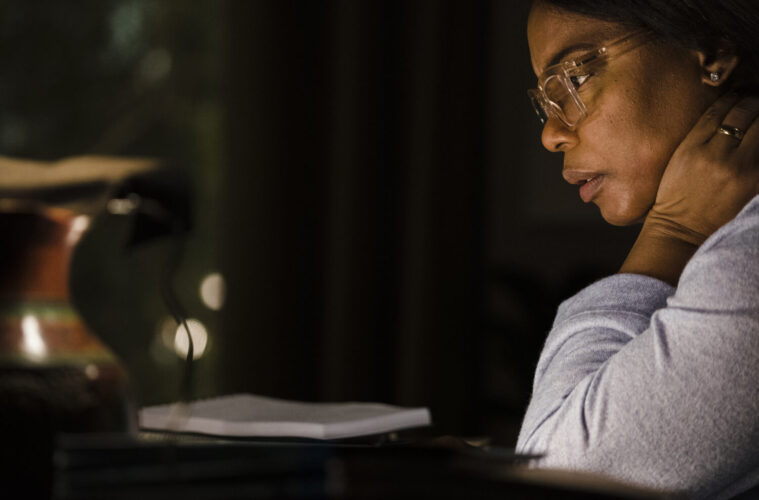
 Origin is a movie about a book — specifically, the bestselling, Pulitzer Prize winning Caste by journalist Isabel Wilkerson, who in the movie is played by Aunjanue Ellis-Taylor. The substance of the drama is the several years Isabel takes researching and writing Caste, during which she probes the connections between the experience of people of color in America and those of Jews in Nazi Germany and the “untouchable” Dalits in India. What connects these seemingly disparate social systems? As she searches relentlessly for a unifying theory, the film flashes back to key moments in history that illustrate the book’s thesis: that caste, not race, is the animating force behind today’s social divisions.
Because Origin is a work of narrative filmmaking, and not a documentary, writer-director Ava DuVernay is burdened with the task of depicting Isabel as a person with everyday challenges and losses, which in this case are extraordinary: Wilkerson lost her mother, husband and cousin, all within the span it took her to complete her book. Thanks to the exceptionally fine cast, which includes Jon Bernthal, Niecy Nash-Betts and Audra McDonald, these characters are brought to life with warmth and humor.
Jockeying between family drama, academic explication, and historical reenactment, Origin attempts a difficult balancing act, and despite striking several graceful notes, never finds its footing. After all, two-and-a-quarter hours is hardly enough time to adequately approach the density of a 400-page tome, or render its complexities into workable drama. What ends up on the screen is a provocative but obscurely argued thesis whose gaps are grouted with melodrama: horrifying scenes of Jim Crow lynching, Nazi book-burning, degrading public toilet maintenance, and, in a cinematic first, a reenactment of the killing of Trayvon Martin. There are few directors in the world who could avoid making such scenes feel exploitative.
DuVernay, who has proven to be a passionate and intelligent storyteller with historically loaded works like Selma and the Oscar-nominated The 13th, has made every effort to remain true to the source material, working closely with Wilkerson and even, according to a Hollywood Reporter article, attempting to mitigate the hierarchical system on her film set. Essentially an art-house filmmaker who nevertheless wants to reach a wide audience, she has undertaken the daunting task of adapting difficult source material in a way that the general public can absorb and comprehend. Based on the evidence here, it would seem that this impulse to educate also comes with a compulsion to over explain.
Interestingly, the structure of Origin echoes that of Intolerance, D.W. Griffith’s 1916 anti-hate epic that invented a new kind of editing. In a purely cinematic attempt to depict “love’s struggle through the ages,” Griffith elected to cut between four storylines in four distinct time periods in order to draw thematic similarities between them. It was an unparalleled art experiment that confused audiences at the time and precipitated the film’s flop at the box office. If Origin suffers the same fate, that will be too bad, since the ideas presented in the film are urgent and galvanizing.