
 Michael Atkinson
  Happy holidays! to a certain breed of neo-Goth, black-nail-polish fan brat, and, as a matter of fact, to a certain stripe of legacy “monster culture” gray panther. We all might’ve hoped for a little high-class batshit in our otherwise sugary seasonal doldrums, and whaddyaknow, for our sins we get some, in the hulking form of Robert Eggers’s Nosferatu, a remake-remake that essentially breaks the bank in Halloweeny ookiness. If the crave is for a monochromatic vibe that smells like castle mold, look no further. You geek out, or you don’t go.
It almost doesn’t matter if it’s a good movie, in any conventional sense, or if Eggers managed to reshape this very, very familiar material in interesting or surprising ways — his only genuine task was to go full retro cobweb, and we knew he would. It’s a mad monster party he almost had to make, as our most uncompromising excavator of folk-horror fossilization, and as far as that medium-low bar goes, he does not disappoint. Of course wondering whether or not Eggers “improved” upon the 1922 F.W. Murnau original is a bit like asking if we could make a better Bosch painting using A.I. — there’s no trampling on the OG.
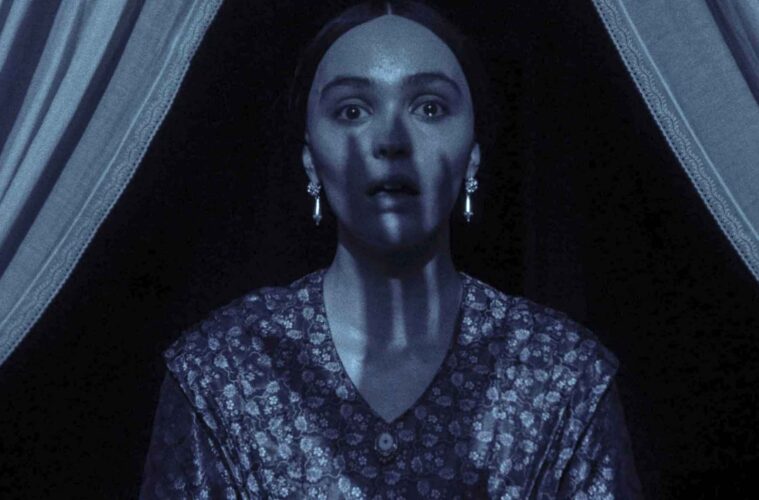
You know the story: Dracula (here, Orlok, because in 1922 the filmmakers never owned the rights to Bram Stoker’s novel) contracts to buy a manor ruin in London (here, somewhere in Germany), sucks the blood of the naive real estate broker sent to his Carpathian castle, whose fiancée back home becomes the undead count’s prey, and so on. Eggers, though, thinks not in terms of narrative cohesion but in terms of shots — his films are best thought of as a collection of awesome proto-Gothic screensavers. His Nosferatu has a slack pace, all the better to make every shot a frameable Creepy magazine cover. Sure, the homages to Murnau are fun, and not overdone, the shadowy compositions look draughted by horror comics maestro Bernie Wrightson, and the 21st-century upticks are ample: As the seemingly asthmatic, Slavic-mustache-sporting vampire, Bill Skarsgård is both unrecognizable and undecipherable but properly cadaverous, while as his object of desire, the rather dewy Lily-Rose Depp is frequently electrified by screaming, toe-curling seizures, and is easily the movie’s most arresting spectacle. Willem Dafoe’s wily Van Helsing simulacra is the only character in the film, major or minor, who doesn’t power-vomit blood at one point or another, something Murnau had gracefully managed to elide. Around them all, the shadows crawl on their own, statues move, rats carpet the streets, gore spurts and gouts. So far, an advocate for actual film stock and practical effects, this time Eggers lets the greenscreens run a little amuck; too often, the Mitteleuropean backgrounds can feel digitally spiffy.
Not to mention, Eggers has a tendency to float his storylines into hallucinative subjectivity, and so just as I am not entirely certain about what “happened” in The Witch (2015) or The Lighthouse (2019), or that objective action even mattered in either case, the mind-meld shenanigans in the new film (Depp’s maiden and Skarsgård’s behemoth seem somehow psychically connected, over years, except when they start arguing) are tough to parse. But so? Are you here for the protein or the greasy carbs?
Still, unless you’re pointing at Simon McBurney shamefully overacting as the Renfield stand-in, the film is far less scarifying than it is simply a visitable Halloweentown, a background video for an October costume party, like Sleepy Hollow (1999) but with a hard scowl instead of the Tim Burton smirk. That’s fine as far it goes, but with geekhood comes compulsion, and so you may find yourself, as I did, overcome with the crosswirings between this film — thieved imagery, massaged story beats — and the hallowed original (for which scripter Henrik Galeen made up the faux-Romanian word “nosferatu”), and between both of them and Werner Herzog’s real-rats-and-catacombs 1979 remake, Nosferatu the Vampyre, and between all three and Stoker’s novel and every semi-faithful film version made of it (there aren’t too many that have tried, actually), but especially Francis Ford Coppola’s magic-lantern near-masterpiece Bram Stoker’s Dracula (1992). When that game is through, you can sniff around for thematic thrust, to which let’s just say that Eggers follows the sodden path — unsurprisingly, and obliquely, of course — of the Count’s romantic/sexual fixation, which, by the way, is barely a whisper in Stoker’s book.
But look at that stodgily written fucker again, and you’ll notice a roaring current of historical-political rage running through it, fueling Dracula’s obsession with his “Szekely” blood lineage and his desire to reestablish his ethnic primacy (via the metaphor of vampirism) after five centuries spent under Ottoman rule. He explicitly cites the 1389 Battle of Kosovo — “the great shame of my nation” — as the beginning of the Slavs’ big sleep under the Turks, framing his entire scheme as vengeance of the ancient past (not so ancient to him) upon the modern world. It’s a proto-race-war, echoing how during the 1990s Balkan bloodletting, ethnic Serbs frequently referred to their Muslim Croats neighbors as “Turks.”
That’s what Christmas is really all about, Charlie Brown. Not incidentally, the ancient Kosovo battle occurred on St. Vitus Day, June 28, which for centuries afterward, according to Rebecca West in her unbeatable Yugoslavia study Black Lamb and Grey Falcon, was a “day of mourning for the Serbian people … until the year 1912, when Serbia’s victory over the Turks at Kumanovo [during the eight-month-long First Balkan War, which ended in May 1913 and which essentially reclaimed all of the Ottomans’ European territories] wiped it out.” Thus, West maintains, St. Vitus Day during the following year, 1914, might’ve been the first occurrence of the holiday in over 500 years to be a cause for celebration, which Archduke Franz Ferdinand, a Serbian enemy, should’ve known, and thus should’ve known better than to make a state visit to Sarajevo on that day. “To pay that visit was an act so suicidal,” West writes, “that one fumbles the pages of the history books to find if there is not some explanation for his going.…”
Thus is the long shadow of Kosovo — that lost battle of 500 years earlier that so haunts Dracula in the late 19th century persisted in the cultural brainpan into the 20th century, long enough to play a part in initiating World War I, and thereafter the European killing fields to come. Stoker didn’t know what was coming, just 17 years after his novel was published, but he knew that in the Balkans, blood is memory. Somebody could make that movie.