
 Will Jones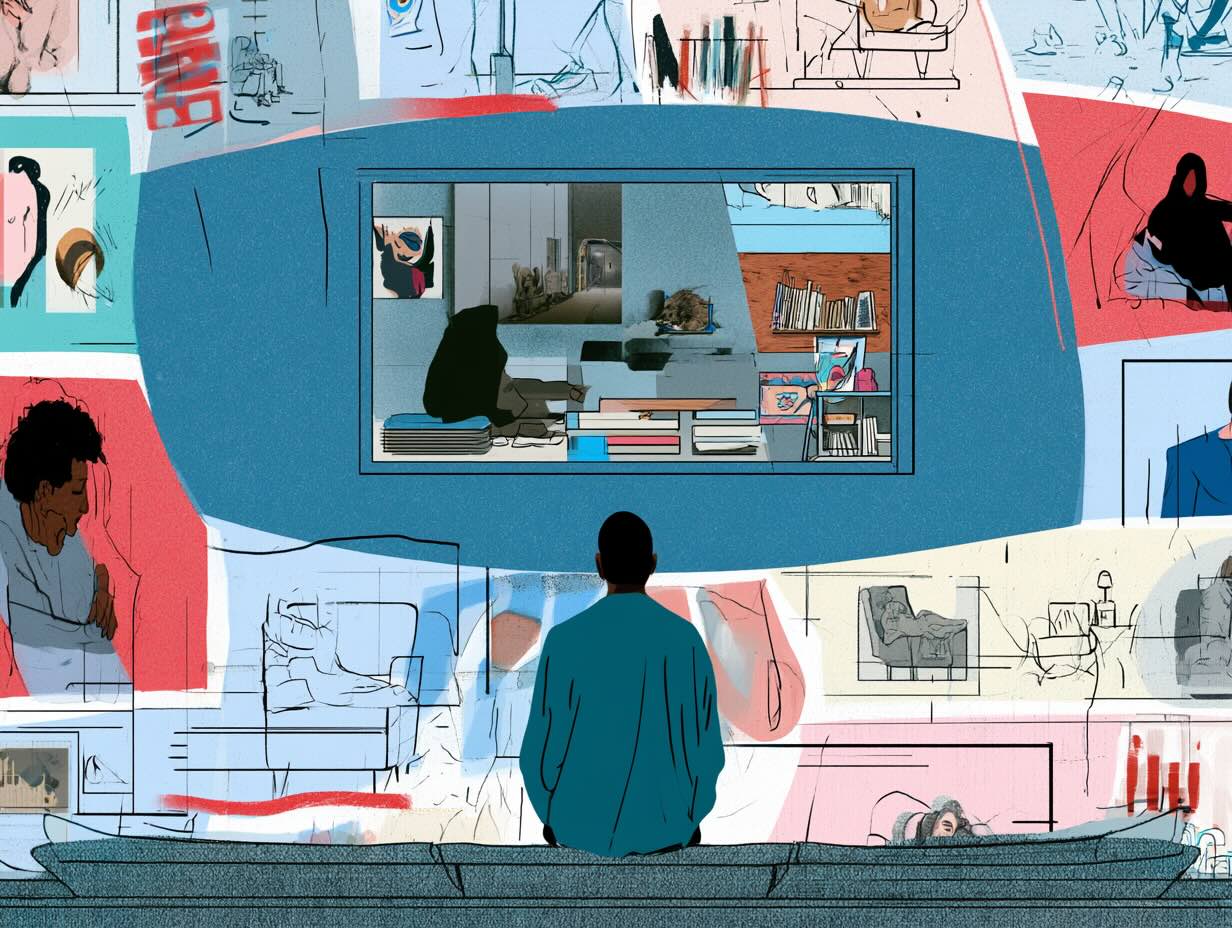
Image credit: Randy Douthit
Randy Douthit first encountered television on a Wednesday afternoon in 1953, when an unfamiliar object arrived at his grandparents’ home in Oregon. His grandfather turned it on (a horizontal rectangle, a picture and a commentator speaking about Korea), and the child who would spend the next four decades behind cameras in studio, satellite, and streaming formats was transfixed. What Douthit could not have known then was that the orientation of that box, wider than it was tall and designed to be watched at rest in a living room, would remain television’s defining physical assumption for seven decades.
That assumption is now breaking, and not at the margins.
Cathode-ray tubes were horizontal rectangles; living rooms were arranged around horizontal displays, and the visual grammar of broadcast (wide establishing shots, two-person exchanges, motion across a lateral frame) developed accordingly. That assumption held through the widescreen transition from 4:3 to 16:9 and through the first decade of streaming. Widescreen got wider. The orientation did not change.
Digital video advertising is projected to exceed 60% of total U.S. television and video ad spend for the first time in 2026, with social video outpacing connected television for the first time: social video growing 13% year over year, against CTV’s 11%. The money moved because the attention moved, and the attention moved to a device held vertically.
A November 2025 Media.net survey of U.S. consumers put numbers on where that attention is: 90% of respondents said they were open to watching short-form vertical video clips on publisher sites that aren’t social platforms; 81% watch vertical video primarily on smartphones; 73% watch short-form content multiple times a day. Clips under 60 seconds deliver roughly 2.5 times the engagement of longer formats. CNN, the New York Times, Time, People, and Hearst have all added vertical-video modules to their editorial sites. None are social media companies.
The Industry’s First Response
Every major streaming platform launched some version of a vertical video surface in the past two years. Netflix introduced Clips. Disney+ launched Verts. ESPN added Verts. Peacock launched Clips. Paramount+ launched Clips. CNN launched Shorts. Across the board, the pattern was identical: an existing library of horizontal content was given a vertical-display product.
Douthit has watched broadcasting change its transmission infrastructure repeatedly, from local studio work in Portland to satellite trucks at CNN to streaming on Amazon Prime Video, and his account of what those shifts demanded is precise about the distinction between technology and craft. “When I started, we’d use satellites and that was a big change, to use trucks to send the signal back live,” he has said. “Once that happened, then things became more important. And when things are live, things can go wrong.” Each transmission change brought new technical demands; the production craft (how to frame a moment, how to hold an audience) had to be rebuilt from first principles every time. What the major platforms attempted with vertical video was the transmission layer, not the production one.
LightShed Partners, whose principals include media analysts Richard Greenfield, Brandon Ross, and Mark Kelley, published a note to investors in late April 2026 evaluating these initiatives. The central finding: “We believe the strategy behind almost all of these products, including Netflix, is dead wrong and misses the far larger opportunity in mobile vertical video content.”
LightShed’s critique was not about whether vertical content matters. What it identified was the gap between launching a vertical product and building one that works. “While it is great to see so many media companies launching vertical content for mobile devices, creating clips of existing content is underwhelming at best,” the note read. “ESPN and Paramount+ are simply reformatting horizontal content into a vertical feed, and it looks awful, with text impossible to read.” Of all the major players, LightShed identified only CNN as producing original programming specifically formatted for vertical mobile viewing.
AWS data presented at the NAB Show supplied the audience context: Gen Z viewers now consume 88% of the streaming content they watch on their phones. A generation whose primary television relationship happens in portrait mode is receiving content built for a living room screen.
Short-Form Video as Discovery Engine
Viewing patterns add a layer the platform strategies don’t fully account for. A YouGov survey of adults in Great Britain, conducted in October 2025 and published in March 2026, found that 77% of viewers who encountered clips from television programs on social media went on to watch the full version. Among 16- to 24-year-olds, 87% had started watching a full program after encountering it through social clips.
The same survey records what the traditional broadcast model would recognize as a complication: 69% of 16- to 24-year-olds said they watched clips from a program instead of the full version. Short-form vertical video is, simultaneously, the most efficient promotional format broadcast has encountered and a competing consumption format for the same audience.
Vaibhav Arya, CEO of Media.net, described the shift in terms of expectation rather than platform mechanics: “Consumers have made it clear: short-form video isn’t just for social platforms anymore. They want the same vertical video experience everywhere they spend time online.” Karan Dalal, the company’s chief operating officer, focused on the engagement mechanism: “Engagement is the core reason short-form vertical video has become the dominant format online. It’s dynamic, immediate, and easy to consume.”
Neither observation is specific to social media. Both describe an expectation that has spread past it. For producers building content rather than reformatting it, the principle Douthit has articulated about television and audience applies whether the frame is vertical or horizontal: “The best television is television that reflects the world we live in. That’s what makes television feel real and relevant to people.” How a producer achieves that, however, is entirely dependent on the frame.
What Production Expertise Actually Requires
Douthit began his career directing local television in Oregon, then moved to CNN, where he created Crossfire and executive-produced Larry King Live, whose 1992 election coverage won a Peabody Award for letting candidates speak directly to voters rather than filtering the campaign through pundit analysis. He spent 25 seasons as executive producer and director of one of the longest-running court programs in broadcast history. All of it, across every platform and transmission change, in widescreen. His framework for production work draws from philosopher Walter Russell’s principle that small details are not secondary to a large subject; they are constitutive of it.
“I’m a student of Walter Russell’s philosophy — one part of which is that people should focus on the results that can come about from small things,” Douthit has said. “It is like that in television. There, of course, you need a person, a theme, a concept that is your big overarching subject. But there are so many small things involved — small being very relative — that are a part of telling that big story. And you have to do the small things well. You have to get them right. Because if you don’t, you are failing the big subject.”
Relatedly, LightShed’s frustration with how platforms approached vertical is, at its core, a catalogue of small things done wrong. Cropping a horizontal library for vertical delivery is a logistics operation. Composing for 9:16 from the start is a production decision. A two-person exchange in 16:9 frames both speakers across the horizontal field; in 9:16, the same exchange requires a different solution. Graphic lower-thirds built for widescreen become illegible when the frame shifts. Text positioned at the bottom of a broadcast screen doesn’t migrate intact to a portrait crop. LightShed documented these failures concretely: text was “impossible to read” in the reformatted ESPN and Paramount+ vertical feeds. Each failure involves a small thing: typography, framing, graphic placement. Each defeats the subject.
Alysia Borsa, president of People Inc., described her team’s building process in terms that identify exactly where the production work lives: “far more than dropping a vertical video onto a page. We’re testing everything — placement, buttons, design, titles — and iterating fast.” [3] Placement. Buttons. Design. Titles. Each is a compositional question, not a distribution one.
Douthit’s description of what television is trying to do extends the same reasoning to the frame question. “There are moments happening, and the way you capture the moment and show it unfolding can bring an attention and opportunity to celebrate and highlight it in a way that preserves it and keeps it special.” What makes a moment visible to an audience (the framing, the graphic treatment, the cut) changes entirely when the frame does. Racing is the reference Douthit returns to when describing how technology and human skill interact: “Racing is the ultimate marriage of human and machine. Each component contributes to the other and they both make each other better. It reminds me of the experience of television.” [8] When the machine changes (new frame, new format, new transmission infrastructure), the human expertise doesn’t transfer intact. It finds a new application.
What the Advertising Data Is Actually Measuring
IAB CEO David Cohen articulated what the advertising market is now tracking: “As we continue down a path where all video will be digital and streamed, marketers are demanding performance like never before. They expect the creator and Hollywood economies to work together to deliver business results.” The same IAB report found that targeting, which climbed 10 percentage points year over year, overtook content quality as the primary criterion for television and video ad buying.
Content quality had been the load-bearing argument for premium video advertising: the case that brand adjacency to professionally produced programming justified price premiums over performance-based digital alternatives. Targeting’s rise doesn’t eliminate that argument, but it weakens it as a standalone rationale. Advertisers optimizing for audience reach and behavioral signal are operating on a logic that doesn’t depend on whether the content was built for 16:9 or 9:16, as long as it holds the audience long enough for the targeting to function.
LightShed’s conclusion was pointed: “None of the major media companies are willing to take a small portion of their massive content budgets to attack original vertical programming.” Alongside the AWS data on Gen Z consumption and the IAB figures on where ad spending is moving, that statement describes the same gap from three directions: the audience has moved to portrait orientation, the advertising money is following, and the content budgets have not.
Douthit’s Walter Russell framework offers the most precise accounting of what that gap costs in production terms. If the small things (frame composition, graphic legibility, text placement, the visual grammar of a two-person exchange in a narrow vertical frame) are not rebuilt from scratch for 9:16, the large subject fails regardless of how well the distribution mechanics work. Four decades in widescreen are neither irrelevant to that rebuilding nor sufficient for it. For a producer who has watched each prior transmission change require not a transfer of expertise but an application of it to different conditions, the argument against simply cropping is the argument that the work starts over. What the major platforms have not yet done is start over.