
 Will Jones
Transforming an encounter into a museum show
The conversation started over dinner.
In April 2025, on the eve of Expo Chicago, art advisor and curator Victoria Mouraux Durand-Ruel sat down with Brazilian painter Gustavo Nazareno, his studio manager, and colleagues from Opera Gallery. Nazareno spoke about a new body of work he had begun developing, inspired by planets, stars, and the cosmos.
The following day, a curator visiting Opera Gallery’s booth paused in front of one of his paintings. She happened to be working on an upcoming exhibition at the Museum of the African Diaspora in San Francisco exploring connections between Blackness and the universe.
The subject sounded familiar.
“Victoria immediately recognized the overlap,” recalls a colleague familiar with the exchange. “She knew Gustavo was already moving in that direction.”
She quickly made the introduction. Months later, several of Nazareno’s works were included in the group show UNBOUND: Art, Blackness & the Universe, at the Museum of the African Diaspora opened from October 2025 to August 2026. It was the first time his paintings were shown in a U.S. museum. For one of the younger artists on Opera Gallery’s roster, it marked an important institutional milestone.
For Mouraux Durand-Ruel, the story illustrates an aspect of gallery work that often remains invisible to the public. Success in the art world is rarely about a single sale or exhibition. It is built through relationships, timing, and the ability to connect artists with the institutions, curators, collectors, and audiences that can help their work reach new stages of visibility.
Building artists’ cultural positioning
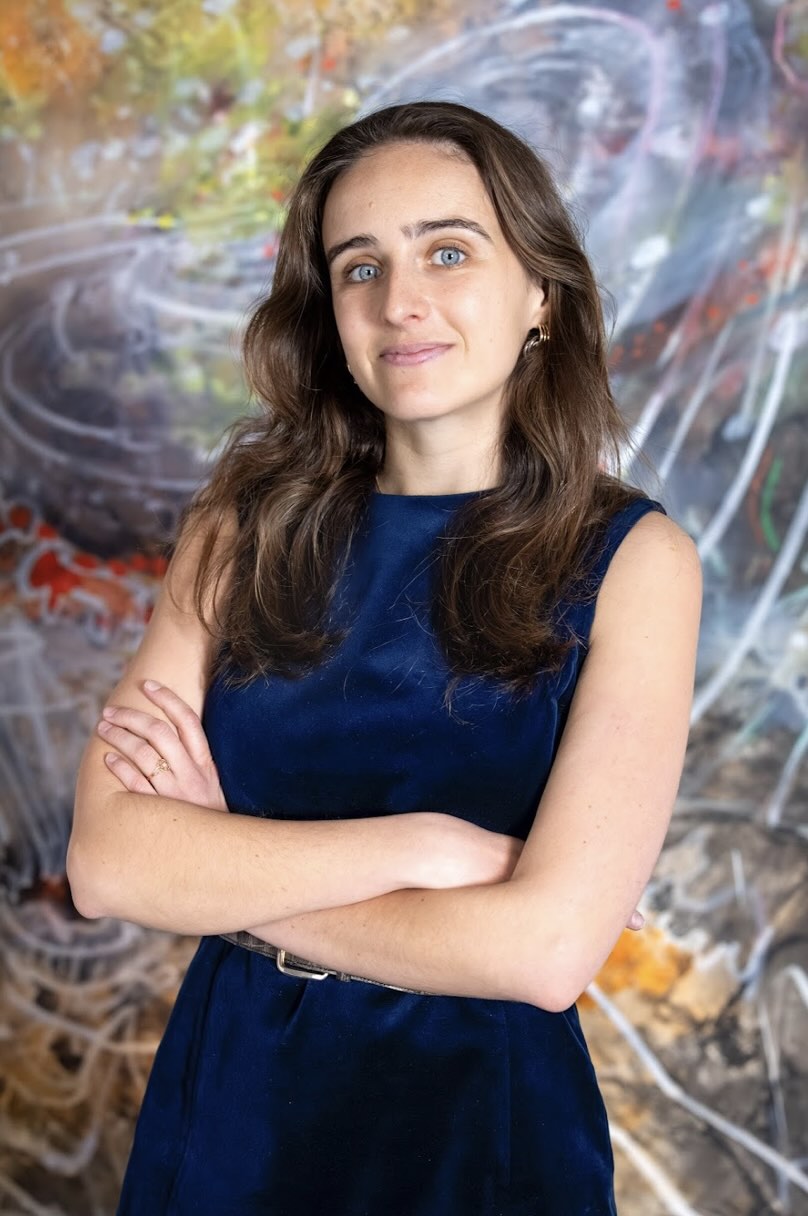
Today, Mouraux Durand-Ruel serves as an art advisor specializing in Modern and Contemporary Art at Opera Gallery New York, where she has played a key role in exhibitions, collector relations, art fair presentations, and artist development.
Her responsibilities extend far beyond the traditional image of a gallery advisor.
She works closely with artists on exhibition concepts and positioning, collaborates on catalogue texts and curatorial narratives, manages relationships with collectors, and helps navigate opportunities that can shape an artist’s long-term trajectory.
That broader approach became especially visible through her work with artists such as Feng Xiao-Min and Xevi Solà, for whom she curated their solo shows in New York at Opera Gallery: Feng Xiao-Min, Sailing Through the Light, presented in April 2025, and Xevi Solà, Endless Sun-days, presented in February 2026. Mouraux Durand-Ruel worked closely with both artists from the exhibition’s conception to execution, helping develop the framing, presentation, and communications campaign surrounding each project to best introduce them to the American press and clientele.
More importantly, these exhibitions became pivotal moments in the artists’ international trajectories. Feng Xiao-Min is now set to open his next solo exhibition at Opera Gallery London in June 2026, while Xevi Solà will present his first museum retrospective this summer at the Seoul Arts Center, underscoring the long-term impact of this cross-cultural positioning.
Taken together, these examples point to a consistent method. Mouraux Durand-Ruel does not see curating, advising, and artist development as separate roles, but as interconnected forms of cultural positioning. An exhibition can introduce an artist to a new market, a collector conversation can lead to an institutional relationship, and a carefully framed narrative can help an artist’s work enter a broader historical conversation.
“It gave me a panoramic view of the art world,” she has said. “I realized I wanted to work on the other side of the fence, in the gallery arena, participating in shaping artists’ careers and helping place their artworks in key collections.”
For her, the goal is never simply to place artworks.
“Advising collectors today is about understanding context,” she says. “It means understanding where an artist’s work sits historically, culturally, and within the larger conversation happening around it.”
Research as a framework for advocacy
That perspective has also been informed by her academic research.
While completing graduate studies in San Francisco, Mouraux Durand-Ruel co-authored a study on contemporary artists from the Global South, analyzing the auction results of 51 emerging artists between 2020 and 2022 and tracing the galleries, institutions, art fairs, biennials, and other stakeholders that contributed to their rise.
The research identified a network of 438 stakeholders involved in the visibility of those artists and found that international recognition rarely happens in isolation. It is created through a combination of market demand, curatorial attention, institutional support, geographic mobility, and sustained advocacy. For Mouraux Durand-Ruel, that research became a practical framework for gallery work: understanding not only what an artist makes, but how their work enters the right conversations, reaches the right audiences, and gains long-term cultural relevance.
Questions about visibility, advocacy, and cultural change continue to influence her thinking today.
Later this year, she plans to launch Mouraux Durand-Ruel Gallery in Manhattan, a new venture that will build upon both her professional experience and her family’s long-standing connection to the arts.
The gallery will focus on contemporary artists while creating dialogue between New York and Europe through exhibitions, talks, publications, and cultural programming.
For Mouraux Durand-Ruel, the project represents a continuation of the work she has spent years doing behind the scenes: helping artists find audiences, creating connections between institutions and collectors, and building the networks that allow cultural careers to grow.
In a moment when attention is increasingly fragmented and cultural spaces face mounting challenges, she sees those relationships as more important than ever.
The conversation may begin over dinner, at an art fair, or inside a gallery booth. What matters is where it leads next.