
 Nia Bowers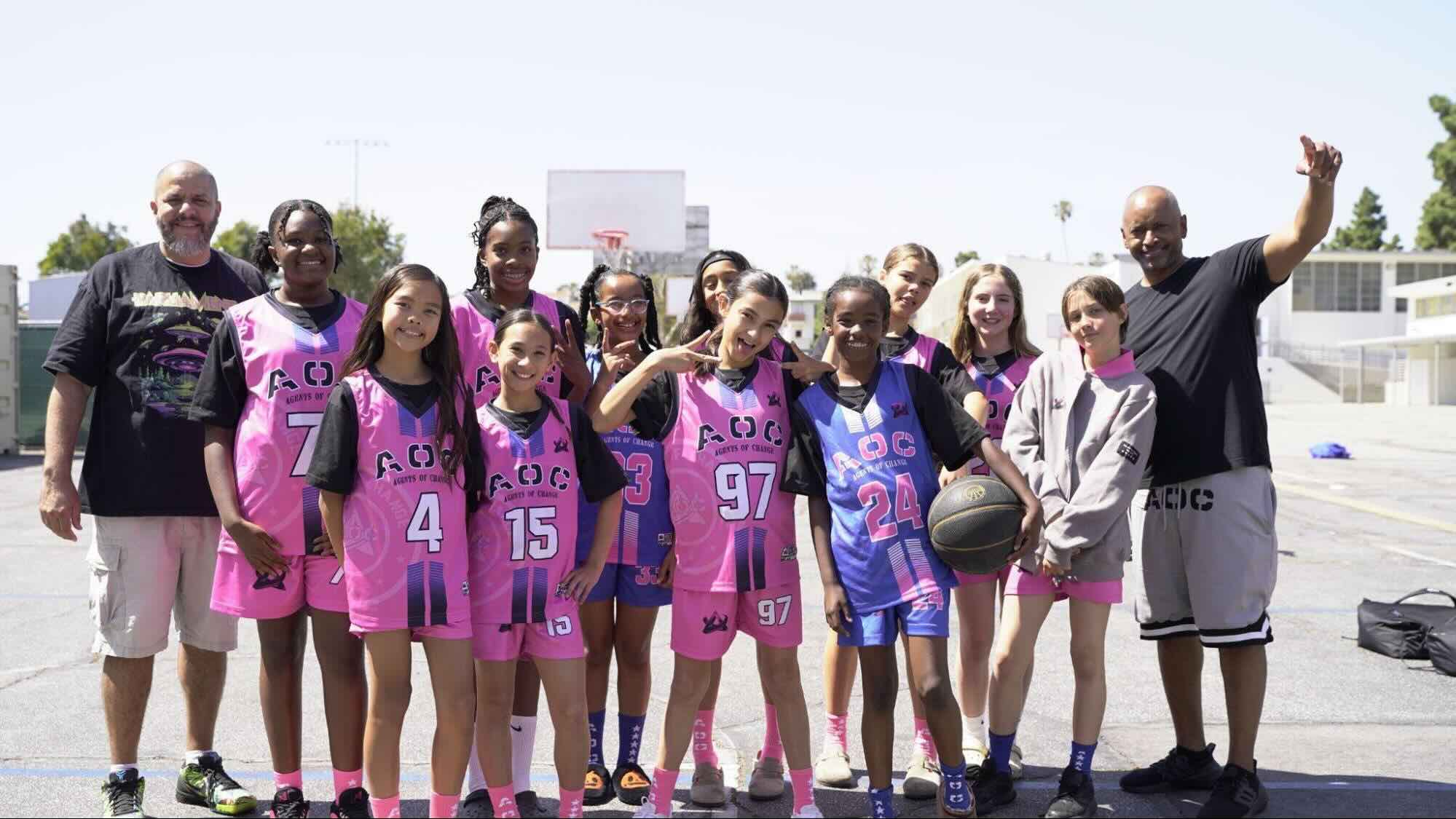
Photo courtesy of H.264 Marketing Partners
A basketball program in Los Angeles is turning a small gym into one of the city’s strongest engines of belonging. Aaron Courseault, owner-director of Agents of Change Basketball, has spent years pulling young people from very different zip codes into the same circle. What rises from that circle looks bigger than a team.
More Than a Team
Courseault started Agents of Change Basketball with a belief that sounds simple and hits hard in real life: a gym can do more than sharpen a crossover or fix a jump shot. It can give a kid rhythm. It can give a family a place to return to. It can pull strangers close enough to see one another clearly.
That idea has reached more than one thousand young athletes in Los Angeles County since 2013. Some arrive with strong support at home and every advantage a city can offer. Others carry money trouble, shaky housing, or the ache of weak guidance. Most youth spaces sort those young people into separate lanes, even when nobody says it out loud. Courseault wanted a room where those lanes dissolve under pressure, sweat, and shared work.
Basketball gives him the doorway, yet the draw runs deeper than drills. Teammates learn who shows up early, who stays late, who needs a ride, who hides pain behind jokes, and who grows louder once trust settles in. Parents begin the season as strangers across a set of bleachers. A few months later, many are cheering for children who do not share their last name, their zip code, or their daily life. Community does not arrive with a speech. It arrives through repetition.
Los Angeles can be brutal on young people who fall between categories. One child may have talent but no ride to practice. Another may have every resource and still feel cut off, guarded, or lost. Courseault understands that hunger and loneliness often share the same bench. Basketball gives both kinds of kids a language they can speak before they know how to explain themselves.
Courseault’s gift lies in reading what a room needs before the room can say it aloud. Some kids need a sharper voice. Some need patience. Some need to hear that talent means very little if they cannot trust the people around them. Basketball makes those truths plain, possession after possession.
Where Strangers Become Teammates
Sneakers scrape across the floor in Santa Monica. A pass slices through traffic. One player calls for the ball, another rises for a layup, and a bench that looked half-asleep a minute earlier explodes with noise. Energy fills the gym, yet the strongest current in the room is trust.
Courseault has built a place where difference does not vanish, yet it stops acting like a wall. A player raised on order and routine lines up beside a teammate who has spent years reading chaos and surviving it. One learns resilience at close range. The other learns what steady support can look like. Neither lesson comes from a lecture. Both show up in the hard, ordinary rituals of practice: box out, help on defense, stay locked in, pick upyour teammate.
Small moments carry the weight here. A coach pulls a player aside after a bad stretch and speaks to him sternly, but not to shame him. A teammate stays after practice for extra shots with a boy who had been fading into the background. A quiet kid finds his voice because somebody kept passing him the ball until he believed he belonged on the floor. Drama in sports often lives in the final seconds. Real change usually starts in the minutes nobody records.
Courseault does not chase the loudest version of youth sports. Hype fades fast. Ritual lasts longer. The value of a hard closeout, a shared laugh after a mistake, or a steady hand on a nervous shoulder can look small from the bleachers. Inside a young life, those moments can hit like thunder.
Families feel it too. Adults who might never share a conversation anywhere else end up shoulder to shoulder, reacting to the same loose ball, the same foul, the same burst of joy after a clean win. Barriers soften when people keep meeting under honest conditions. Basketball, at its best, strips away performance. A child either trusts the person next to him or he does not. Once that trust takes root, whole rooms begin to change.
The Long Game
Early proof came from the program’s first team. Years later, players from that group moved into pro basketball, military service, and sports media. Courseault sees those paths as evidence that the court can shape judgment long after the final buzzer. Wins matter, yet the truest measure arrives when a young person carries discipline, calm, and self-respect into adult life.
That is why people around the program talk less about trophies and more about direction. A teenager who once floated through school starts guarding his time. A family that felt cut off from its neighbors starts seeing familiar faces every week. A player who feared being judged begins taking up space with pride. None of that fits neatly on a scoreboard, yet all of it matters.
Money can slam the door on that kind of growth, which makes access a moral question as much as a sports question. Last year, Agents of Change Basketball gave more than $123,000 in scholarships, so financial strain would not keep kids off the court. Courseault has stayed clear about the reason. “We’re not just building players. We’re building people. We’re building perspective. We’re building something that lasts.”
Los Angeles has no shortage of programs that promise impact. Courseault’s work feels powerful because it asks for daily effort instead of grand slogans. Kids have to show up. Coaches have to care enough to correct and guide. Parents have to keep coming back until familiar faces become real ties. What forms inside that gym is neither soft nor sentimental. It is sturdy.
Aaron Courseault is building a youth movement through basketball, but the ball is only the spark. Real power sits in the bond between teammates, the steadier pulse inside families, and the growing belief that a child’s story can take a better turn when enough people rally around it. One gym cannot fix every wound in a city as large and restless as Los Angeles. One gym can still change the future for the kids who walk through its doors, and sometimes that is how a movement begins.