
 Nia Bowers
Galilean Relativity is simple. If you drop a ball on a plane in flight, the ball falls straight to the floor just like it would if the plane were stationary. The principle is that the laws of physics act the same inside a body in motion as they do when the body is stationary. Physics has always held that the speed of light is an absolute constant, that light starts from a theoretical absolute rest. This belief is not only pure conjecture but weird! Does absolute stationarity even exist? If so, how does light know where it is? Why would light vary from the rest of physics? This paper argues that the speed of light is consistent with Galilean Relativity. It includes the speed of its source and is still a constant. It always travels at C relative to its source. It does not begin at a theoretical station; it is cumulative!
The diagram below is a simple diagram of the interferometer.
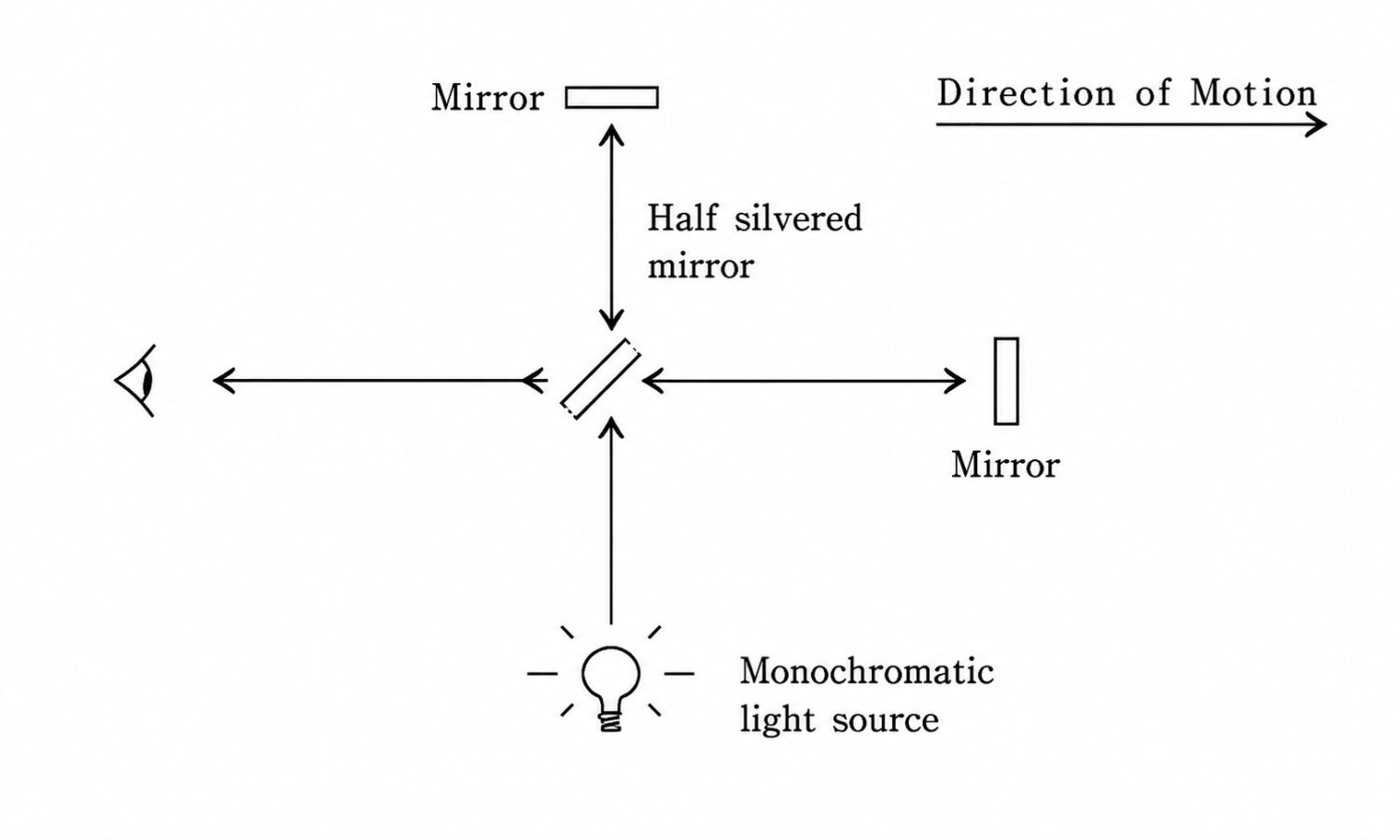
There are two of these devices in the world. One in Livingston, Louisiana, and the other in Hanford, Washington. The diagram represents an experiment conducted in 1881 by Albert Michelson and Edward Morley, called the Null Result of the Interferometer, perhaps the most famous experiment ever conducted in physics. What Michaelson and Morley expected to find was a wave interference, a series of light and dark lines. They believed that the speed of light is absolute. They expected that, because the parallel leg is longer than the perpendicular leg due to motion, the light beams would not arrive at the same time and would exhibit wave interference. The same interference occurs when the wakes of two speed boats collide. The interferometer showed no interference! For this reason, the experiment is called “The Null Result of the Interferometer”! The eventual explanation for this experiment is that motion causes time to dilate and space itself to contract, the Theory of Relativity
There is a simple explanation for the Null Result of the Interferometer: the speed of light is cumulative. It picks up the speed of the object that propagates it. Because the additional speed of light is the same as the interferometer itself, light travels the additional distance of the parallel leg in the same time as it would at stationary. Then light strikes the mirror, is absorbed and re-emitted in the opposite direction at C – V. Because the speed is slowed by the same speed at the interferometer is traveling toward it, light travels the same distance as it would if it were stationary. The same thing happens to the perpendicular beam. Both beams arrive at the observer at the same time, showing no wave interference. It is not necessary to compress space itself and dilate time to explain the Null Result of the Interferometer. The simple explanation is always correct. I call this Norberg’s razor!
Conclusion
The Null Result of the Interferometer proves that the speed of light is cumulative, not absolute! The Theory of Relativity is based upon a false assumption.
Interested in learning more? Explore the author’s book:
www.amazon.com/Synthetics-Rising-Douglas-Norberg-ebook/dp/B0G1LB5M4H