
 Matt Emma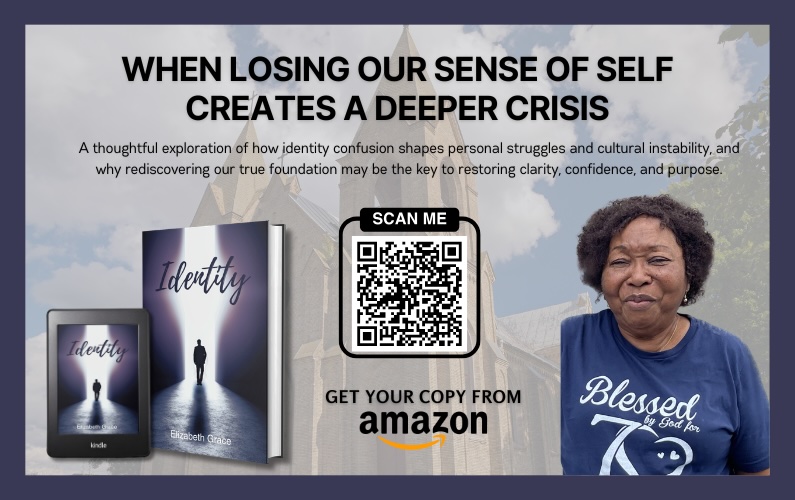
The condition of being oneself and not another, a person’s character including his or her qualities and beliefs, and a sense of self that motivates and energizes a person to live intentionally, these are common definitions of identity. Identity is the very essence of who a person is. It shapes decisions, responses, confidence, and direction. It works quietly in the background of daily life, guiding choices even when we are not consciously aware of it. When identity is stable, life feels coherent. When identity is shaken, confusion follows.
But in Identity, Elizabeth Grace presents a thoughtful and steady argument that identity crisis is not limited to individuals alone but reflects a wider cultural struggle. When large numbers of people become unsure of who they are, society itself begins to show signs of instability.
How Identity Shapes Society?
Every person carries an internal understanding of who they are. That understanding influences how they treat others, how they handle success and failure, and how they respond to pressure. When identity is rooted in something steady, behavior tends to reflect confidence and responsibility. When identity is uncertain, insecurity often drives actions.
Grace explains that much of today’s social unrest, personal dissatisfaction, and moral confusion can be traced back to a loss of identity. People search for meaning in wealth, status, appearance, or influence. Yet when these external measures fail to provide lasting security, frustration increases. This frustration does not remain private. It spills into families, workplaces, and communities.
The Influence of Family and Culture
The book carefully examines how family and culture shape identity. Strong family traditions and supportive environments can create belonging and stability. Individuals raised in such settings often develop a clearer sense of self. They understand their place within a larger story.
However, not all foundations are strong. Broken homes, inconsistent guidance, and cultural pressure can leave lasting uncertainty. When belonging feels unstable early in life, insecurity may follow into adulthood. Grace does not approach this with blame but with understanding. She
also acknowledges that identity is influenced by environment, yet she also emphasizes that it can be restored.
Cultural expectations add another layer of pressure. Society often defines worth by achievement, popularity, or material success. These definitions encourage comparison. They create competition instead of confidence. When people measure themselves constantly against others, identity becomes fragile.
The Deeper Root
Grace brings the discussion back to Scripture. According to the biblical account, humanity was created in the image of God. This foundational truth established identity before performance entered the picture. Adam’s identity was secure in fellowship with God. Authority, purpose, and belonging flowed naturally from that relationship.
The fall disrupted that connection. With separation came confusion. Humanity began searching outward for what had once been secured inward. Grace suggests that this original disruption continues to influence modern life. When connection to the Creator is overlooked, identity becomes unstable.
The Ripple Effect of Confusion
When individuals lose clarity about who they are, their decisions reflect that confusion. Some seek control through power. Others chase validation through success. Some withdraw into isolation. These responses are not random. They are attempts to secure identity without a stable foundation.
Grace points to biblical examples that illustrate this pattern. King Saul’s insecurity led to jealousy and destructive behavior. In contrast, David, despite rejection and hardship, maintained confidence because his identity rested in God. The difference between the two was not circumstance, but foundation.
Restoration Begins Personally
While the crisis may be cultural, Grace insists that restoration begins personally. When individuals rediscover their identity in relation to God, stability returns. The New Testament speaks of becoming a new creation in Christ. This transformation is not about erasing personality or history. It is about restoring connection.
Paul’s life provides a powerful example. Once defined by status and rigid religious zeal, he encountered Christ and experienced a shift in identity. That transformation did not remain private. It influenced entire communities. Personal renewal had a cultural impact.
Identity offers a return to clarity. Through personal reflections, life aspects, and so much more, Grace invites readers to examine the source of their self-understanding. If identity is built solely on shifting cultural standards, instability will continue. If it is anchored in a relationship with God, steadiness follows.
An identity crisis is not merely an individual struggle hidden behind closed doors. It shapes families, workplaces, and nations. Yet it is not permanent. According to Elizabeth Grace, the path forward is not endless reinvention. It is restoration. When people return to the foundation of who they were created to be, both personal and cultural clarity can begin to take root again.
If you are seeking clarity and facing difficulties in finding your purpose, Identity by Elizabeth Grace reminds you that true identity is not given by the world but rooted in faith and spiritual understanding.
Availability:
The book is available on Amazon: https://www.amazon.com/dp/B0FHMG7Q11/
About the Author:
Elizabeth Wariboko has been a committed Christian for 42 years. As a Christian, she engaged her talents in the church community and served as a Sunday School teacher, preacher, and teacher of the Word of God, serving on various committees from time to time in the furtherance of God’s work and the building up of the church of God.
She worked successfully as an educator for 44 years as a high school teacher. Her practice as an educator was centered on the philosophy that each student brought their unique personalities and backgrounds to the classroom. She therefore focused her practice on catering to the individual differences of her students.
Life and experiences have shown her that she is a lifelong learner, greatly interested in the behavior of her students and people in general, finding out what motivates them to think and behave the way they do.
Her strong commitment to the word of God and some understanding of human behavior as exposed by her experiences has enabled her to gain insights on issues in general, and while
raising five children of her own and the learning process of that exercise has helped to fashion her views on life.
Elizabeth is retired and lives in Minnesota.
Book Details:
Book Name: Identity
Author Name: Elizabeth Grace
ISBN Number: 979-8895265079
Ebook Version: Click Here
Hardcover Version: Click Here
Paperback Version: Click Here