
 Michele Stueven
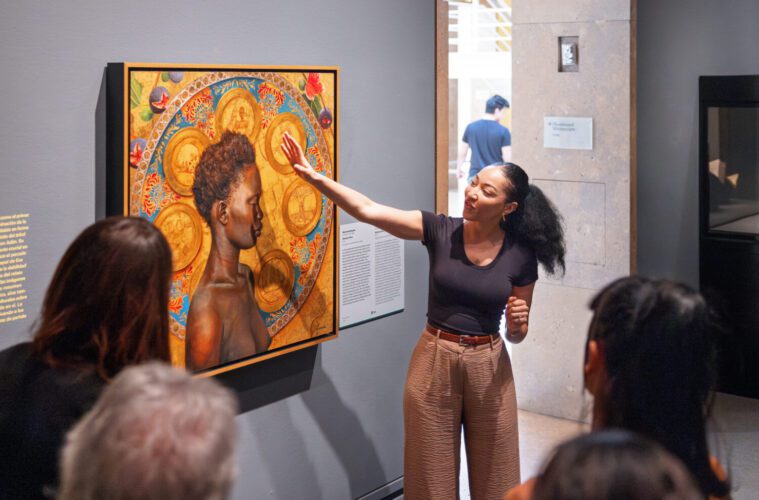
When LA-based artist Harmonia Rosales visited the Getty Center’s Manuscripts Study Room last summer, she became fascinated with the intricate medieval paintings in ancient missals that gave the biblical account of how the world was created.
Inspired by the details of the illustrations, like deep blues depicting a celestial sky and gold leaf halos. Rosales applied Renaissance and Baroque techniques to relate a different creation narrative, one based on West African Yoruba mythology and her Afro-Cuban ancestry. Her painted interpretations alongside the historic manuscripts are on display in the Getty exhibition Beginnings: The Story of Creation in the Middle Ages, through Sunday, April 19.
The exhibition, co-curated by Senior Curator of Manuscripts Elizabeth Morrison and Associate Curator of Manuscripts Larisa Grollemond, features medieval manuscripts that depict Christian beliefs about the creation story, alongside select representations from Jewish and Islamic traditions.
In Portrait of Eve, Rosales recasts the traditional Eve as a figure from West African Yoruba mythology in oil, gold leaf, and silver leaf on panel, showing a contemplative Eve in front of a golden halo that symbolizes the path of her life, including birth and the snake of knowledge, which can be both good and bad.
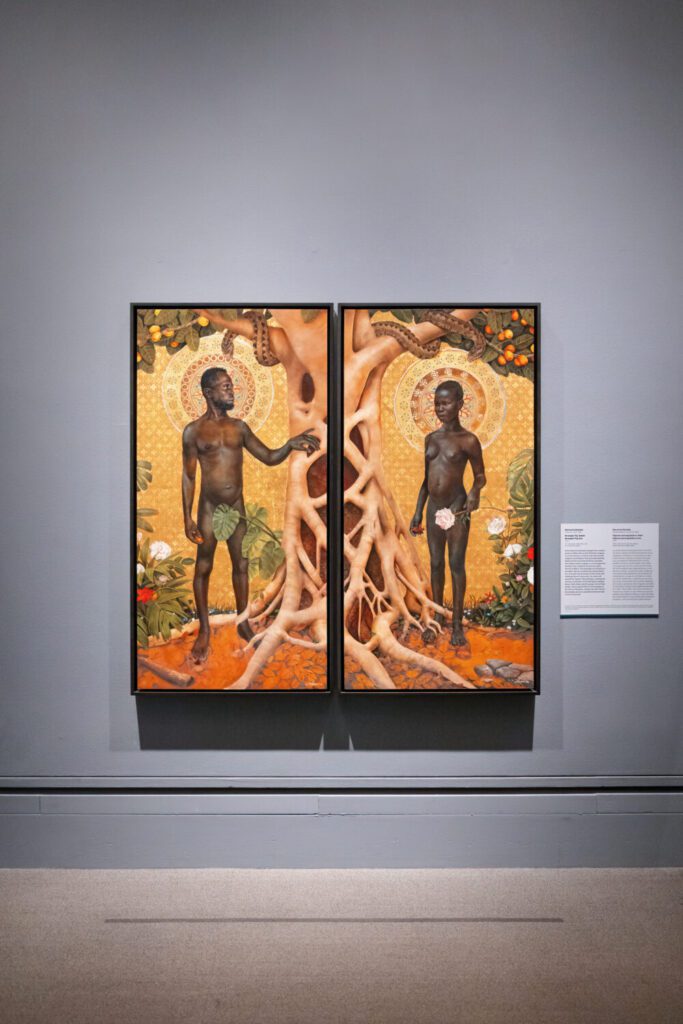
Adam and Eve (Courtesy The Getty)
“My whole mission is to bring Black bodies back into the historical divine conversation with the same, theological weight as Christianity,” Rosales tells LA Weekly during an afternoon walk-through of her exhibit. “ So I entwine a lot of the history within African spirituality. I also want to show the beauty in our skin tones, hair textures, and things that were seen as not aesthetically pleasing by European standards. By understanding the complexity of skin tones, I can illuminate them, just as in lighter skin and Renaissance works, because I’m utilizing the same colors. She represents the mother to the African diaspora, our ancestors. The ones who were enslaved. “
In Adam and Eve, Rosales changes the story up to her own interpretation. The medieval paintings of the Black pair are entwined with a black strangler fig tree, symbolizing manipulation, strangulation, and displacement of enslaved American people.
“I wanted to take the whole male and female aspect out of it and really talk about conformity,” says the self-taught artist. “How often do we have to perform, or choose to perform. Being a first-generation Cuban growing up in a small town in Illinois, I had to do a lot of conforming. My identity was almost completely erased.”
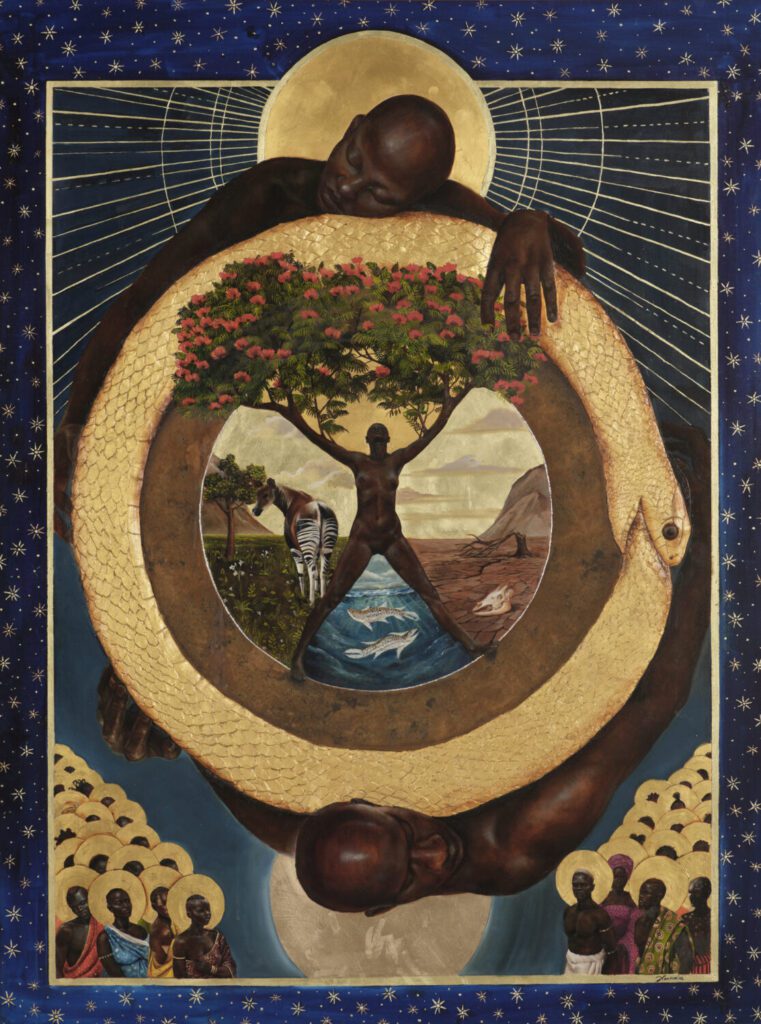
Creation, 2025 (Courtesy of the artist © Harmonia Rosales, Elon Schoenholz Photography)
Creation, an oil-on-panel painting, shows the linear nature of the Christian creation narrative portrayed in pages like The Creation of the World from the Stammheim Missal, which is on display in the gallery and served as the visual inspiration for her art. This will be the last time the Stammheim Missal will be on view for some time. There will be other manuscripts on view in a new exhibition opening in August, in advance of the planned closure.
More of Rosales’ work can be found in her recently published book, Chronicles of Ori: An African Epic, an illustrated, Afrofuturist retelling of Yoruba stories accompanied by reproductions of her paintings that visualize the narratives.
The Getty Center will begin its first series of modernization initiatives since its 1997 opening and will be temporarily closed to the public beginning March 15, 2027, with reopening planned for spring 2028. During the closure, Getty will continue to collaborate on programs with partners across Los Angeles, the United States, and at the Getty Villa, which will remain open.
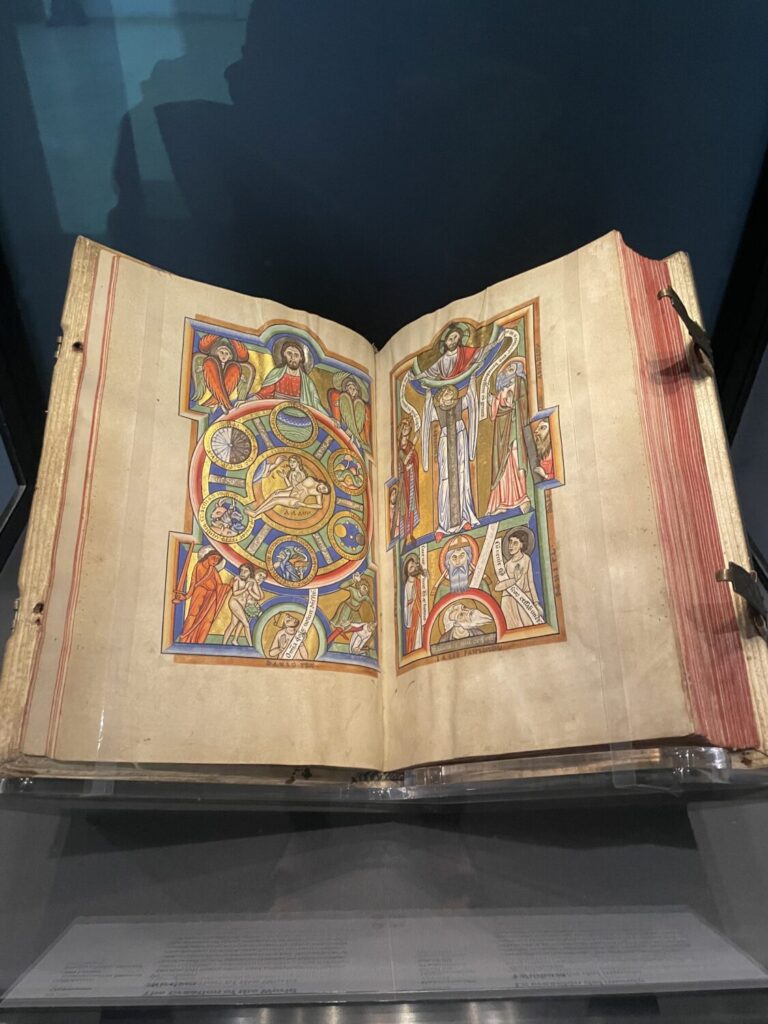
Twelfth Century Stammheim Missal (Michele Stueven)