
 Wyles Daniel
From architectural blueprints to AI-integrated digital ecosystems, Yifei Wang has forged a path that bridges art, technology, and empathy. A graduate of the University of Pennsylvania’s Weitzman School of Design, Wang has become an internationally recognized multidisciplinary designer whose projects span fintech, IoT, mobility, and sustainable product design. With multiple international awards—including the London Design Awards, New York Digital Awards, and Muse Creative Awards—her work reflects both creative excellence and social consciousness.

We sat down with Wang to discuss her transition from architecture to interaction design, the balance between innovation and empathy, and how her patented electric vehicle (EV) charging system redefines sustainability and safety.
Interviewer: What inspired your transition from architectural design to digital product and interaction design?
Yifei Wang: Architecture taught me to design for people within space; digital design taught me to design for people within systems. During my master’s at Penn, I became fascinated by human-computer interaction and how digital tools can extend spatial experience into emotional experience. I realized that the essence of design—whether a building or an app—is creating meaningful interaction. Moving into UX and product design allowed me to explore how data, AI, and storytelling can transform everyday behavior on a much broader scale.
Interviewer: Many of your projects integrate AI and IoT technologies. How do you balance technological innovation with human empathy?
Yifei Wang: For me, technology is only powerful when it amplifies empathy. In every project, I start with the question: what emotion or need are we really designing for? AI and IoT offer incredible possibilities, but they must remain invisible—serving the user’s intuition rather than controlling it. I often use speculative design and user research to ensure that systems not only respond intelligently but also resonate emotionally. Innovation should feel human, not mechanical.
Interviewer: Could you tell us more about your recent work with QCharge and the Super Q Center project?
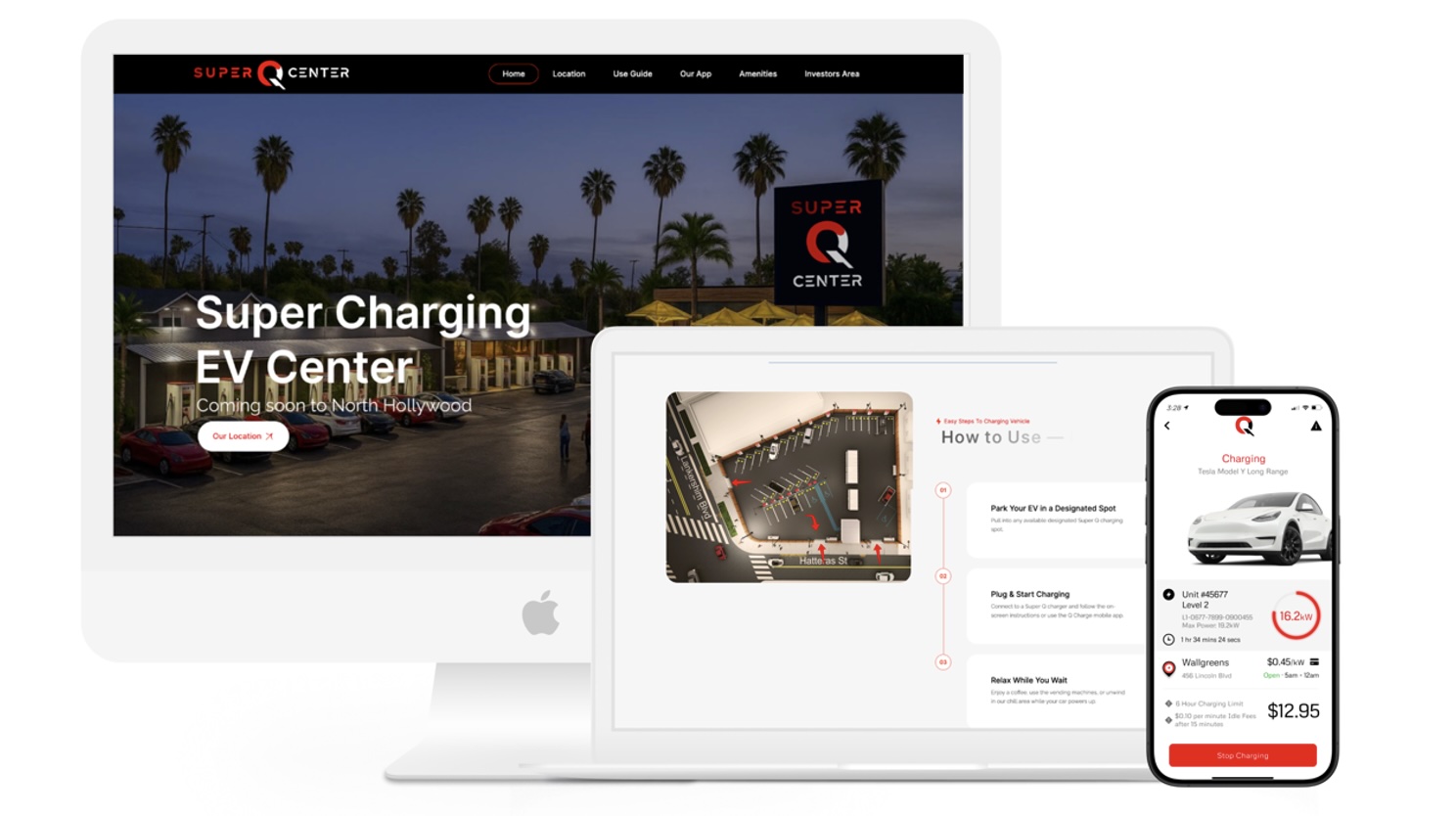
Yifei Wang: Yes, the Super Q Center is one of our latest initiatives at QCharge, representing a major leap in smart and sustainable EV infrastructure. It combines patent-pending hardware and a proprietary AI-integrated software platform designed to redefine what a charging experience can be.
We’ve integrated AI camera technology that recognizes vehicles and users in real time, ensuring a safe, seamless, and efficient process. The chargers are EV-agnostic, supporting most major electric and plug-in hybrid vehicles, and they deliver high-powered DC charging starting at 180 kW, drastically reducing charging time.
Beyond performance, the Super Q Center also considers user comfort—it includes amenities such as food options and vending machines, creating a more human-centered charging environment. For me, this project is about turning infrastructure into experience—a place where sustainability, convenience, and intelligent design converge to make clean mobility accessible to everyone.
Interviewer: You’ve received several international design awards. Which one holds the most meaning for you, and why?
Yifei Wang: Each award represents a different stage of my creative journey, but the London Design Awards stands out. My project LunaTemp, a wearable thermometer for infants, won Silver for Best Connected Products. That recognition meant a lot because it combined technical precision with emotional design—it was about helping parents feel closer and more secure. It reminded me that design at its best can bring comfort as much as innovation.

Interviewer: If you could define a designer’s social responsibility in one sentence, what would it be?
Yifei Wang: A designer’s responsibility is to translate complexity into clarity and compassion—to make the invisible systems of our world understandable and humane.
We live in an era of overwhelming data and digital acceleration. Our task isn’t just to innovate; it’s to mediate—to help people find meaning and belonging in increasingly technological environments. Whether designing for fintech, AI education, or sustainable transport, I see design as a language of connection between people and possibility.
Interviewer: What exciting new projects or directions are you exploring next?
Yifei Wang: I’m currently exploring how AI-generated interaction models can enhance accessibility in financial technology and urban mobility. I’m also developing a multi-sensory design framework that merges emotion recognition with real-time data feedback—essentially, creating products that can “feel” alongside users. Beyond that, I plan to continue working across disciplines, bringing together art, engineering, and ethics to imagine what “human-centered” truly means in the era of intelligent systems.
Closing Thoughts
Through her cross-disciplinary practice, Yifei Wang continues to demonstrate that the future of design lies not in technology alone but in its ability to connect, comfort, and empower. Her career exemplifies a rare harmony between innovation and empathy—an evolving dialogue between human experience and digital possibility.