
 Wyles Daniel
Yuqi Liu, Studio Photo (2025)
Inside a quiet studio in Huanglu Town, a historic area of Chaohu City in China’s Anhui Province, a sheet of handmade paper hangs suspended in the air, slowly drying. Across its surface, tiny specks of gold shimmer faintly in the light—barely visible at first glance, yet unmistakable once the eye begins to linger. The flecks appear almost accidental, like dust caught in sunlight, but they are anything but random. Each one is the result of a centuries-old technique from the tradition of Chinese decorative paper craft.
For Yuqi Liu, an Anhui-born artist based in the United States, this process forms the foundation of a new body of work for 2026, the Year of the Horse. While the series begins with the zodiac motif, its focus extends beyond symbolism to the quiet, methodical language of craft. Over the past year, Liu has immersed herself in traditional papermaking and finishing techniques, exploring the intersection of historical craftsmanship and contemporary art. Rather than treating these methods as relics, she approaches them as living processes capable of generating new visual meaning.
This investigation began in the summer of 2025 at the Duoyingxuan studio in Huanglu Town, where Yuqi Liu focused on the traditional sprinkled-gold technique (洒金). The process—dampening the paper, applying alum-and-glue sizing, and scattering fine gold powder—produces a delicate, luminous surface through precise control.
One of the most technically demanding paper-finishing methods, it requires both accuracy and sensitivity. Through repeated practice, Yuqi Liu gradually mastered the technique, approaching it not as preservation but as a contemporary reinterpretation of material and process.
Long interested in the cultural and physical qualities of paper, Yuqi Liu further deepened her practice during this trip by working with Liu Jing, a national-level inheritor of the craft, and participating in key stages of traditional papermaking. As Yuqi Liu notes, “Papermaking is not only a technique—it carries the foundation of our civilization.”
During her practice, she methodically organized Traditional Paper Finishing and Treatment Techniques (纸笺加工技艺) and the differences among paper types. “For example, sprinkled gold (洒金), mud gold (泥金), Marbling(流沙), powder-wax paper (粉蜡笺), and burnished patterning (砑花) each corresponds to a different finishing method. Only after actually doing the work did I realize how much aesthetic judgment and manual control it requires.” As she worked with her hands, she also read related literature, extending her technical experience into historical background, aesthetics, and cultural meaning.
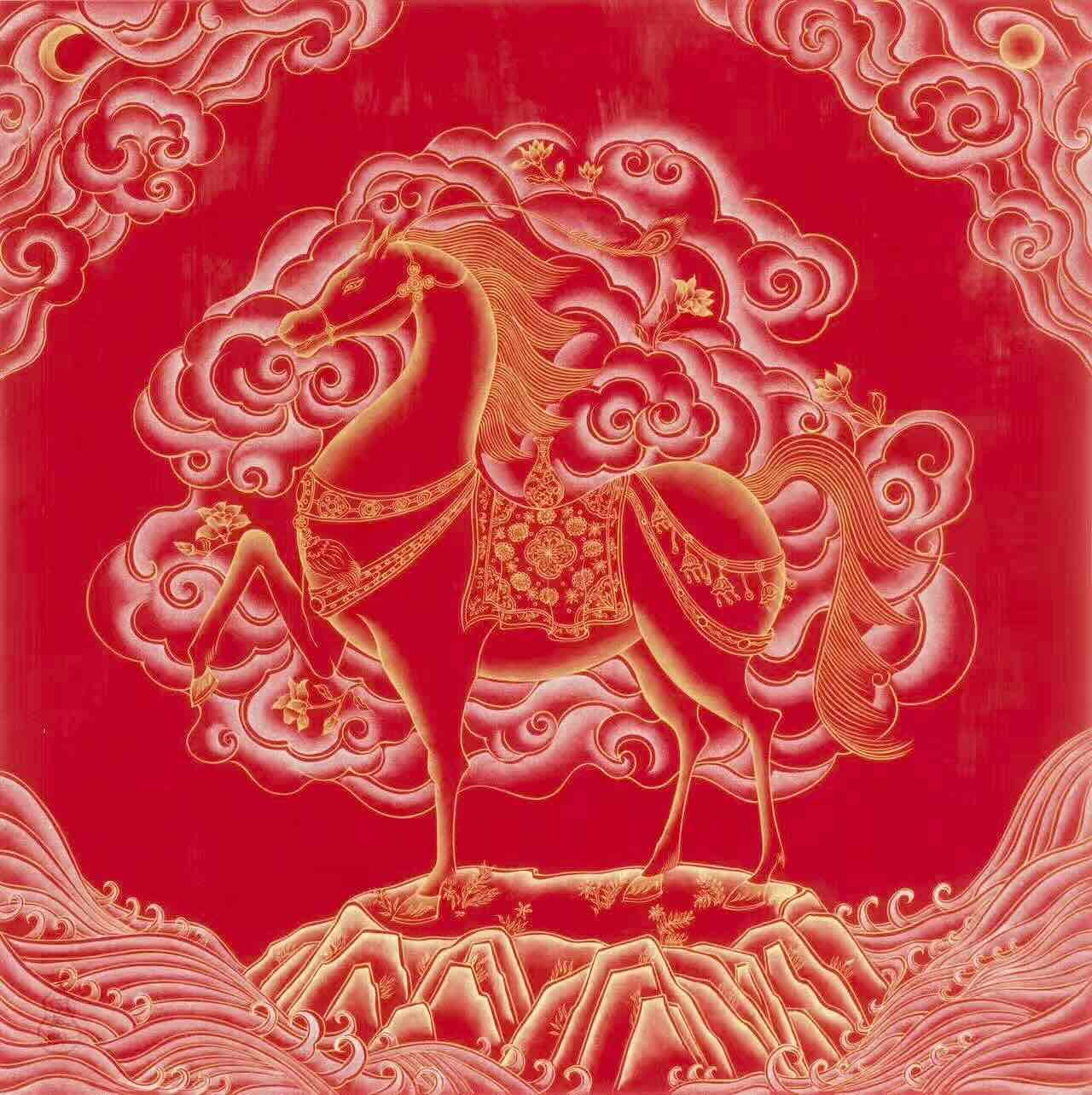
Yuqi Liu, Zodiac of the Year of the Horse, powder-wax paper, hand-painted with pure gold (2025)
Building on this foundation, Yuqi Liu began to use powder-wax paper as a primary medium, creating a work centered on the zodiac symbol of the Year of the Horse. While the series exists in several variations, one version stands out in particular for its material articulation: it employs gold and silver powder, allowing the same subject to assume different visual weight and luminosity across distinct material languages. Rather than functioning as a mere variation in color, the work derives its expressive force from the layered interaction of powder, wax, and burnishing. This surface structure incorporates sheen, fineness, and durability into the visual narrative itself, constructing what can be understood as a “second layer of language” beyond the image—one that is perceptible through both touch and light.
Powder-wax paper dates back to the Tang dynasty and is made by applying mineral pigments, followed by waxing and burnishing the surface. Typically using unsized xuan paper as a base, the process produces a smooth, luminous surface that combines absorbency with durability.
Historically used in court decoration and fine stationery—often alongside gold and silver techniques—it reached its peak during the Qing dynasty (Kangxi–Qianlong). After declining in the early 20th century, the craft was revitalized in Huanglu Town. In 2008, it was recognized as part of China’s national intangible cultural heritage, with Jing Liu named as its representative inheritor.
Yuqi Liu plans to further develop this series around the twelve zodiac animals while expanding her use of traditional materials, including powder-wax and mud-gold paper, within contemporary contexts, and introducing these practices to a broader international audience through exhibitions, workshops, and public programs. For Liu and Liu Jing, this work extends beyond individual practice into a form of cross-cultural dialogue, positioning traditional craft as a living, contemporary material language. By reinterpreting these techniques within new cultural frameworks, Liu not only preserves but transforms them, allowing intangible heritage to actively engage with contemporary art and opening new possibilities for exchange between tradition and innovation.