
 Michael Atkinson
In just over five years and three modest films, Jane Schoenbrun has established themself as an indisputable auteur with a particular, and maybe even troublesome, textual obsession: looking backward, to their own queer youth wandering the toxic fields of American media culture. They might just be a key generational voice — I look at my last decade of suburban undergrads, and I see Schoenbruns all the way down. Low-budge and unpredictable, the movies can often feel half-thought-out, but that’s only a glumpy way of saying that their syntax and imagery are open-ended, inconclusive, responsive only to semi-conscious emotional tatters. “Reality” is routinely Heisenberg’d: Schoenbrun loves unexplained membranes and irradiated slippages between who we are and what we’re watching.
So far, Schoenbrun has bounced from one medium-topic to another: We’re All Going to the World’s Fair (2021) submerged into the loneliness of chronically online adolescence; I Saw the TV Glow (2024) opens the tribal wounds of hermetically sealed TV obsessiveness; and now Teenage Sex and Death at Camp Miasma wallows, half-satirically, in the psychosexual fallout of Gen X sleepover life twisted by late-century slasher films. Schoenbrun’s earlier movies begin in a state of bottled anxiety and then spiral into psychosis, but Camp Miasma opens as an elaborate goof, limning for us the long commercial legacy of the fictional 1980s Friday the 13th-ish Camp Miasma movie series (which runs to 10 or more sequels, big on VHS). This includes a hilarious wake of cheesy merch, from arcade games and rap albums to bobbleheads of “Little Death,” the hermaphroditic slasher figure with a large air-vent duct-cube on its head. The detailing is mint and inspired, as is the filmmaker’s sharp eye on how Gen Z (the intended audience) seeks escape by manufacturing weird nostalgia for the base crap of the ’80s and ’90s.
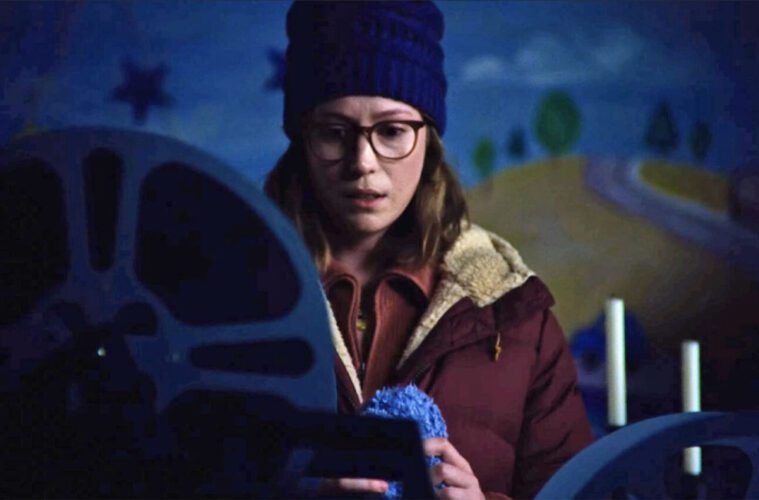
Then, we meet Kris (Hannah Einbinder), a fresh-faced “Sundance wunderkind” who’s already been hired to reboot the Camp Miasma franchise, and who is already driving in the snow to meet the reclusive Final Girl from the first 1980 film — one Billie Presley, played by a dewy Amanda Fix in the old footage we see and by a witchy, drawling Gillian Anderson in the present. Risibly, this spooky, aged Billie has sequestered herself in a log cabin on the grounds of the abandoned summer camp where the OG film was shot, painting and drawing ceaseless iterations of the Little Death vent pattern and rewatching the film on 16mm. (Pointedly, not VHS.) A superfan, Kris is at first bedazzled — especially once the blunts are rolled — but of course the fabric of what’s what begins unraveling, and everything becomes subjectively mushy, as if addled from watching too many old ultra-violent B-movies.
One wonders if Schoenbrun, after her last film’s success, had in fact taken meetings about a similar real-life effort to resurrect a slasher brand (the Zoom call with development execs rings with authenticity and nausea); regardless, the dedication to the genre is real, and at first the new film echoes the cheapjack feel of the old films in every frame. We hardly get out of that cabin, but that doesn’t stop Schoenbrun from eventually unleashing all manner of free-associative strangeness, from the obviously painted Thomas Kinkade snowscapes outside to maybe-urban-legend, maybe-not tales of Little Death living at the bottom of the nearby lake, ready to return through what looks like a theater’s projection booth portal….
From there, the mock-academic queer-theory perspective Kris initially offers to a dismissive Billie about the franchise (something about “the intersection of queerness and the depictions of the monstrous”) takes earnest center stage, ladling in chunks of the first Camp Miasma movie and Billie’s traumatic experience in it and smooshing it into Kris’s trauma from seeing the film too young and her own sexual disconnectedness. (The grainy scenes from 1980 include an unrecognizable Eva Victor as a Mohawked punk DJ.) Far from punishment for female sexuality, the slasher threat is explicitly equated with orgasms. Meanwhile, the film naturally veers toward literally becoming the reboot Kris is dreaming about, and then blasts right past the idea into a dazzling stew. (A name-check of Wes Craven’s remarkably meta New Nightmare, from 1994, which leaked his Elm Street franchise into the real moviemaking world, raises the conceptual stakes a bit.) Nothing is too silly for Schoenbrun, whose choices are often so counterintuitive they end up being charming: An in-your-face massacre montage from the old film matter-of-factly forgets its 1980 context and is recrafted as an anachronistic lark — why not? — shot like a careening Lego Movie action scene, punctuated by giant cartoony geysers of blood and scored to Counting Crows’ “A Long December.”
Where we end up: In a movie, of course. Ultimately, Teenage Sex and Death at Camp Miasma is both thoroughly self-involved and self-lampooning — which in a post-Tarantino movie world might not be terribly surprising. I think World’s Fair is still Schoenbrun’s tiny shot heard round the world, and you can’t be blamed for thinking they may already be skating a bit, making news and getting by, like a number of other youngish filmmakers, on the strength of audacity and dream imagery. But regardless, whether or not the film has much rhyme or reason, it’s a hoot, and the filmmaker knows their guns and sticks to them.