
 Will Jones
Source: Tempdrop
Productivity culture has long been built on consistency. Show up the same way every day. Perform at the same level. Push through. For women, that expectation often creates an underlying disconnect between what is demanded and what is biologically realistic.
Gemma Rigby of Tempdrop believes the issue runs deeper than workplace pressure. It is rooted in a system that was never designed with women’s physiology in mind. Women are expected to operate on a fixed daily rhythm while navigating a hormonal cycle that shifts week to week. The result is often misinterpreted as inconsistency when it is simply biology at work.
“Hustle culture ignores the fact that women are cyclical,” Rigby explains. “When we measure ourselves against a standard that never accounted for that, it is easy to feel like we are falling short.”
She also challenges one of the most persistent misconceptions around menstrual health. “The idea of a perfect 28-day cycle with ovulation on day 14 is a myth for most women. Only 12.4% of women experience a 28-day cycle, while most fall within a much wider 23–35-day range, and even then, ovulation can fluctuate by much more,” she says. “When that becomes the benchmark, normal variation starts to look like a problem.”
Rigby’s perspective is grounded in personal experience. After years on the contraceptive pill, she came off it and began tracking her cycle. What she discovered reshaped how she understood both her body and her work. Energy, focus, and mood followed patterns. Productivity was not inconsistent. It was cyclical.
“I spent years thinking I needed to be more disciplined,” she says. “In reality, I just needed to understand my biology better.”
Through her work and exposure to fertility awareness education, including insights from experts such as Michael Vardi, founder and CEO of Tempdrop, she began exploring the deeper science behind cycle tracking. What started as curiosity became a turning point. “I realized I had been forcing a linear model onto a cyclical body,” she says. “Once you see it, you cannot unsee it.”
Rigby is careful to frame this conversation without extremes. She emphasizes that the goal is not to separate how men and women work, but to acknowledge a difference that already exists. Because beyond the shared 24-hour circadian rhythm, women experience cyclical hormonal changes across the menstrual cycle that are linked to measurable shifts in mood, energy, sleep, and behavior, with large-scale data showing significant variation across multiple biological and psychological domains.
Source: Tempdrop
“Equality is not about pretending biology does not exist,” she says. “It is about understanding it well enough to support people properly.”
She refers to the menstrual cycle as four distinct phases that mirror the seasons. The follicular phase brings renewed energy and creativity. Ovulation supports communication and confidence. The luteal phase favors focus and detail, followed by a gradual shift inward. The menstrual phase creates space for rest and reflection.
“My biggest productivity shift came when I stopped trying to perform the same way every day,” Rigby says. “I started planning my work around my cycle, and I was able to do more with less effort.”
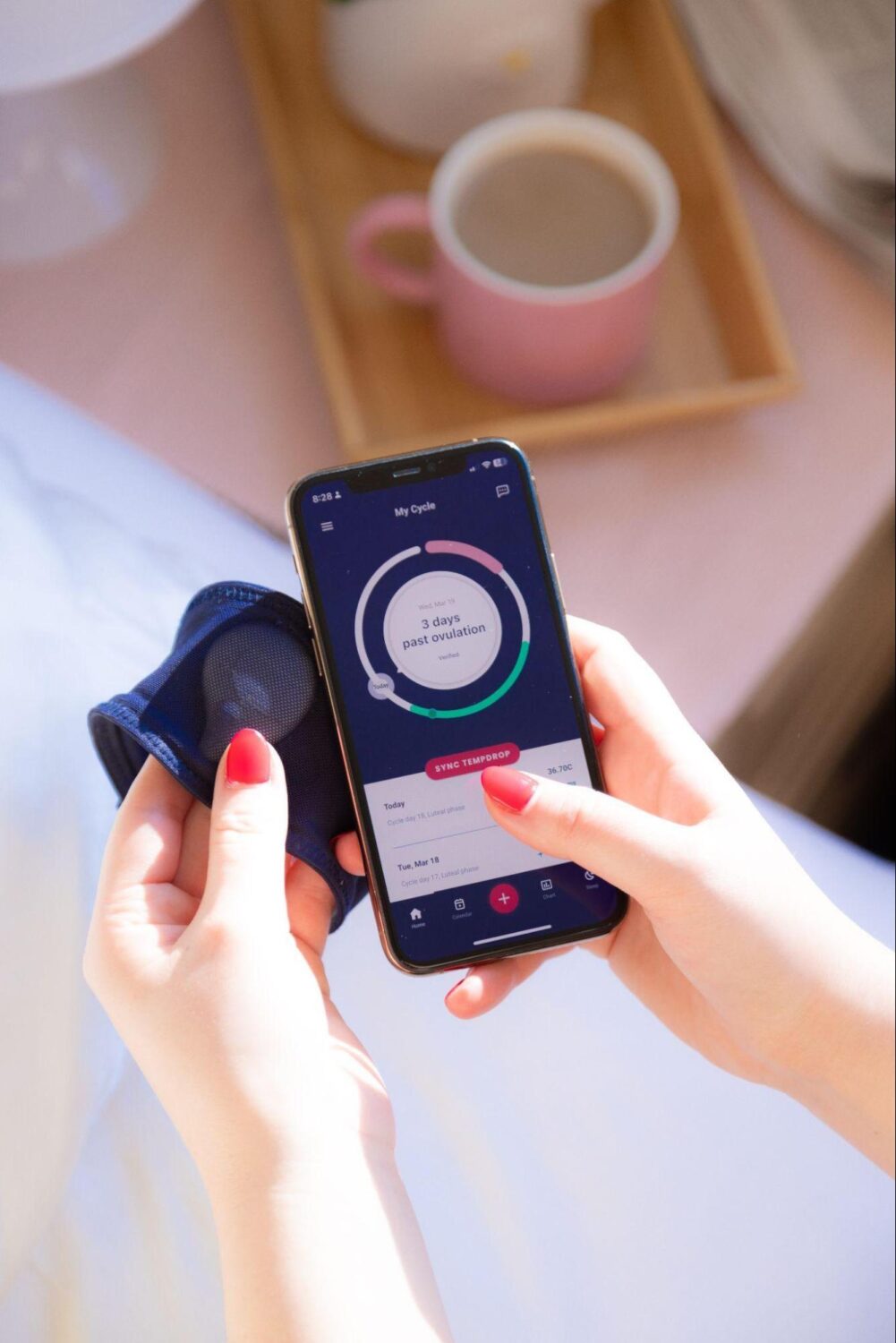
Beyond productivity, Rigby emphasizes that cycle awareness plays a critical role in health. A key focus is tracking ovulation, which marks a significant hormonal shift. Tempdrop supports this through a wearable armband that tracks basal body temperature alongside other physiological signals. When paired with observations such as cervical mucus and optional ovulation tests, it provides a clearer picture of the cycle.
According to her, this data becomes particularly important in mental health. Rigby highlights premenstrual dysphoric disorder as an example of how biology can be misunderstood. Symptoms often appear sudden and severe, yet they follow a predictable pattern linked to the luteal phase.
“For many women, it feels random,” she says. “But when you start to track your ovulation, you can see that it is not random at all. It follows a schedule.”
She explains that misdiagnosis is common when this pattern is missed. Mood fluctuations may be labeled as anxiety or other disorders without recognizing their cyclical nature. Tracking ovulation introduces clarity. It gives both patients and clinicians a shared reference point.
“Your cycle becomes a report card for your health,” Rigby says. “It allows you to walk into those conversations with evidence.”
With awareness of the luteal phase, she adds, women can anticipate when energy may dip or emotions may intensify. That insight could allow for proactive adjustments, whether that means lighter workloads, more rest, or clearer communication in relationships.
“It shifts the goal from fixing yourself to managing your biology,” she notes. “Workplaces are beginning to take notice of these patterns. Legislative changes and evolving policies in some regions are starting to recognize menstrual health as part of broader well-being conversations.” Rigby believes this is only the beginning and that data will be central to driving further change.
For her, education remains the foundation. Rigby sees a need for earlier and more comprehensive education across schools, healthcare systems, and at home. She also emphasizes the importance of including men in these conversations to build awareness and empathy.
Tempdrop reflects this approach by making cycle tracking both accessible and shareable. Users can choose to share their data with partners, clinicians, or support networks. The wearable design prioritizes comfort, allowing women to gather insights without adding complexity to their routines.
“If you do not understand your cycle, you cannot fully advocate for yourself,” Rigby says. “When you do, it changes the quality of every conversation you have about your health.”
She also points to the long-term potential of aggregated data. As more women track their cycles, the insights generated can contribute to research and improve the broader landscape of women’s healthcare.
At its core, Rigby believes her perspective is a cultural reset. The menstrual cycle has often been framed as a limitation within traditional productivity models. She sees it as an advantage when understood properly.
“My biggest productivity hack is listening to my biology,” she says. “It is where performance and well-being finally align. Our bodies are not something to push through; they are an extraordinary source of insight when we learn how to listen.”