
 Chad Byrnes
 A24’s The Iron Claw is not your typical sports movie. You won’t be rooting for the hero to score a championship belt, pin a villain to the mat, or sprint through his hometown while the town cheers him on. Thank God. Instead, writer/director Sean Durkin unspools the true story of the Von Erich brothers and their rise to wrestling fame with a mounting anxiety that’s downright Kubrickian. At first glance, this movie might look like a straightforward biography, but it’s so much more. Thanks to Durkin’s uncanny filmmaking, the story takes on several gradations, working as both an intimate portrait of a family in crisis and a searing indictment on good ol’ American ambition.
Named after the Von Erich brothers’ signature move, The Iron Claw opens on the sweaty, bulging visage of Fritz Von Erich (Holt McCallany), the family patriarch, as he struggles to break free from an opponent. It’s a haunting glimpse into the boiling rage that’ll eventually ravage his family like a virus. It’s the early 1960’s and Fritz emerges from the arena to greet his wife Doris (Maura Tierney) and his adolescent sons. Although worried that Fritz just purchased a car they can’t afford, he tells them not to worry, nothing can stop them. They need to be tough. Weakness is the enemy. Fritz talks a good game, but underneath the bravado he harbors a well of resentment for a world he thinks robbed him of a future in wrestling. “They kept it from me,” he recites to his sons like a mantra. “You can get it back for me!”
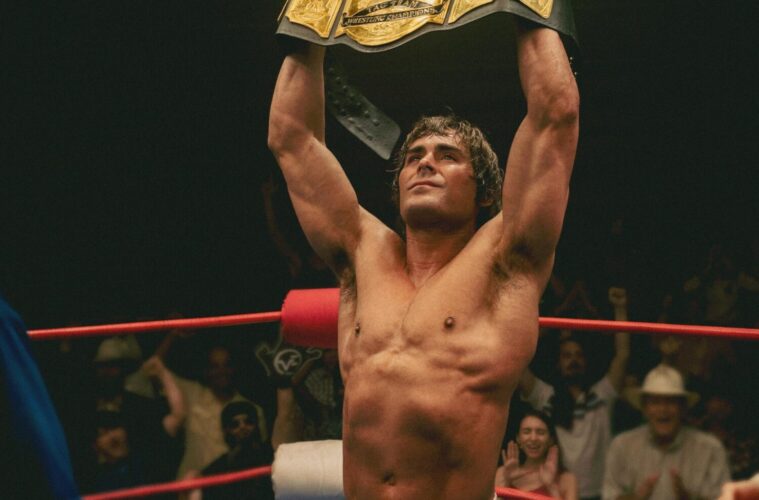
Fast forward to 1980. Dallas, Texas. Fritz runs a wrestling promotion company that organizes matches for the local community. It’s also a perfect springboard to indoctrinate his four sons into the game. The eldest, Kevin (Zac Efron), is the leader. A sensitive, quiet figure who looks like he was chiseled from granite, Kevin can wrestle like a champ, but struggles to promote himself. Efron’s physical transformation from wispy heartthrob to a mass of muscle and gristle is a little shocking at first, but his amazing performance overshadows any preconceived notions.
Kevin’s brothers include Kerry (The Bear’s Jeremy Allen White), a hopeful Olympian who joins the family business after President Carter boycotts the games in Moscow, David (Harris Dickinson of Triangle of Sadness), an extrovert who outshines Kevin with his oratory finesse, and finally, there’s Mike (Stanley Simons), the youngest brother who especially gets under Fritz’s skin since he’d rather play guitar and write songs than wrestle. Even though Fritz tries to control their dynamic, the four brothers stick together, forming an unbreakable bond.
There are red flags from the beginning. As Fritz trains his sons with a punishing intensity, Kevin expresses his concern to his mother who tells him to mind his business. Mind your father, it’s God’s plan. Religion plays a subtle yet powerful role in the film. For Doris, it grounds her in safety, even as it blindfolds her to reality.
Her husband isn’t as passive. An archetype of an old-school masculinity, Fritz believes in God, guns and winning. He’s the kind of guy who throws the word “sissy” around like confetti. McCallany plays Fritz without an ounce of vanity. He gives a measured, frightening performance. Convinced of his own superiority, he motivates his kids by pitting them against each other or playing favorites, depending on who’s excelling at the time. He wants them to win, not so they can experience personal happiness, but so he can recapture a glory that eluded him in his youth. His energy is humorless, gruff, frustrated, but more dangerously, focused.
Kevin gets lucky by meeting Pam (Lily James), a no-nonsense beauty who helps him discover a vulnerability he didn’t know he had. But their relationship isn’t all roses. As years pass and tragedy strikes his family, Kevin convinces himself that he and his brothers are cursed. It’s a notion that’s followed him most of his life. Durkin teases out the implications of their abusive upbringing by focusing on Kevin’s journey. Taught to repress his emotions, Kevin never learned to communicate. Efron’s facial expressions tell us everything we need to know. His turn as a man who wades through the world with a childlike uncertainty is textured, tormented and brilliant. He walks a tightrope between paralyzing fear and a need to regain control.
This movie has a power that defies description, but I’ll try. Durkin chronicles the Van Erich story with a wistfulness straight out of the Richard Linklater handbook. Intelligently, he takes the time to observe their day-to-day lives before bringing the hammer down. Nothing is rushed. As a director, his patience is priceless. The wrestling scenes themselves are masterfully framed and choreographed with the camera circling the ring hypnotically. For Durkin, wrestling is a ballet, a beautiful synthesis of bizarre histrionics and physical brutality, and even if the fights are preplanned, the brute physicality can take a toll.
This is only Durkin’s third film, but it’s quite obvious that he’s a fascinating filmmaker with an original voice. In all his films, he’s able to incorporate tonal shifts and divergent emotions while creating a suffocating terror that hovers over the narrative like a ghost. Although his films have an eerie quality, he doesn’t need to make a horror film, he sees horror in everyday life. He’s also a natural storyteller who’s constantly digging for something universal in his narratives. In Martha Marcy May Marlene, Elizabeth Olsen joins a cult, not because it’s rebellious but because Durkin portrays American domesticity as truly deadening and claustrophobic. In 2020’s The Nest, a married couple move to England during the height of the Reagan era to escape financial collapse only to discover that hypocrisy follows you everywhere. This time, Durkin uses the Von Erich story to explore the lengths Americans will go to achieve notoriety and validation. As you’ll see, they’ll go quite far, killing themselves and their loved ones in the process.