

 Asher Luberto
 “All great designs start with an even greater story.” That’s the motto of interior design, anyway, but it seems cinema’s greatest decorator has forgotten about the story altogether — what’s the point of designing a remarkably bespeckled building if no one’s going to live in it? It seems no one is living in Wes Anderson’s movies anymore — the deadpan, blank-faced “humans” at the center of Anderson’s movies are merely a part of the decoration, no more emotional but no less beautiful than the intricately woven carpets and tapestries that draw our eyes to his films. Like his greatest influence, the Italian director Federico Fellini whose wonderful style grew more carnivalesque and ridiculous in his later years, Anderson has found himself going over the top as well, almost doing a satire on his own shtick. With The Phoenician Scheme, the eye candy has become inedible.
I’m not saying you won’t get lost in Anderson’s film, but what’s a heist movie without engaging characters? What’s Oceans 11 without the suave charisma of George Clooney or the scenery chewing and food chewing of Brad Pitt? The Phoenician Scheme centers on a grotesque swindler who has left a string of loose ends and dead wives in his wake. In a hilarious deadpan tone, he claims “I never personally murdered anyone,” with an emphasis on personally. His grand “scheme” is to build a dam, tunnel and canal in an attempt to exploit a vast desert similar to Saudi Arabia, that way he can build his already expansive enterprise into something even more profitable.
When we meet Zsa-zsa Korda (Benicio del Toro), he’s smoking a cigar in a plane no bigger than a limousine which, because of an assassination attempt, goes up in flames while going down in a hurry. As an indicator of his morals, he ejects his pilot and directs his own rescue, asking ground control whether he should land in a nearby field. He does, but the near-death experience causes him to reach outa to his innocent, sequestered daughter Liesl (Mia Threapleton) who’s been living in a convent and whose selfless eyes represent everything he isn’t. He wants her to be the sole heir to his estate, as well as to enact revenge on his enemies should they be successful in killing him.
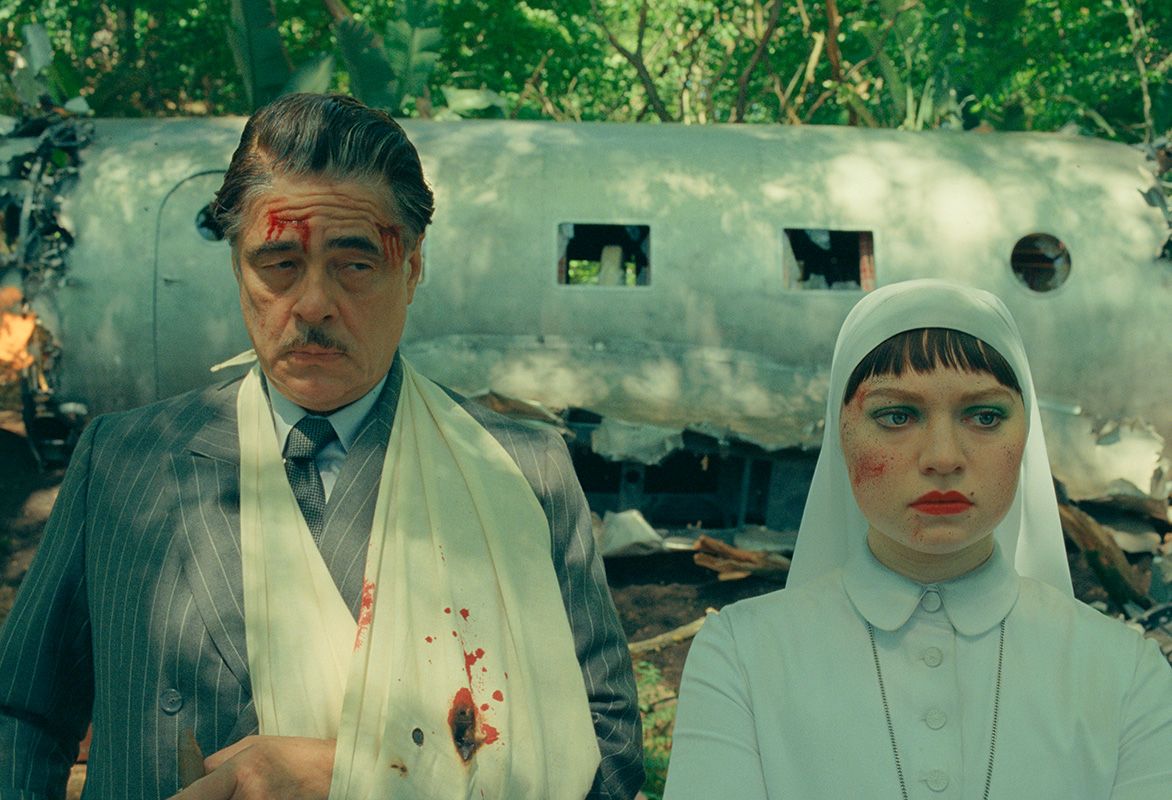
(Focus Features)
In a brooding voice-over, Korda tells her the details of his plan, which are more muddled and drawn out than a coffee-stained grocery list. A tutor Bjorn (Michael Cera) must accompany them to keep his daughter safe while they train across Europe to garner investments from different investors, among them a couple of elderly finance bros (Tom Hanks, Bryan Cranston), the leader of a syndicate (Jeffery Wright) and his illustrious cousin Hilda (Scarlett Johansson), whom Korda seeks to marry for more money. Soon they are all on a jet headed for the desert when they are attacked by a kamikaze pilot, followed by a slapstick fight in which Korda and Uncle Nabar (Benedict Cumberbatch in a comically fake beard) smash each other with vases until one of them drops. What’s the point of all this? I couldn’t tell you if I tried. It seems the heist, as well as the emotional journey between Korda and his daughter, are secondary to the design and performances on display.
As with Anderson’s previous film Asteroid City, the story is just an excuse to pile on witty banter, whimsical chaos and visually inventive dynamism, a barrage of symmetrically framed images and tracking shots that have been a staple of Anderson’s ever since The Grand Budapest Hotel, but the cinematic showmanship feels less like an extension of the plot and more like, well, just showmanship. Similar to Asteroid City and his string of Netflix short films, the movie sweats every detail, frame and curated set-piece, but the result is coldly calculated, like a perfectionist who built the most stunning dollhouse ever constructed but has placed a bunch of cheap dolls at the center.
Korda is perhaps the most insufferable ringleader in all of heist cinema, a bratty snob whose only character trait is an infatuation with consuming more money, but there is something interesting about the atmosphere around him, a universe that no other director could pull off. Does the movie make sense? No. Is there an excess of pointless action? Sure. Are there a bunch of A-list actors wasted on monotone caricatures? Yep. But you have to appreciate the unique style of Anderson’s film. After all, even the most whimsical auteurs (influences like Fellini and Jacques Tati) are fascinating even at their most indulgent. Even Anderson’s recent string of lifeless misfires call back to his most noteworthy films (Rushmore, Moonrise Kingdom), reminding us that maybe, just maybe, he’ll once again emphasize story in his next design.