
 Erin Maxwell
 Set in an alternate version of history where the ’90s is less about grunge music and more about survival, a young girl sets out to find her missing brother in a retrofuturistic hellscape of a dystopian America. Directed by MCU dynamic duo Anthony and Joe Russo, The Electric State is based on the illustrated novel by Simon Stålenhag, a dystopian sci-fi story that blends a haunting narrative with striking visuals. Through the journey of a young girl named Michelle and her companion robot, the tale unfolds across desolate landscapes strewn with the remnants of man-made horrors, revealing the slow collapse of civilization. Stålenhag’s story blends ominous realism with creeping dread to craft a cautionary tale of technology run amok, depicting a world where civilization is undone by its own hubris and addiction.
While a surreal, bleak tale about a lonely teenage girl and her robot companion might lend itself to a surreal, introspective A24 film, the Russo brothers needed something with broader appeal for Netflix. To that end, Christopher Markus and Stephen McFeely take a loose approach to the source material, stripping away some of its heavier themes in favor of a more universally relatable narrative, and as result, create a product that lacks depth, nuance, and any trace of an evocative story.
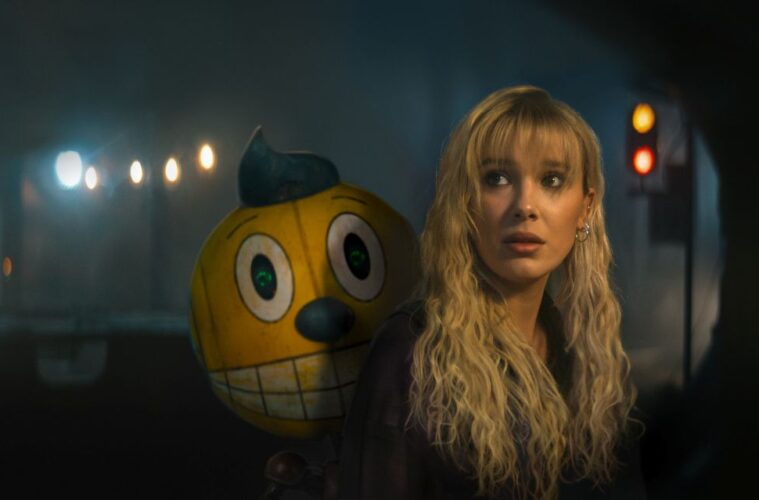
After the robot uprising, the resulting war, and the destruction of modern society, Michelle (Millie Bobby Brown) finds herself alone in the world after a tragic accident. However, after meeting a renegade Kid Cosmo robot, she becomes convinced that the conscience of her little brother Christopher may be housed in the bot’s smiling plastic visage. In an effort to save her sibling, she must travel to the Exclusion Zone, where vanquished robots are housed. Along the way, she picks up a smuggler Keats (Chris Pratt) and his trusty utility droid Herman (voiced by Anthony Mackie) as the motley crew traverses the remains of the American West.
For fans of Stålenhag’s book, the film is anything but a faithful adaptation of the profound, poignant original story. While it borrows some of the tome’s phantasmagorical imagery for a few of its backdrop, The Electric State strips away the slow-burning, emotional depth that makes the source material so compelling. Instead, Netflix’s version prioritizes action over the eerie, meditative journey.

(Netflix)
Judging The Electric State on its own merits, the concept of sentient robots is anything but new. We’ve feared Skynet, rooted for Johnny 5, been conflicted by Roy Batty’s fight for morality, and dissolved into a weeping pile of goo after the Iron Giant’s ultimate sacrifice. While The Electric State doesn’t break new ground in that regard, it does deliver visually compelling world-building, particularly in its depiction of the cartoonish automatons now weathered by years of surviving a war zone. Credit is due to the numerous VFX studios that brought Stålenhag’s mechanical mascot monsters to life.
However, flipping the novel’s somber narrative into an action-packed buddy movie proved to be too arduous for the Russos, turning instead to slapstick antics and celeb voice cameos as a substitute for solid storytelling. The lackluster acting only exacerbates the issue, with the cast delivering performances as stiff as their robotic counterparts. A true shame as Brown would have shined as a more true-to-page Michelle.
For fans of Stålenhag’s original work, the sad, sinister saga that envelops the reader in The Electric State is entirely absent in Netflix’s adaptation. Instead of embracing the story’s macabre mysteries and tragic backstories, the film’s more straightforward approach, relying on conventional sci-fi story ideas and stock characters, results in a disappointingly generic tone. Packed with uninspired bot battles, formulaic character arcs, and occasional goofy sidekicks, The Electric State unravels into a disjointed spectacle, devoid of soul, originality, and any meaningful connection with its audience.