
 Chad Byrnes
 With a title like Death of a Unicorn, your expectations might be unrealistically high or very low (depending on how you feel about the mythological horned creatures). Either way, writer/director Alex Scharfman’s debut, which features literal unicorns impaling billionaires, is undeniably ambitious and occasionally amusing, even after it runs out of steam from a draggy second act. An uneven fusion of satire, family drama, and schlocky horror, Unicorn relies too heavily on sketch-comedy absurdity and not enough on caustic wit to transmit its message regarding the spiritual rot of the top one percent. Still, the first-time filmmaker infuses his movie with enough exploitative madness and gory kills to help us at times forget about its threadbare plot and plastic characters.
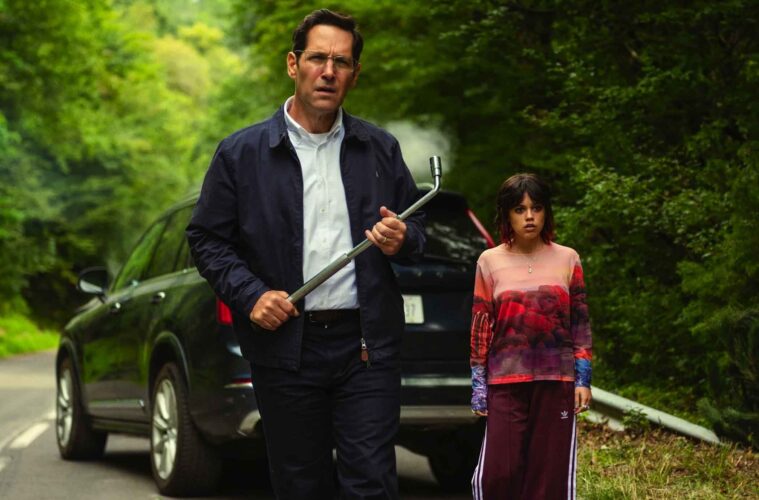
We open on Elliot Kinter (Paul Rudd), a harried attorney, and his moody daughter, Ridley (Jenna Ortega), as they drive to a weekend retreat hosted by Elliot’s boss, pharmaceutical CEO Odell Leopold (Richard E. Grant), who’s dying of cancer. Elliot has been summoned to Odell’s nature preserve in the mountains of Canada for an important meeting; on the way, he loses the signal on his cell (and his cool) before accidentally hitting a baby unicorn with his car. Before loading the poor creature into the trunk, his daughter touches its horn, transporting her to a psychedelic vortex which causes her pronounced acne to magically disappear.
The minute we meet the Leopolds, a clan of eccentric, rich blowhards, it’s clear that Scharfman’s intent is to excoriate billionaires, a noble — and timely — theme. In addition to Odell, who’s withering away in a wheelchair, there’s his scheming wife, Belinda (Téa Leoni), and their man-child son, Shepard (a scene-stealing Will Poulter). After the Leopolds discover the unicorn in the trunk of Elliot’s car, and quickly realize its blood has healing powers, they see dollar signs. Odell has his in-house doctors run tests on the creature in hopes of using its supernatural properties to make them millions. What they don’t realize is that the dead baby unicorn has relatives, large ones, and they’re circling the mansion like predators, predators with spikes on their heads and razor-sharp teeth.
Meanwhile, Ridley, who has a degree in art history and knows a thing or two about unicorns from studying ancient tapestries, warns them to stop what they’re doing, as their actions could have dire consequences. They dismiss her as an ignorant child with a useless degree — you can imagine how that turns out. Pretty soon the unicorns wreak vengeance upon the human scum who are poking and prodding their child like a lab rat. And this is when the movie comes alive, after an interminable amount of exposition and flat jokes.
The film’s problems are rooted in the second act, which is frustratingly dull — like watching a drunk get from the foyer to the bedroom without destroying everything in sight. Instead of deepening our interest in these people or their perversities, we spend 40 minutes with simplistic jerks whose behavior is as annoying as it is predictable. It would help if the Leopolds were funny instead of merely loathsome, but their comedic interplay is strangely bloodless. Thankfully the action-packed final third rescues the movie from complete ruin.
Satire, especially of the “Eat the rich” variety, works best when the characters are somewhat believable, or at least interesting (Saltburn), and not just marionettes in a grandiose play (The Menu). Unfortunately, Scharfman is a disciple of the latter’s school of parody, where everyone is a stand-in for a type and not a self-contained character. On the other hand, if he wanted to go full schlock, à la Lloyd Kaufman’s Toxic Avenger, he should’ve dropped the speeches and earnestness and pushed the movie’s more grotesque elements. Everyone is simply too tedious to be perverse. The unicorns are the only ones with any teeth.
Although the actors can’t camouflage the defective script, the performances are all terrific, particularly Ortega, who pours herself into every scene. Barry star Anthony Carrigan gets some of the heartiest moments, as the butler with a conscience. And it’s great to see Téa Leoni again after a long break between feature films, her last being 2011’s Tower Heist. However, Richard E. Grant, who could shine in an insurance seminar, is sadly wasted, and saddled with lackluster dialogue. Rudd brings his usual sweet goofiness to his role, although Elliot is a frustrating mishmash of emotions: One minute he’s a corporate sycophant who sides with his employers, the next, he’s a protective, loving father. You can practically see Rudd struggle to make sense of this underwritten role. Actually, the father-daughter storyline is so hackneyed and gooey, you’ll need to remind yourself you’re watching a movie about killer unicorns and not Terms of Endearment.
Scharfman finally brings the goods when the unicorns gallop onto the estate and rip everyone into pieces. The action sequences are surprisingly intense, violent, funny, and deftly handled. And although the CGI-designed critters aren’t quite up to a Jurassic Park–level of craftsmanship, it’s not that important when they’re chomping on human flesh. The film finally finds its footing, comedically and otherwise, when it leans into the creature feature horror elements.
In movies, satire comes in all shapes, sizes, and genres. From Miloš Forman’s 1967 anti-communist romp, The Fireman’s Ball, to last year’s gorefest The Substance — which took aim at Hollywood’s standards for feminine beauty — the list of films that subvert our perception of social and political constructs is long and varied. What we require from these films is that they entertain us while opening our eyes. In Death of a Unicorn, there’s literally nothing new to learn about rich jerks, except that they’re dreadfully boring. Thankfully, Scharfman’s bloodlust overwhelms his more philanthropic concerns. Besides, we came to see a movie about killer unicorns, didn’t we?