
 Nia Bowers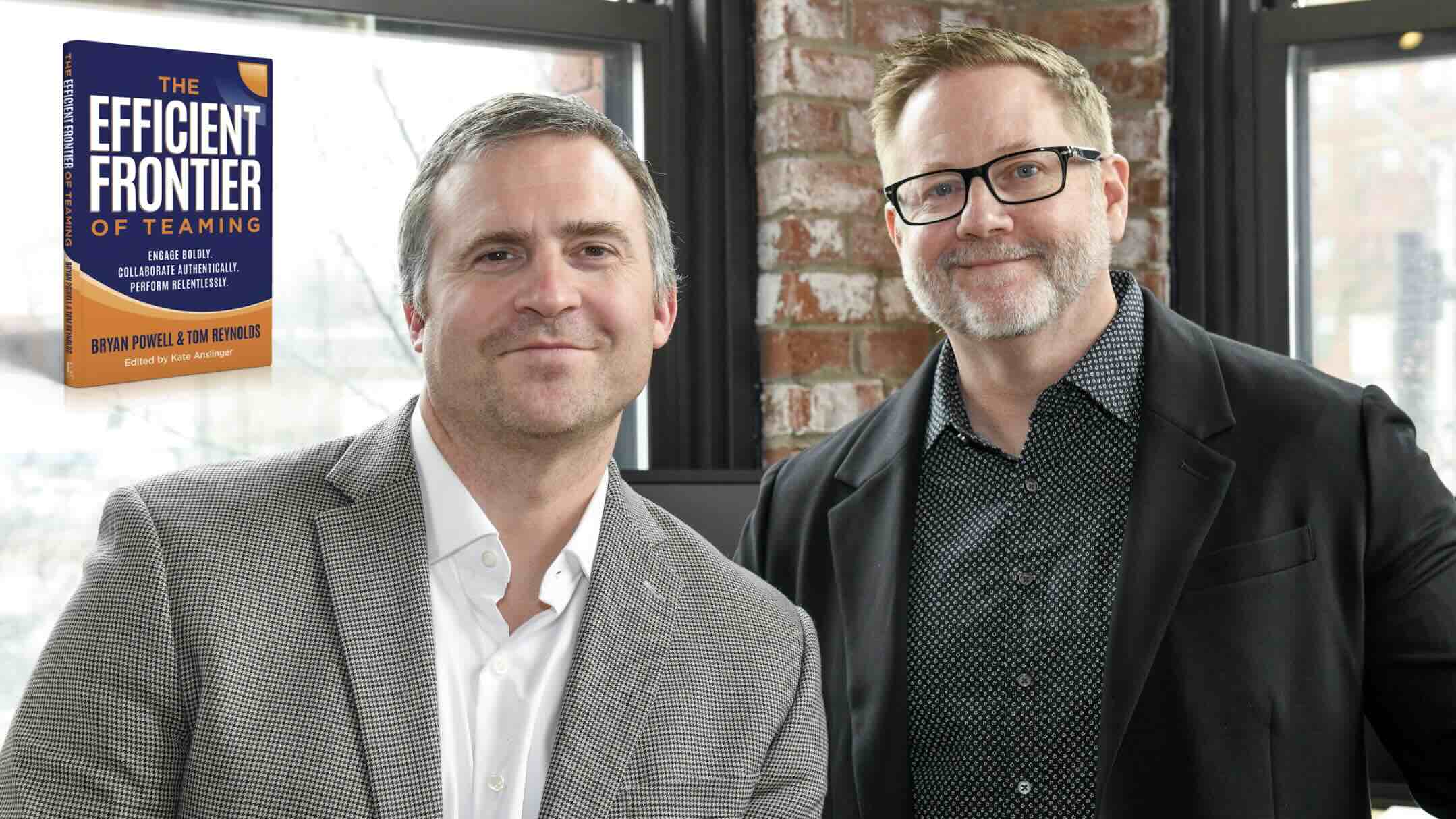
High performance is not accidental. Teams perform optimally when accountability, psychological safety, and execution are intentionally designed through clear systems and reinforced by leadership behaviors. Even with this careful creation and refinement process, if engagement and authenticity are lacking, teams may find themselves falling stagnant in their growth. Most teams plateau not because of a lack of talent or strategy, but because their operating system is flawed.
Bryan Powell and Thomas Reynolds have made untangling this reasoning their mission with their co-authored book, The Efficient Frontier of Teaming. In their findings, when trust, clarity, and accountability are misaligned, team performance suffers. Sustainable results stem from leaders treating team effectiveness as a designed system rather than an assumption.
The Teaming Duo
Powell has worked in leadership psychology, team performance, and real-world execution over the past decade. He has coached senior leaders in the field and high-performing teams across wealth management, financial services, and complex professional environments. He has over 4,000 coaching hours and obtained graduate-level training in organizational leadership and performance psychology.
Reynold’s complementary skillset is rooted in psychology, assessment, and long-term organizational design. A seasoned coach, assessor, and solution designer, he serves leaders across diverse industries worldwide through his boutique consultancy, Leadership for the Long Term. Together, their work reflects years of observing what enables teams to move beyond surface-level collaboration into sustained, measurable performance.
Why Talented Teams May Plateau
Talent does not guarantee cohesion or performance, because those attributes result from leadership and accountability.
Teams often focus on tasks and metrics while ignoring the relational and psychological dynamics of group interaction. When the focus is on the numbers instead of the people, a crucial task is left to the wayside, one that can only be performed by leadership: psychological safety.
Surface-level collaboration may occur when it is necessary for a team activity, but it masks deeper issues such as withheld feedback, unspoken disagreements, and unclear ownership.
While teams have the capability, this low psychological safety creates silence among the team and leadership, instead of the innovation desired. Without intentional design from leadership, teams often default to patterns that feel safe but limit performance.
Much of the book draws from moments where teams believed they were “high-performing” until they examined how decisions were actually made and whose voices were missing.
The Cost of Silence in Leadership Teams
When leadership is caught up in metrics, they may forget that silence is measurable as well, and it is an expensive cost. As Powell and Reynolds discovered, strategic blind spots stem from voices that are neither invited nor heard.
Leaders may believe their team is aligned, but when silence reigns, compliance is actually driving behavior. This suppression of dissent reduces a team’s adaptability under pressure, a vital resource in team activities.
Powell and Reynold’s work focuses on shifting thinking from the tasks teams want to accomplish to the team as a whole, often through cognitive examination of processes. By questioning what the shift would look like, they hope to encourage change.
With silence and compliance struggles, it is encouraged to examine the following questions as they apply to a team:
- Who speaks most often?
- Whose ideas are adopted?
- What topics feel unsafe to challenge?
Designing for Psychological Safety and Accountability
In their professional and practical experience writing this book, Powell and Reynolds found that trust and accountability are not opposites; they are mutually reinforcing.
Psychological safety enables risk-taking and learning, while accountability ensures that standards and execution remain high.
To achieve this, leaders must model vulnerability while reinforcing performance expectations.
In practice, this can look like:
- Clarifying decision rights.
- Defining shared standards of communication.
- Establishing structured feedback loops.
- Measuring engagement alongside results.
Lessons from Coaching High-Pressure Environments
In particular, in Powell’s experience, results-driven industries quickly expose team weaknesses. In financial services and professional firms, mistakes are visible and costly, making it imperative that these teams work to ensure cohesion and success.
In the book, Powell speaks about his own experience: his leadership differed from that of the majority of the executive team, and instead of embracing this, they thought they could coach it out of him. He shares that the experience deepened his appreciation for the diversity of thought and experience.
It is this that the duo identifies as the key to higher-level performance and to escaping that plateau, not group thinking or other biases that arise from “everyone is meant to fit the square peg in the round hole.”
Powell and Reynolds combine their years of experience to bring audiences a book grounded in examples and insights on how to rise above stagnation in a team environment by taking ownership of compliance and addressing this leadership flaw to design a psychologically safe team.