
 Will Jones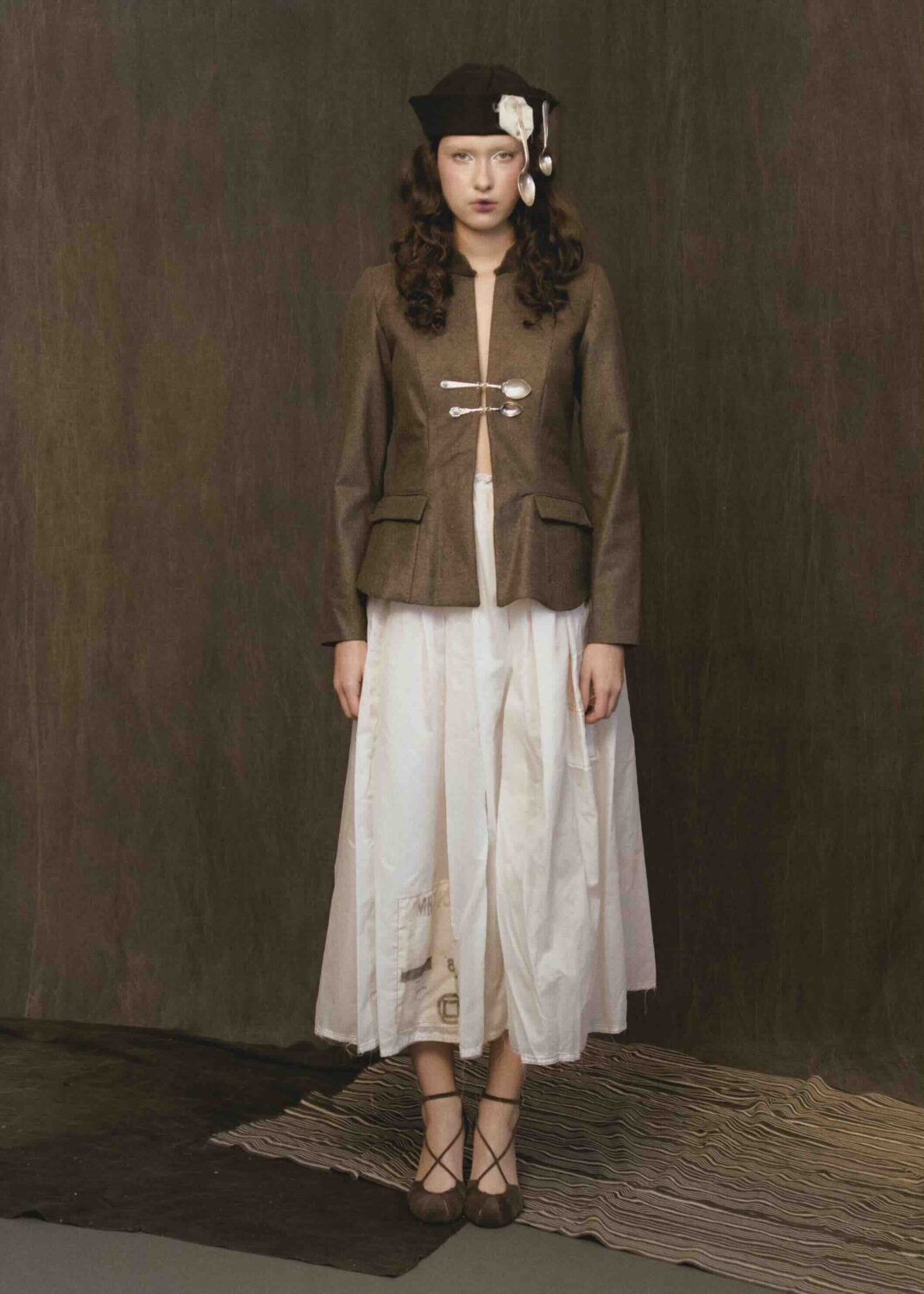
With Tools of Survival, Rachel Sacksner turns material, process, and purpose into a sharper argument for what fashion can hold and what it should refuse
Rachel Sacksner is not interested in fashion that moves quickly, looks polished, and disappears just as fast. Her work pushes in the opposite direction. In a culture that often rewards surface, speed, and sellability, Sacksner is building a practice rooted in intention. She cares about what materials mean, what construction choices communicate, and what a garment can carry beyond appearance. That position gives her work an edge. It also gives it weight.
“I am interested in design that has a reason for being,” Sacksner says. “If a choice is there, it should serve something larger than image alone.”
That philosophy comes through most clearly in Tools of Survival, the collection that established the deeper logic behind her design perspective. The work is not simply autobiographical, and it is not trying to use history as decoration. It is a design argument built through material. In the collection, Sacksner draws from the story of her great-grandmother, a Holocaust survivor whose wedding dress was made from a World War II parachute. That story gave her more than emotional inspiration. It gave her a framework. It showed her how clothing can be shaped by necessity, adaptation, and resourcefulness without losing conceptual depth.
“What stayed with me was not just the image of the dress,” she says. “It was the thinking behind it. It changed the way I understood the relationship between need, transformation, and meaning.”
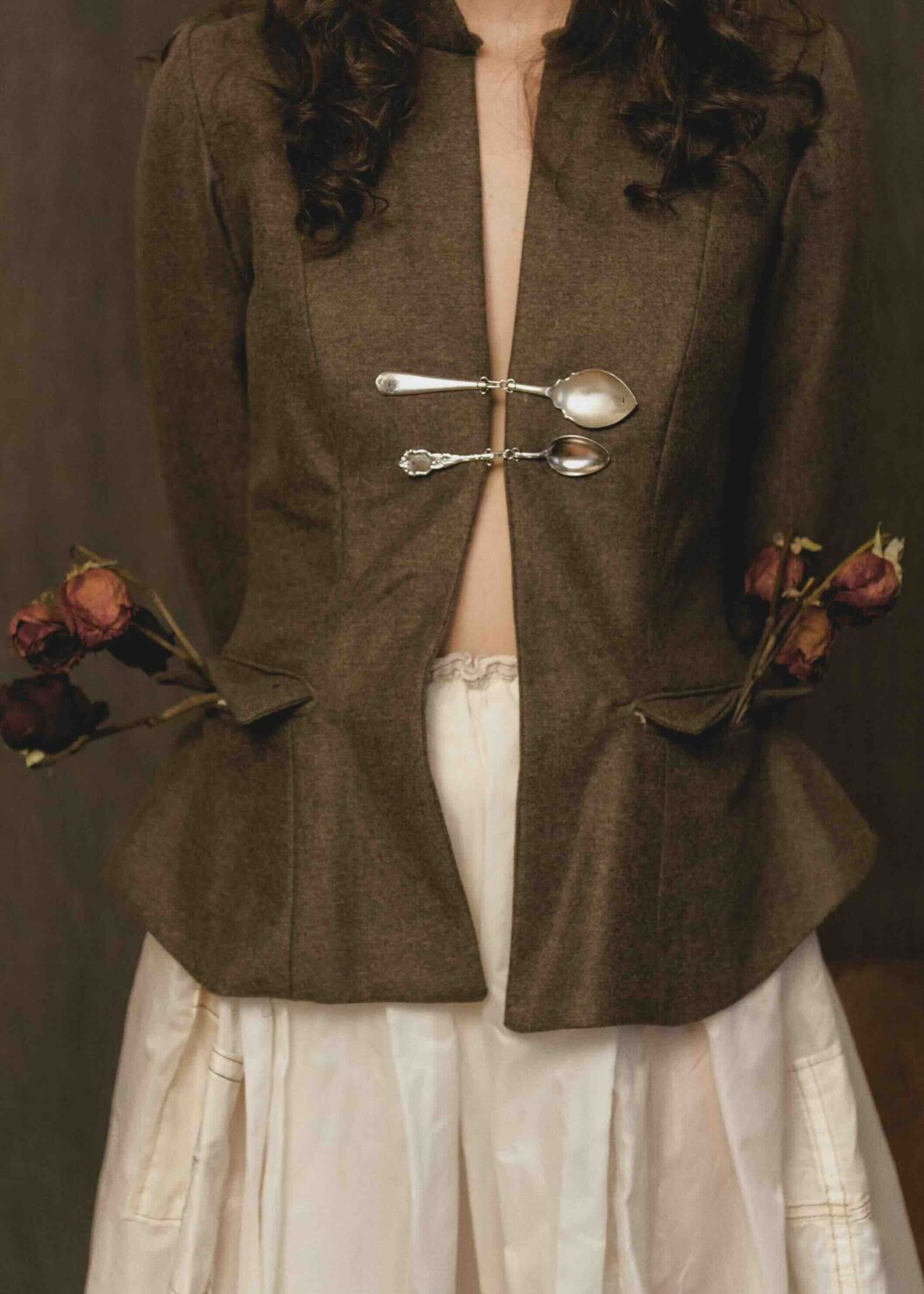
That distinction matters. In Sacksner’s hands, the parachute is not a sentimental reference. It is a material that already carries history, violence, rescue, survival, and reinvention. When she repurposed old war parachutes in Tools of Survival, she was not making a general statement about sustainability. She was working with objects that already had emotional and historical gravity. The same is true of the secondhand items she incorporated, including spoons tied to her grandmother’s story. These were not neutral materials. Their prior use was part of the design logic.
“I wanted the materials to speak before the garment was even fully understood,” Sacksner says. “They already held a kind of evidence.”
That is what makes the collection stronger than a concept piece built around symbolism alone. It uses design to think through adaptation. It asks what happens when necessity becomes form. It also insists that repurposing can be more than a responsible gesture. It can be a method for carrying history forward without flattening it. In a fashion landscape where the language of sustainability can sometimes become vague or cosmetic, Sacksner’s work feels more exact. She is not using old material because it sounds virtuous. She is using it because the material is part of the meaning.
That level of rigor connects to the way she was trained. Before committing fully to fashion design, Sacksner studied interior design while making clothes on the side. That early education sharpened her understanding of function and form, and it gave her a stronger sense of how utility and structure can shape a final object. When she later pursued a bachelor’s degree in fashion design, she brought that way of thinking with her. The result is work that does not separate construction from concept.
“Interior design taught me to think carefully about use, structure, and spatial relationships,” she says. “When I moved into fashion, I carried that with me. It made me more aware of how every element has to support the whole.”
That awareness also explains why she talks so much about intention. Sacksner says one of the most important lessons she has learned is that every decision inside a design has to serve a clear purpose. It is easy to overcomplicate an idea. It is harder to refine it until every choice feels necessary. For her, editing is not secondary to creation. It is one of the most important parts of the process.
“Learning to refine is just as important as learning to make,” she says. “You have to know when something is adding depth and when it is just adding noise.”
That mindset puts her slightly at odds with parts of the industry, and she knows it. Fashion can reward momentum, trend fluency, and immediate visual impact. Sacksner has had to learn how to trust her own perspective in that environment, especially as someone who is detail-oriented and naturally exacting. She describes that balance as one of her biggest challenges.
“There is always pressure to think about what is expected or what feels marketable,” she says. “I had to get more confident in the idea that a distinct point of view matters, and that it is worth protecting.”
That confidence now reads clearly in her work. What sets Sacksner apart is not just technical skill or personal narrative on their own. It is the fact that she can bring technical knowledge, emotional depth, and conceptual structure into the same garment without losing clarity. Her collections are meant to evoke thought as much as visual interest. They are meant to ask something of the viewer.
“I do not want fashion to stop at looking beautiful,” she says. “I want it to hold a question, a memory, or a larger idea that stays with someone.”
That is also where her future direction becomes most compelling. Sacksner is interested in building a brand where each collection is driven by strong narrative and technical rigor. She wants to create work that challenges the current industry, not by rejecting fashion, but by asking more of it. In her view, fashion can operate as a serious design medium for education, research, and thought, not just product. That ambition gives her work a different kind of seriousness.
“I want to keep building collections that make people think beyond the surface,” she says. “That is where the work feels most honest to me.”
Tools of Survival makes that ambition visible. It shows a designer who understands that garments can carry more than trend, and that materials can do more than decorate the body. Rachel Sacksner is building fashion through function, memory, and resistance to disposability. That makes her work harder to reduce, which is exactly the point.
For more information about Rachel Sacksner, visit her Instagram.