
 Jon Stojan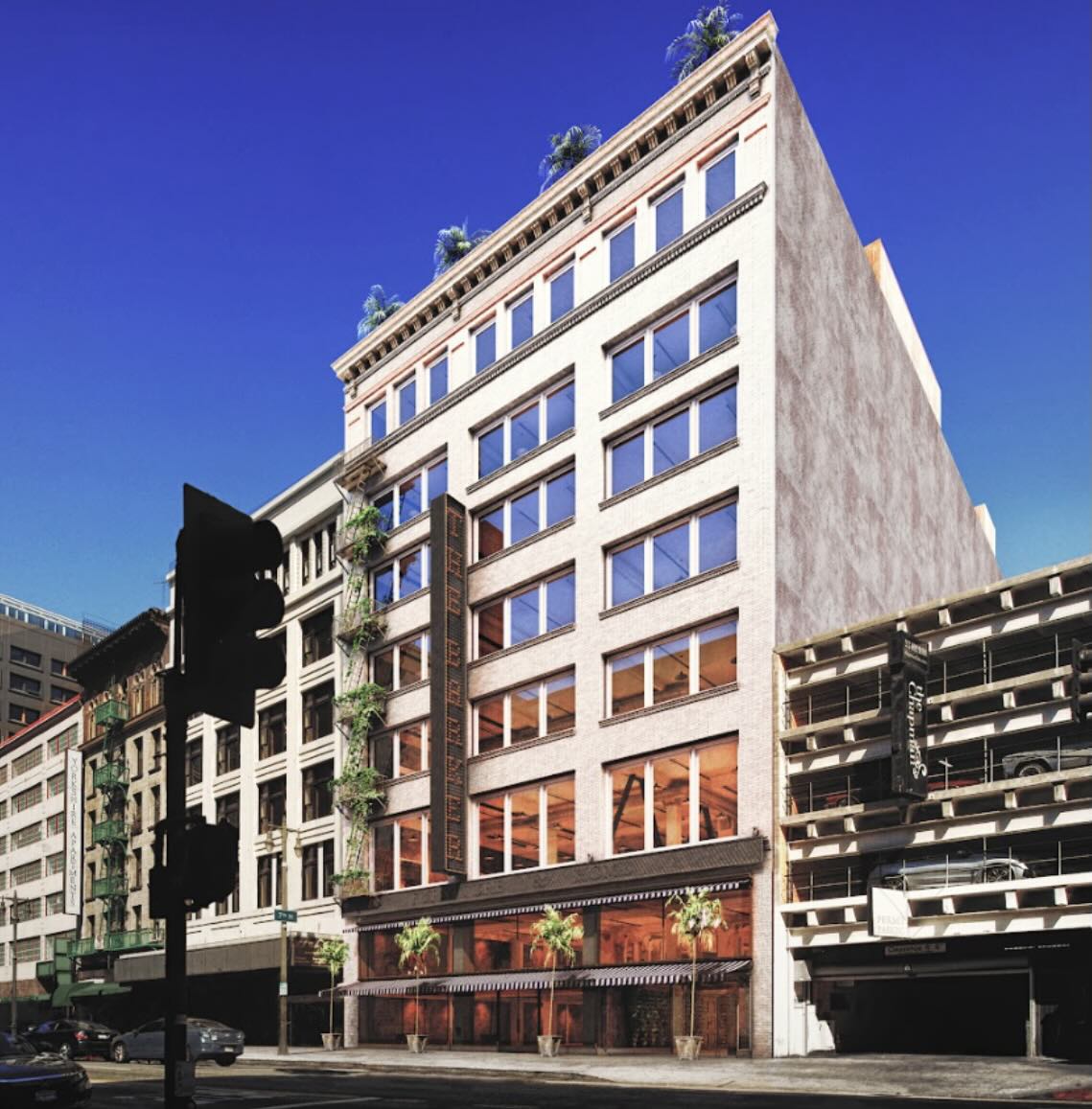
Polygoniq, a technology startup based in Prague, specializes in 3D graphics. It develops extensive asset libraries featuring trees, cars, and materials and works on visualizations for clients across various industries. Utilizing tools like Blender, Adobe Photoshop, and Unreal Engine, the company boasts a proficient coding team that excels in automation.
Polygoniq’s most interesting and complex project is the Barker Broadway building in Downtown Los Angeles. 722 South Broadway was originally constructed in 1909 by Clara Burdette. It served as a retail and warehouse space for the Barker Brothers furniture company and was marketed as California’s largest popular-priced furniture store. Acquired by Sätila Studios in 2016, it’s now being thoughtfully repaired and upgraded, with the goal of maintaining its original essence.
The restoration aims to celebrate the building’s history while making it an “urban sanctuary for visionaries and innovators.” Sätila Studios acknowledges that there’s a lack of environments that nurture people’s well-being and inspire them. Hence, it has made it its mission to develop the nine-story building as a village and cultural center for creative and innovative minds, offering them quality food, facilities, and workspaces for various industries and experiences. Adam was tasked to create a digital twin and VR experience for the Beaux-arts-style building to model everything in Blender and bring it into Unreal Engine.
The collaboration between Polygoniq and Sätila Studios has a compelling backstory. It started in 2016, with Ted Grebelius, Sätila Studios’ co-founder and a Swedish entrepreneur, meeting Adam Preisler, who, at the time, was a 3D artist at AsymmetricA Ltd in London. The former showed his dedication to his vision by spending hours in the office, immersing himself in the creation of his buildings’ 3D model, and collaborating with Adam to make it a reality.

Ted developed an interest in VR technology in 2015 after he and his brothers received the HTC Vive from their father. This exposure prompted him to explore Unreal Engine and see the potential of VR in designing their buildings. His vision was to design and experience buildings in VR and feel the space’s dimensions and ambiance in a way that static images could never convey.
After acquiring the Barker building, Ted sought Adam’s specific expertise with Unreal Engine and modeling. Initially, the project focused on creating a basic model to visualize the building’s dimensions without emphasizing materiality. The early version was essentially white and featured only rudimentary materials. Ted shared his initial SketchUp model, which served as the foundation. From there, Adam enhanced it, adding details and making continuous improvements. They adjusted ceiling heights and other elements, refining the model iteratively until it achieved a more realistic and detailed representation.
During this project, Adam primarily used Blender for 3D modeling, concentrating on the building’s materials, lighting, and other visual elements. Ted was actively involved, discussing details like door placements and bathroom designs. This collaborative process allowed for continuous iterative refinement. At first, their focus wasn’t on preparing the models for Unreal Engine but on refining the design in Blender. They reviewed the progress periodically, and once Ted was satisfied with the model’s state, they created an Unreal Engine file for walk-through and real-time visualization. This process was challenging and required Adam to address numerous technical issues and ensure that every detail was accurately represented in the virtual environment.
Adam also provided standard archive images, as one view or perspective is highly effective for visualizing projects. 3D rendering ensures accurate representation of materials, textures, geometry, and lighting, resulting in a cohesive vision for clients. This level of detail is crucial for Ted, a client with extensive reconstruction plans for a multimillion-dollar building. “Ted is deeply invested in the project’s outcome,” Adam shares. “He values the visualization process to ensure that the project goes smoothly. He has a perfect reference for the final design and ensures it aligns perfectly with his vision.”
Ted was insistent that Adam needed to experience the Barker Broadway building for accurate modeling personally, so he flew him to Los Angeles. Adam then captured over 100 photos of each floor, from the overall structure to the exact texture of the brick walls. This meticulous approach ensured that the digital model reflected the actual building measurements precisely as Ted envisioned. Having completed the initial model dimensions, Adam was flown out a second time to refine and add detail to the entire model, including the wellness center, the terrace on the roof, and the Barker signage on the front of the building.

Their collaboration continued even a year later after Adam moved back to Prague. In 2018, he established Polygoniq with co-founders Martin Preisler (Adam’s brother) and Jan Vopička. Fast forward to 2024, Ted and Adam rejoined forces to complete the wellness center and restaurant. Since then, Blender has become incredibly fast, allowing real-time rendering in the viewport, making Unreal Engine no longer a necessity.
Besides speed and efficiency, Blender’s open-source nature allows seamless sharing and collaboration. Moreover, it’s completely free, so clients can open their project and see it themselves.
“Our aim for clients who order visualizations from us is for them to truly feel the space and not just see it,” says Adam. “This level of immersion can only be achieved if the image is realistic enough. When all elements—size, material, reflections, color, light, perspective, and composition—align perfectly, the client can make well-informed decisions because they’re almost seeing what the outcome will look like. After all, if any aspect of the visualization is incorrect, it can lead to misguided decisions.”
Adam describes the Barker Broadway project as a trial by fire. It was the first major project he spearheaded using Unreal Engine, and it represented one of his most challenging undertakings in the field. This experience, filled with trials and errors, tested his skills and demonstrated the dedication and innovation required to bring such a vision to life.