

 Falling James
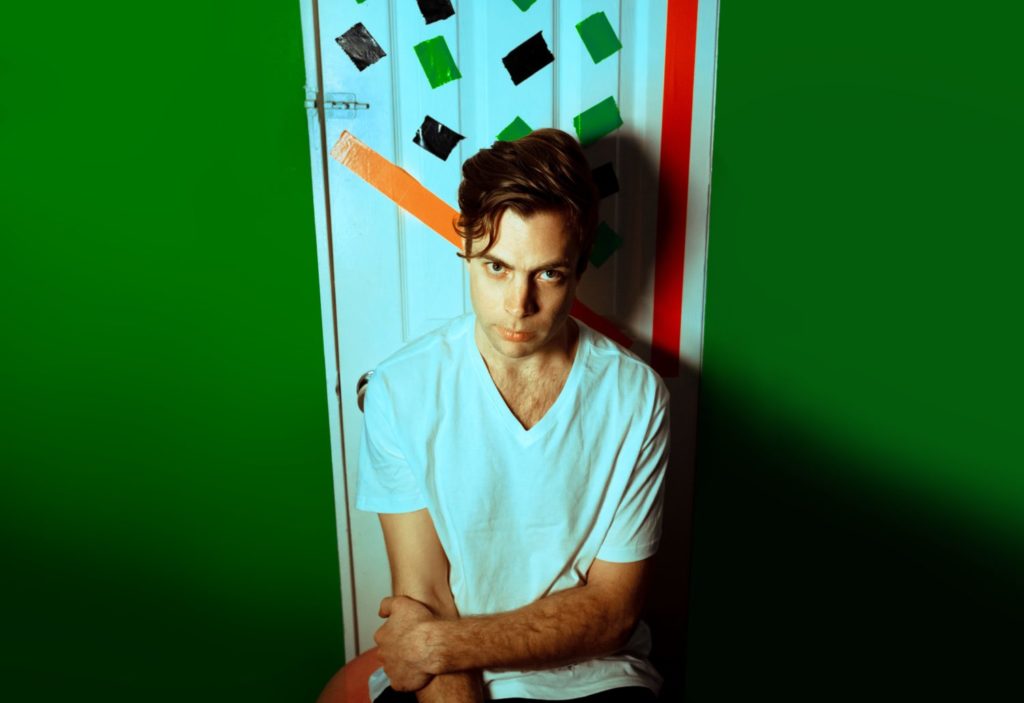
There are guitar heroes, and there are guitar heroes. If you consider technical prowess alone, Alexander Noice is one of this city’s flashiest guitarists. But it’s what Noice chooses to do with his impressive technique that elevates his original music beyond mere mechanical derring-do into something far more artistic and provocative.
Mashing together unexpected combinations of new music, electronica, punk, prog rock, jazz and pure pop, the Highland Park guitarist’s new album, Noice (Orenda Records), is a major contender for local album of the year. Its madcap whirlwind of frenetic angelic/robotic voices, propulsive funk rhythms, jazz-bent saxophone and spiraling galaxies of intricate guitar patterns is beyond breathtaking — there’s no one else even attempting this kind of daring and bracing music.
Noice is freakier and more modern minded than vintage prog or even free jazz, and yet it’s also rooted in a relentless melodicism and dance-music rhythms that emphasize emotional heft and artistic ambition more than musical athleticism. Noice and his eponymous five-piece band of heavy hitters demonstrate the dynamic range of their debut album at a record-release show at Bootleg Theater on Sunday, September 8.
It doesn’t take long for Noice to get fully trippy. Just seconds after the group’s dual singers —Argenta Walther and Karina Kallas — begin telegraphing their birdlike voices in unison like urgent town criers on the opening song, “Affectation,” the rest of the band drop in, launching a nonstop, swirling merry-go-round of sound. Gavin Templeton’s alto saxophone sends out loopy distress signals as drummer/sampler Andrew Lessman and bassist Colin Burgess lay down a contrastingly earthbound foundation. The vocalists’ lines become increasingly demented even as everything is linked together with bandleader Noice’s fluttering, shimmering shards of electric-guitar light.
“Black Darwin” might be even stranger. In Bennet Cerf’s video, a stone-faced Noice stares impassively at his hand as if he were looking at a cellphone. Life goes on around him in a blur — a woman puts on her makeup, a man shaves, people go swimming, his smiling friends gather for dinner and a party — but Noice remains oblivious to it all, transfixed by his own hand.
“In that song, I have a broad lyrical content questioning our evolution with current technologies and a consumptive mindset,” Noice, 33, says in a phone interview. “We’re naturally a socially integrated species, but we’re conditioned to be very obsessed with the individual.”
Eventually in Cerf’s video, everybody stops interacting with one another and stares at their hands or covers their eyes until they are wrapped up in long, slinky black cables that are connected to an ominous white tower. Noice describes it as “a somewhat dystopian pairing of imagery.” The video includes a cameo by local singer Ihui Cherise Wu, who performs with Noice in her band Polartropica. The music, meanwhile, juxtaposes operatic vocals and insistently beeping electronics with Burgess’ nimble, driving bass and Lessman’s unusual drum accents while Noice makes his radiant guitar riffs sound like keyboards, including a ’60s-style garage-rock/horror-film organ.
The rest of the record ranges from the offbeat space-age euphoria of “Ambit,” which is tattooed with Noice’s icily fine pinpricks of guitar, to “Never Thought I Would,” in which Walther’s and Kallas’ arty vocals sail over funky interludes and grungy hard-rock collisions. “I had re-watched 2001: A Space Odyssey,” Noice says about the genesis of “Ambit.” “Similar to ‘Black Darwin,’ it’s about the relationship with technology. It refers to a spherical thing — eyes — but also … the literal orbiting of a planet. There’s also a circular motion that happens with the good stages of your life.”

“Noice” album cover (courtesy of the artist)
The album culminates with “On the Fondalack,” a seven-minute incantation that progresses from Kallas’ and Walther’s tremulous, sotto-voce explorations, which are initially broken up with Lessman’s stop-and-start junkyard percussion and Templeton’s sax flurries, before the whole thing expands, getting both wider and weirder. What, exactly, is a Fondalack? “It’s a boat [USS Fond du Lac] that my dad was on at the tail end of World War II,” Noice says. “As a medic, he refused to carry a gun. How daunting it must have been for a 17-year-old to have to go to the gnarliest war of all time but not have a weapon and potentially save people.”
In his bio, the guitarist-composer describes his intent for Noice onstage as “acrobatic in its execution and cinematic in scope.” “I try to make the music evoke imagery,” he explains. “That’s part of the reason for the elaborate arrangements, to not have a literal narrative but to take you along in a story with music. I want to evoke certain color spectrums. … It’s not too dissimilar to an opera singer taking you on a journey instead of it being fed to you frame by frame. … It’s pretty episodic music but has a minimalist aspect, with constant layers that are staying intact while other parts are shifting.”
How does Noice reconcile his jazzy, improvisational tendencies — he’s worked with such forward-thinking musicians as Vinny Golia, Daniel Rosenboom, Dorian Wood and Billy Uomo — with the album’s dense, formal structure? “The arrangements are pretty set, but there are open sections,” says Noice, who wrote, arranged and produced the record. “Everything is through-composed, but then we have moments when we can open things up — a breath away from the intertwined arrangements. There’s a lot of tweaking in rehearsals. They’re all just amazing, talented musicians,” he adds about his group. “I can get away with quite a bit if it’s technically tricky.”
He notes that drummer Andrew Lessman, who also plays in Polatropica, is the band’s biggest multitasker. “He’s playing two people. He’s the seventh person [in the band] because he’s doing all these samples live,” Noice continues. “Vinny Golia also writes really difficult music. He knows the threshold of your ability — it pushes the edge of our capabilities and makes us learn his language better.”
Does he ever worry about pushing his singers too far with his intense vocal parts? “I’m pretty amazed with how much I’ve written and how they’re able to sing and sustain it,” Noice says. “You have to have moments when they can rest. There’s a few songs where it’s kind of an endurance [test].”
Noice was born in Kalispell, Montana, and raised there until his family relocated to Southern California when he was 11, which was around the time he first picked up the guitar. His family ended up living variously in Pasadena, Alhambra and Highland Park. “I initially got into rock,” he recalls. “Hendrix was the main one, which got me into the blues, especially Albert King and Buddy Guy.” The blues led him into jazz and the playing of such guitarists as Wes Montgomery, John McLaughlin and Grant Green, which in turn evolved into an appreciation for avant-garde musicians like Marc Ribot, Bill Frisell and Nels Cline. Noice also likes how Adrian Belew (especially with Talking Heads) and Robert Fripp made “it not sound like a guitar — I incorporate a lot of effects to have a wider color spectrum.”
As a songwriter, he says he’s influenced by the work of such classical and jazz composers as Louis Andriessen, Dmitri Shostakovich, Igor Stravinsky, Thelonious Monk, Wayne Shorter, György Ligeti and Steve Reich. “One of the biggest influences is Charles Mingus, who was drawing music from all of his influences,” Noice says. He also likes the work of avant-garde composers Meredith Monk and Joan La Barbara but says that when it came to the new album, “I dialed that back to bring in more of a pop sensibility. It has a classical lineage with moments that are influenced by Debbie Harry or whatever. … The first band I fell in love with was The Beatles — and their sophistication for having a place for every part.”
From the rock and underground-music world, Noice also cites Deerhoof, early Dirty Projectors, Can, James Chance & the Contortions, Talking Heads (particularly the Remain in Light era), Aphex Twin, The Stooges, early Brian Eno and especially David Bowie. “Odd pairings tend to spike my musical interest,” he says.
When Noice was a student at CalArts, he was taught by the late, renowned jazz bassist Charlie Haden. “I took a class with him. That was nerve wracking, and you’re just playing in front of him,” he says. “I did a few gigs with him when I went to CalArts and a few more after I got out of school. … The way he plays is like this soft pillow that makes you play more melodically. He wasn’t a very technical teacher, but he had these amazing stories that had these metaphorical meanings. It was a little bit otherworldly being in the same room with him.”
Noice revealed his unique style of playing and composing with the trio Falsetto Teeth, who played around the local scene from 2008 to 2013. “Falsetto Teeth was more my rock and punk influences, but it was in the back of my head to do a project with this particular instrumentation,” he says about his eventual decision to start Noice. “I wanted a larger band, and I wanted female vocalists. I was hearing multiple vocal harmonies and also a lot of interplay between horn and guitar.”
Does Noice have any special plans for the album-release show? “We’ll be having a particular lighting thing happening … and electronic interludes that will tie certain songs together,” he discloses. “And we have two opening bands that are great.”
Noice perform with Similar Fashion and Kidi Band at Bootleg Theater, 2220 Beverly Blvd., Westlake; Sun., Sept. 8, 8 p.m.; $10; ages 21 & over. (213) 389-3856, www.bootlegtheater.org.