
 Jon Stojan
Image credit: Gaspard Gabriel
The bass guitar has long been considered the unsung hero of the music world, often confined to providing the low-end foundation that supports a band’s sound. But for Gaspard Grenon, better known as Gaspard Gabriel, the bass is far more than just a rhythmic anchor—it is a lead instrument, a storyteller, and a vehicle for artistic expression. His upcoming album, The Awakening, set for release on February 14, 2025, challenges traditional notions of bass playing, seamlessly blending melody, harmony, and groove to create a rich, layered sonic experience.
Gaspard Gabriel’s musical journey began at the age of nine when his brother gifted him a guitar, but it was at twelve that he found his true voice in the bass. “I fell in love with the instrument, and I believe its role and register allowed me to find the foundation I needed to build myself as a person,” he reflects. His passion led him from the music scene of Paris to the academic rigor of Berklee College of Music in Boston, where he refined his craft and embraced a wide spectrum of genres, from jazz and funk to progressive and electronic music.
With The Awakening, Gaspard Gabriel has created an album that not only showcases his technical mastery but also redefines the bass’s role in composition. Composed, arranged, and produced during his time at Berklee, the album is an intricate fusion of influences, pushing the boundaries of what bass-driven music can be. As he steps into the spotlight with this project, Gaspard Gabriel invites listeners to experience the bass in an entirely new way—one where it takes center stage as both the heartbeat and the voice of the music.
Redefining the bass
Gaspard Gabriel’s journey with the bass began as a natural evolution from his early years playing guitar. Introduced to the instrument at 12, he immersed himself in transcribing bass legends like Flea, James Jamerson, Jaco Pastorius, and musicians from groups such as Jamiroquai and Tower of Power.
This deep dive into bass-driven music not only shaped his technique but also helped him establish a personal foundation. “The bass is a low and grounded instrument, and I think the reason I love it so much is no coincidence,” he reflects. His first major composition, XVII, written at 17, showcased his early exploration of chordal approaches, an influence that carried into his later work.
Rather than creating a traditional bass-focused album, Gaspard Gabriel sought to strike a balance between the instrument’s supportive role and its potential as a lead voice. “The Awakening is to me a musical accomplishment, where I found balance between being a supportive bassist and lifted as a lead player when I take a solo or play a melody line,” he explains.
Influenced by groundbreaking bassists like Anthony Jackson, Victor Wooten, John Patitucci, and Thundercat, he developed a style that embraces both rhythm and melody. Through his compositions, he reimagines the bass as an instrument capable of anchoring a song while also carrying the emotional weight of a lead performance.
A lifelong journey in music
Shaped by an insatiable curiosity, Gaspard Gabriel has absorbed and experimented with a wide range of genres, from jazz and funk to Brazilian and house music. Continuously refining his craft, he developed a unique approach to the bass that extends beyond traditional boundaries. “I am constantly re-centering around the foundational role of playing bass,” he explains.
While his early years were spent exploring chordal techniques, his current focus is on tone, timing, feel, and vocabulary—elements that allow him to communicate more clearly through his instrument.
The creative process behind The Awakening reflects this evolution, with the bass serving as both a structural foundation and a means of storytelling. “Because The Awakening is a solo project, I put more things into it like chords, melodies, counterpoint parts, etc. I composed everything on bass, so my creative process was pretty much clear when I started writing,” he imparts.
The album, developed over three years at Berklee, is deeply personal, inspired in part by a dream of traveling through Jupiter’s vibrant, shifting atmosphere. That vision became the inspiration for Big Cake!, a track that embodies his approach—rich with movement, layered textures, and unexpected turns. Every note in The Awakening is a reflection of his artistic growth, capturing both technical precision and emotional depth.
Layered soundscapes driven by bass
Approaching The Awakening as a carefully constructed sonic puzzle, Gaspard Gabriel layered textures and influences to create a dynamic and immersive listening experience. He enjoys crafting music that unfolds unpredictably, likening his process to assembling LEGOs, where each element fits together to build something greater than the sum of its parts.
“I like surprises, when suddenly something changes or goes up to somewhere else,” he explains. For him, the bass is not just a rhythmic foundation but a tool for storytelling, creating counterpoints that add both structure and emotional depth. “Everything sounds so dramatic on bass, even a major triad,” he notes, emphasizing how low frequencies have a scientifically proven ability to relieve stress and calm the nervous system.
Blending jazz, fusion, acid jazz, Afro, and 70s/80s Japanese music with soul and R&B, he was intentional about shaping The Awakening into a unique and personal project. “Having clear intentions regarding influences and how to blend them during the creative process creates new colors and unexpected results,” he says. This philosophy echoes Antoine Lavoisier’s famous idea that nothing is lost, nothing is created, everything is transformed.
Each song on the album evolves in sections, breaking down and rebuilding in unexpected ways, allowing space for the talented musicians on the record to shine. Through this layered approach, Gaspard Gabriel turns the bass into more than just an anchor—it becomes a driving force that shapes the entire musical landscape.
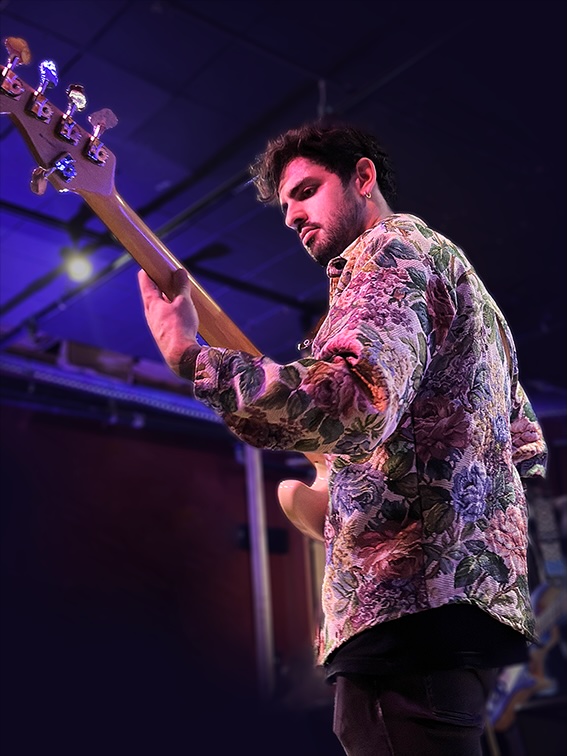
Image credit: Gaspard Gabriel
Breaking stereotypes: Bass as a lead instrument
For Gaspard Gabriel, the bass naturally holds a melodic presence rather than being limited to a supporting role. His approach to composition ensures that every instrument interacts harmoniously, allowing the bass to shine without overshadowing the overall musical balance. “I built everything around written bass lines to have a sense of harmony and synergy where all instruments sing along and respond to each other,” he explains.
Rather than focusing on changing listeners’ perceptions, his goal was simply to serve the music in the best way possible, trusting that a well-crafted bass line could stand as a melody in its own right.
This philosophy is most evident in the two bass suites, Princess Nyasaä and Secret Place, which showcase his abilities as a soloist while incorporating rich harmonies. “Both were composed for my girlfriend. I hope people will enjoy it,” he shares.
By emphasizing warmth in his bass tone and carefully placing other instruments in the mix, he created a unique atmosphere that highlights the depth and expressive power of the bass. Through this approach, Gaspard Gabriel presents the instrument not just as a rhythmic foundation but as a compelling voice within the musical conversation.
Learning from the greats
A diverse range of musical icons has shaped Gaspard Gabriel’s approach to the bass, each leaving a distinct imprint on his playing style. “I owe so much to Flea, Marcus Miller, Thundercat, and Jaco Pastorius,” he shares, crediting their innovative techniques and expressive playing for helping him refine his own voice on the instrument.
He has spent years studying their lines closely, developing a deep appreciation for groove, melody, and technical mastery. Francis Rocco Prestia from Tower of Power also had a profound impact on him, and even now, he continues to uncover new details in Prestia’s playing that push him to explore fresh ideas.
Beyond bass-heavy influences, Gaspard Gabriel draws inspiration from composers like Ryuichi Sakamoto, Joe Hisaishi, and Stravinsky, whose works challenge him to think outside traditional bass structures. “I love listening to music that’s completely unrelated to the modern electric bass and translating it onto the instrument,” he explains.
This cross-genre influence is evident in The Awakening, where jazz, funk, classical, and cinematic elements seamlessly intertwine. By absorbing such a wide spectrum of styles, he has cultivated a unique sound that blends technical precision with an instinctive, emotional approach to the bass.
Techniques and gear behind the album
Attention to tone and detail played a crucial role in shaping the sound of The Awakening for Gaspard Gabriel. Although he primarily plays 5-string basses for their extended range, he made a deliberate choice to keep all bass lines and chords on the main four strings for this album.
This decision allowed him to maintain clarity and balance in the mix while ensuring that each note carried the right weight. “When I mixed the album, I typically cut some of the low frequencies to maintain clarity in the chords and counterparts to leave space for the deeper bass lines,” he explains. With over 80 individual tracks per song, crafting a well-balanced mix was no small feat, requiring both technical precision and creative intuition.
Each of the four basses he used—a Fender Jazz Bass, Bacchus, Sire V7, and Capurso—brought its own distinct tonal character, adding depth and variation to the compositions. Working in Pro Tools, he relied on an array of plugins, including Hitsville EQ, the Avalon VT-737, Teletronix LA-2A, Soothe 2, Black Box, and the Manley Tube Preamp, to refine the final sound. Collaboration was also a key factor in achieving the album’s sonic depth.
“Many people helped me along the way, and I’m especially grateful to Tiger Okoshi for showing me how he writes and composes,” he says, acknowledging the legendary trumpeter’s influence. Mastering engineer Jonathan Wyner put the final touches on the album, bringing out the nuances in Gaspard Gabriel’s intricate arrangements. The result is a sound that is both polished and organic, allowing the bass to remain at the heart of the musical journey.
Bringing “The Awakening” to life
Gaspard Gabriel approached The Awakening with a clear vision, composing every piece before bringing in the musicians who would bring the songs to life. While most of the arrangements were already in place, he fine-tuned certain elements to ensure seamless interaction between the bass and drums.
“I did have to make a few adjustments to tighten things up, especially in how the bass and drums locked in,” he explains. His approach to bass playing goes beyond rhythm, incorporating melodic elements that enhance the overall harmony of the compositions. By weaving his lines into the melodies, he ensured that every instrument had space to shine while maintaining a cohesive sound.
The collaborative process proved to be a defining moment for the album. “I’ll never forget when we rehearsed Fly Away for the first time. I was beyond happy with the result,” he recalls. The chemistry between the musicians elevated the music beyond what he had initially envisioned, solidifying his confidence in both the material and the players. Featuring an impressive lineup, including Akihiro Kokufukata and Joey Du Bois on trumpet, Coy Simmons on alto saxophone, Hana Uwai, Paul Vanier, and Arman Wali on piano, Angelo Della Valle on guitar, and Willem Jochems on drums, the album became a true collective effort.
Having worked with these musicians on multiple projects, Gaspard Gabriel knew they would bring something special to the recording, making The Awakening a testament to both his artistry and the power of collaboration.

Image credit: Gaspard Gabriel
A message to bassists
Gaspard Gabriel hopes that The Awakening resonates with musicians, particularly bass players, by offering fresh ideas and inspiration. For him, the album is not just a showcase of technical ability but a testament to the evolving role of the bass in modern music. “If The Awakening can create a connection to the greats who’ve influenced me, that would be an incredible gift,” he says.
While the electric bass has increasingly stepped into the spotlight as a lead instrument, he remains committed to its fundamental role—providing the depth and foundation that holds a band together. He acknowledges the challenge many bassists face in balancing groove with expressive playing, admitting, “I’m also guilty of the post-Jaco Pastorius syndrome.”
In crafting the album, Gaspard Gabriel sought to strike that balance, blending solid bass lines, intricate grooves, and melodic, chordal elements. “Virtuosity is great but with a nine-piece band, I had to make important artistic decisions,” he explains. His goal was to create a cohesive and dynamic listening experience where the bass enhances rather than dominates the music.
Whether players take inspiration from his harmonic approach, rhythmic precision, or compositional style, he hopes they walk away with a deeper appreciation for the instrument’s possibilities.
Gaspard Gabriel’s forthcoming album, The Awakening, set to release on February 14, 2025, showcases his innovative approach to the bass guitar and solidifies his position as a leading bassist of his generation. Gaspard Gabriel’s unique ability to blend fundamental grooves with intricate melodies redefines the bass guitar’s traditional role, transforming it into a dynamic and expressive lead instrument.
His music draws inspiration from a wide range of influences, resulting in a sound that is uniquely his own, seamlessly merging technical precision with emotional depth. The Awakening is more than just an album; it is a testament to the bass guitar’s evolving role in music and an invitation for listeners and musicians to explore new creative possibilities. With this release, Gaspard Gabriel pays homage to the legacy of influential bassists while paving the way for a new era of bass-driven composition.