
 Jon Stojan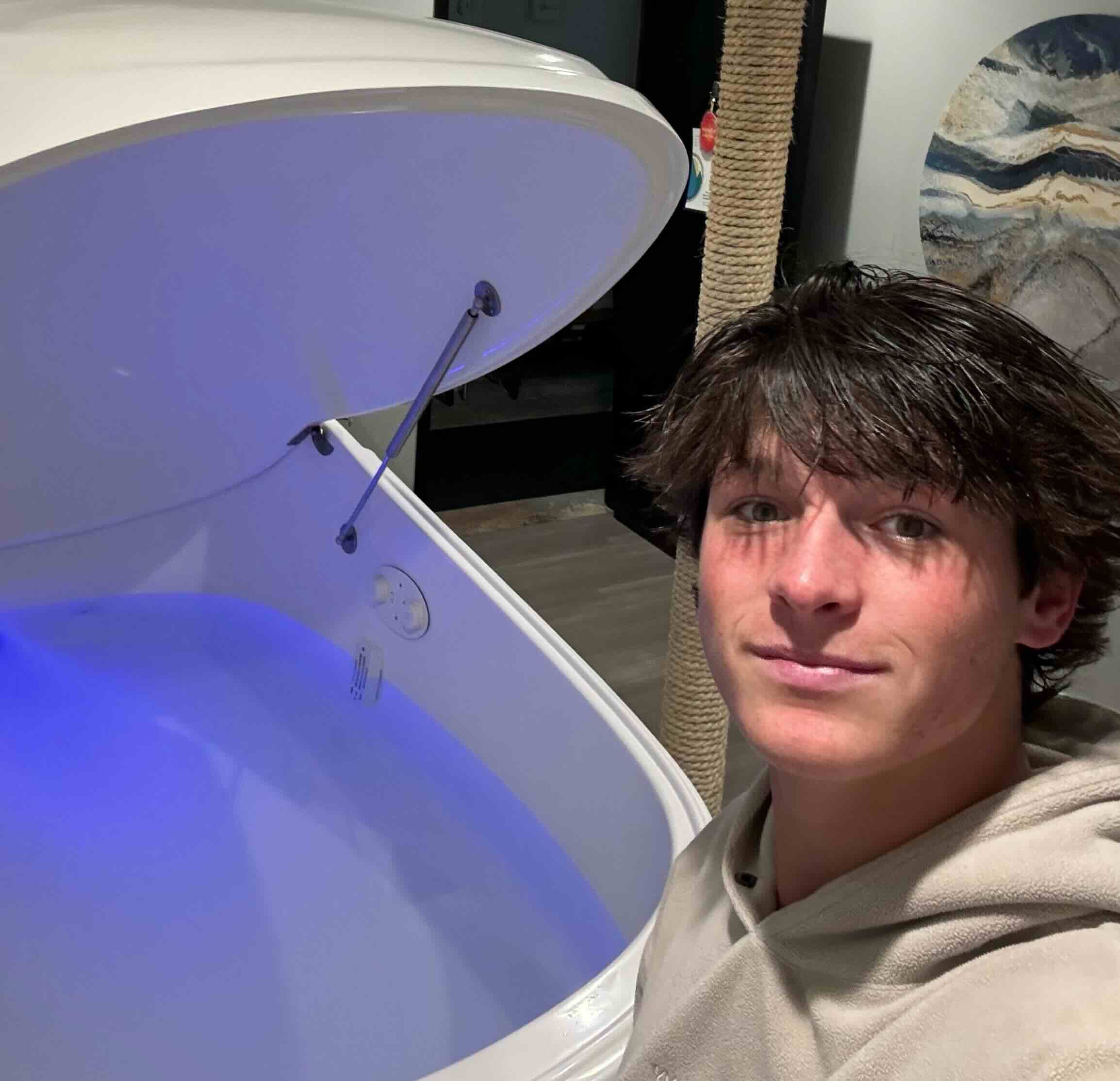
Image credit: Ryan Tuttle
My name is Ryan Tuttle and I’m a college-bound 19-year-old from Thomasville, North Carolina taking a gap year. I’ve lived all my life with anxiety, dyslexia, and ADHD.
This year, I began a quest to bio-hack my brain with innovative and affordable interventions instead of meds.
After copious research, I decided to try sensory-deprivation tanks; cryotherapy; high-intensity interval training; and meditation to try to help my mood/anxiety; focus; academics; and sleep. The goal: try to float/freeze/sweat/breathe away my anxiety, dyslexia, and ADHD—or at least ease how much these brain-quirks impact my life.
*
Float (~$50/float – less with membership)
A float-tank is an egg-shaped pod about the size of a mini-cooper holding a foot of exactly skin-temperature water, plus over a thousand pounds of Epsom salt.
Immediately upon entry: unexpected peace. The saltwater feels barely-there, and the completely dark and insulated pod mutes the outside world. My mind and body are instantly, almost magically, calm. Science says just a single hour floating can reduce anxiety and boost mood, and that regular floating can actually change the way your body responds to stress, decreasing cortisol and making you more resistant to the stress-storm of everyday life. That tracks. Leaving a float, I feel totally shielded from the storm and sleep like a grizzly bear.
Floating also increases focus. It may even support “super-learning” since deep-relaxation promotes mental clarity, which is why US Navy SEALs use float tanks for warp-speed language-learning—good news for my dyslexia!
Conclusions? Floating works for me and hard science supports that. I’ve now woven-in weekly floats, seeing lasting benefits in my brain-functioning and overall well-being.
Freeze (~$45/session)
Just three minutes in a cryochamber filled with nitrogen gas cooled to -230° Fahrenheit can boost mood, sleep quality, and cognitive performance, and reduce depression/anxiety.
A cryochamber looks like a freezer and feels like one, too—except colder. I go for max-intensity: 3.5 minutes. It’s a different, almost surreal kind of cold—like being buried head-deep in perfectly dry, super-cooled snow.
Cryotherapy boosts noreprenepherine in the bloodstream (a neurotransmitter linked to alertness, memory retrieval, focus, and mood), so after 90-seconds, I feel like sunshine. This super-mood lasts hours. At night, sleep is way easier thanks to some combo of pain relief, better-regulated circadian rhythms, and an intensified rest-and-digest reflex. Science also says cryo can help your brain work, and can improve ADHD, specifically, which I didn’t notice immediately, but I may over time.
Conclusions? If you’re brave, and seeking a mood-boost, better sleep, and maybe even a brain-boost, cryotherapy is calling.
Sweat (FREE)
Almost every morning, I find a quiet park and walk for one minute; then sprint for another minute. I repeat 10 times. It’s grueling. Music helps. I close with a cool-down jog.
If you’re looking for an instant mood and focus enhancement, anxiety relief, and you’re not afraid to sweat or burn, HIIT is the way to go. I’m also sleeping like a champion—consistent with a recent meta-analysis on HIIT and sleep—and my brain feels sharper post-workout, tracking the science which supports the benefits of HITT for ADHD specifically. Finally, I’ve improved my cardiovascular fitness faster than ever since incorporating HITT into my daily regimen.
Conclusions? If you’re willing to dig deep, regular HIIT is a powerful biohack for mood, focus, and fitness.
Breathe (FREE)
Because I have an ADHD brain that’s always running a hundred miles-a-minute, meditation has sounded impossible. But transcendental meditation (TM) is actually super-simple: Find a word and repeat it over and over in your head for fifteen minutes. That’s it.
By the end of my first TM session, I am relaxed, but it’s not other-worldly like after a float, and I don’t get any of the feel-good flood that follows HIIT or cryotherapy.
Conclusions? Over time, I’m sure meditation could be useful when it comes to my mood/anxiety, focus, performance, and sleep. Science says so. I just didn’t see any immediate returns, and I’d rather spend my weekly biohacking time chilling in a float tank, freezing in a cryochamber, or running intervals to quiet my mind.
*
Seems like I’m finding out that I can float/freeze/sweat/breathe away my anxiety, dyslexia and ADHD—not completely, but meaningfully. So, you can too. Just keep an open mind, and listen to your body—powerfully, you can work together to evolve into a calmer, more focused, and higher-performing you.