
 Angelica Burlaza
Photo Courtesy of Fanyun Peng
On a December afternoon in New York City, in a museum more often linked with speculative futures than ancestral ghosts, a small crowd watched the air fill with data. Motion-capture rigs traced the arc of a dancer’s arm; sensors listened for shifts in breath and weight; projected light reflected on the walls like an oncoming storm. At the center stood multimedia artist Fanyun Peng, walking the line between ritual and code. Rain Rite, the work she presented and spoke about at the CICA Museum’s Art in Action event in New York, had first been performed earlier that year, in June, at a studio in Brooklyn. What she shared at Art in Action was not a live reprise but an in-depth presentation of the project’s process and conceptual framework; an exploration of how bodies, histories, and algorithms might coexist on the same stage.
The December 20, 2025, event was billed as an international platform for experimental and process-driven contemporary art, a venue where artists share their methodologies as much as their finished pieces. Instead of offering a polished performance, Fanyun dissected her process, revealing how embodied movement, Chinese ritual traditions, and interactive systems can be woven into a living framework rather than a fixed spectacle. The question hovering in the room was not whether the technology worked, but whether it could bear the weight of cultural memory without reducing it to mere effect.
Fanyun’s response unfolded in fragments of gesture and code. She invoked Nuo, an ancient Chinese ritual tradition, as an open protocol rather than a mere museum artifact, a set of embodied instructions that could be translated and extended into contemporary media. She asked the audience to imagine rain not as a visual effect, but as a choreography of attention passing through a collective, with each body acting as both a sensor and a transmitter. By the end, Rain Rite felt less like a single project and more like a case study in how the language of interaction design might be rewritten to accommodate history, spirit, and shared experience.
From Ritual To System
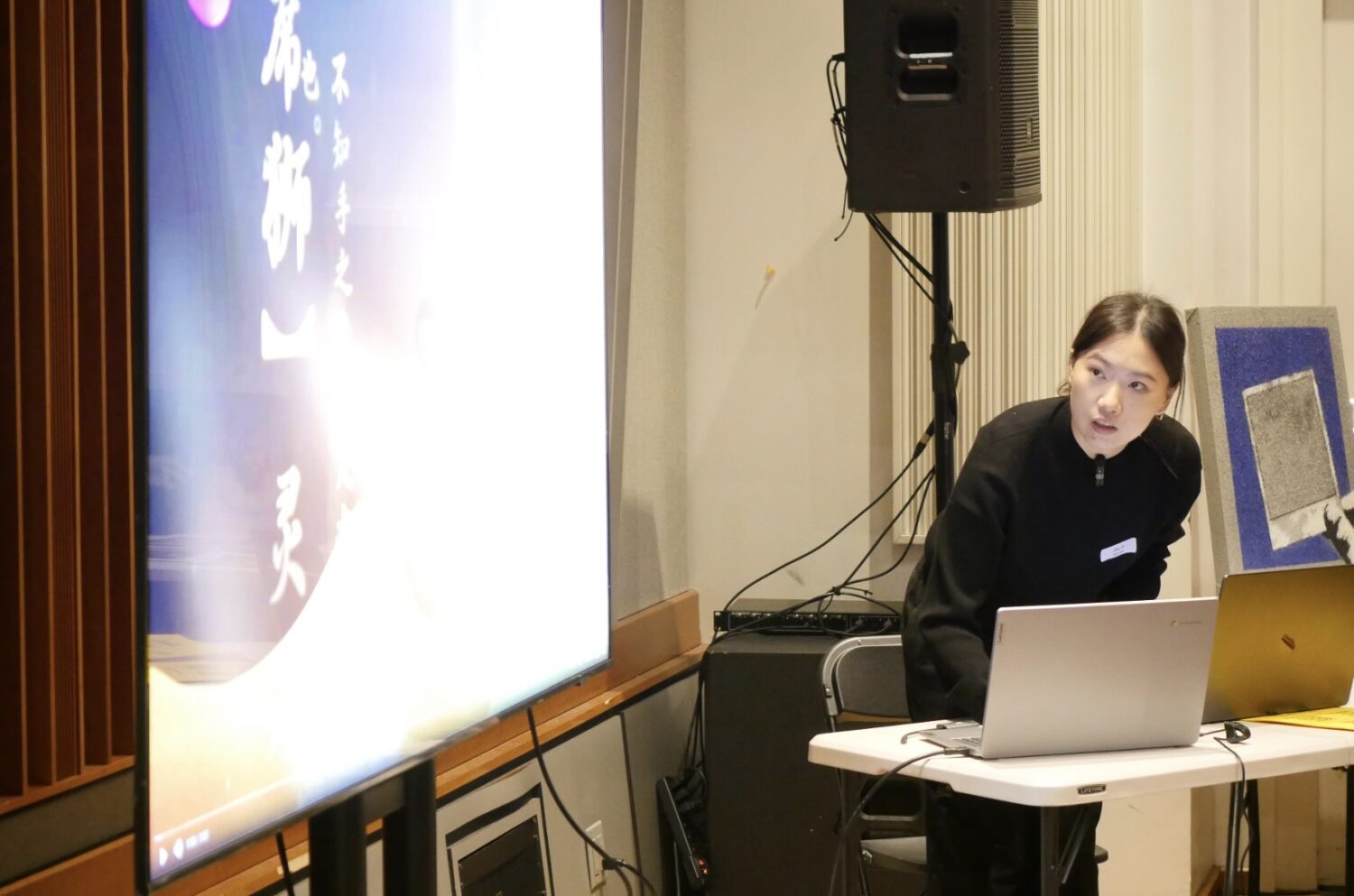
Photo Courtesy of Fanyun Peng
Fanyun’s path into this hybrid territory began in computer labs and design studios. Trained in computer science at Sichuan University and later in design and technology at Parsons School of Design, she built her early career as a creative technologist, developing interactive installations, AR prototypes, and immersive environments for brands, cultural institutions, and education-focused enterprises. Those years yielded pop-up planetariums, responsive exhibition experiences, and experimental industry-backed projects, each refining her sense of how human bodies negotiate space, interface, and power.
Fanyun’s commercial work often invited audiences to “play” with systems—wave at a screen, step into a responsive field, and trigger visual feedback. In Rain Rite, those prompts are reconfigured through the lens of ritual. Drawing on research into Nuo practices that use movement, masks, and sound to mediate between worlds, she treats each gesture as both input and invocation, asking how digital systems might be tuned to recognize not just motion but intention.
During her Art in Action presentation, Fanyun framed ritual as a living structure rather than a static heritage reference. Sensors and motion capture were reconceptualized as tools for establishing a feedback loop between performers, environment, and audience response. Technology, she emphasized, functions as a responsive medium that supports emotional and cultural expression. The system listened for shifts in tempo and proximity, “deciding” when to amplify sound, alter projections, or soften the visual field, always oriented toward the bodies it was designed to serve.
Rain Rite’s collaborative nature underscored this stance. The earlier Brooklyn performance brought together visual artist Melody Hu, 3D and motion capture specialist Xinyao Wang, and sound designer and composer Chad Xu. Instead of operating in isolated departments, the team iterated in overlapping cycles, adjusting lighting cues to accommodate movement phrases, rewriting musical motifs to echo ceremonial rhythms, and retuning thresholds so performers could move with intuitive confidence rather than technical caution.
That very process mirrored the improvisational nature of ritual itself. Traditions survive by responding to new circumstances; systems that cannot adapt become dead code. By exposing her workflow in a public forum, Fanyun made visible a kind of ethnographic engineering, embedding cultural research not only in references and documentation but in the thresholds, parameters, and latencies that govern how a system behaves.
Industry At An Inflection Point
Behind the intimacy of the CICA-affiliated presentation lies a broader shift in the experiential industry. Over the past decade, brands, museums, and public institutions have embraced immersive technologies, chasing engagement metrics with VR, projection mapping, and sensor-based installations. Multimedia artists like Fanyun have helped build that landscape, crafting experiences for campaigns and exhibitions that treat public space as a temporary theater.
The Art in Action event emerged as a counterweight. Instead of centering polished deliverables, the series foregrounds research, methodology, and evolving practice. That orientation reflects a growing recognition that interactive media is now a primary site where cultural representation, surveillance, and embodiment are negotiated. For practitioners who straddle commercial and independent work, it raises pressing questions: What does it mean to use the same toolkits for both ritual and retail? Who benefits when bodies become inputs?
Fanyun addressed this tension directly. Situated both within and adjacent to the experience economy, she described a quiet reckoning spreading through the field. “Everyone talks about immersion,” she noted, “but rarely about what people are actually immersing into.”
In one of the evening’s highlights, she offered an unsparing observation. “There is a little secret in our industry,” she said. “Most large-scale interactive campaigns quietly log how you move, where you hesitate, how long you look, and that behavioral data is later fed into optimization models. But almost no one tells the audience this is happening, because the experience is framed as pure play.” After a pause, she added, “Rain Rite is partly my way of asking: What if we treated movement as something sacred instead of something to be monetized?”
That remark cast the work in sharper relief, highlighting how the same infrastructures that enable poetic, ritual-informed experiences also power sophisticated surveillance regimes. By centering a piece that refuses to log or monetize participant movement, Fanyun positions herself and her collaborators within an emerging countercurrent that insists on aligning experiential innovation with ethical constraints.
Toward Experiential Ethics
The implications extend beyond one museum event. As institutions and brands look ahead, they confront an audience more skeptical and better informed about data practices, and more attuned to questions of appropriation and authenticity. The CICA Museum’s role as a hub for contemporary art that embraces interactive work places it at the center of these debates, drawing artists who are determined not just to deploy new tools but to interrogate them. Rain Rite’s inclusion in the event suggests that the most consequential developments are occurring at the intersection of technology, ethics, and tradition.
Fanyun’s practice hints at a blueprint for this next phase. Her background in UX engineering and front-end development has trained her to think in terms of flows, friction, and user testing; those sensibilities now inform how she choreographs the audience experience in performance contexts. When she speaks of ritual as “a way of structuring time, attention, and relationship,” she is also describing system architecture.
As the audience drifted out of the Art in Action space, projections fading and equipment powering down, the questions Rain Rite raised lingered. Attendees debated whether ritual could survive translation into sensor-laden environments and whether museums should disclose more about how interactive systems operate. Fanyun seemed less interested in mere closure than in keeping those questions active.
“Ritual,” she remarked to a small group, “has always been a kind of technology. What is new is not that we use tools, but that our tools now remember us. The challenge is deciding what we want them to remember, and what we are willing to let go.” In a field racing to capture every trace of human movement, Rain Rite’s refusal to turn embodied presence into data reads like a modest, insistent counterspell. On the international stage that CICA and Art in Action provide, that refusal may be its most enduring innovation.