

 Kalyn Corrigan
“I need to be scared of something,” Steven Soderbergh tells me as we sit down to discuss his new film, Presence. “Every movie that I have worked on, there’s gotta be a pocket of fear about some aspect of it. There’s gotta be something that really gives you the night sweats, or else you’re kind of directing from the back of the limousine. It could be a conceptual thing. It could be the schedule. It could be any number of things — but if there isn’t something about it that scares me, it means I’ve probably either done it before, or it just feels like it’s not very challenging.” In terms of his latest project, a ghost story shot from the point of view of a housebound spirit, the filmmaker heeded the call to action upon realizing that his go-to method of operating the camera himself would actually demand the embodiment of the entity. In a rare event, the director almost becomes part of the cast, as he is, in a way, the very presence itself.
In the film, a family moves into a new suburban home but soon becomes convinced that they are not alone. Captured in a first-person POV style, the specter gains an unusual attachment to Chloe (Callina Liang), a teenage girl who’s still reeling from the recent loss of a friend, much to the chagrin of her mother Rebekah (Lucy Liu) and her brother Tyler (Eddy Maday). Chloe seeks solace in her father Chris’s (Chris Sullivan) company, but as time goes on, it seems as though the wraith haunting their halls feels compelled to do something, and that unlocking that specific purpose could be the key to releasing the apparition from the shackles that bind its being to this mortal coil.

Steven Soderbergh during the Opening Ceremony of Sitges Film Festival on Oct. 3, 2024 in Sitges, Spain. (Borja B. Hojas/Getty Images)
“It’s actually a drama that has a ghost in it,” Soderbergh specifies. “It was generated by something that happened in our house in Los Feliz. We had a house sitter while we were gone, taking care of the cats, and she saw somebody in the house while she was there. We were aware that a woman had passed in the house before we bought it, but when we did a little more diligence on the story, it got more intriguing in the sense that there was some controversy around the circumstances of this woman’s death.” While the filmmaker admits that he himself has yet to feel anything otherworldly in his home, he talks about how this very personal experience inspired him to gain a fresh perspective. “This did get me thinking what it would be like if I were that woman, and I was still hanging around, and some new people showed up to live in what I considered to be my house.”
Making a camera emote when the viewer is denied a subject’s face to reckon with presents its own set of unique challenges, but an Academy Award-winning director like Soderbergh is nothing if not motivated by the impossible. “If you’re making a movie or project in which you are rigorously in a single POV, there’s a danger of creating a sense of frustration on the part of the audience because they’re not seeing a reverse,” he explains. “Seeing a reverse is a very primal desire on the part of the audience. They really want to look into the eyes of the character that is experiencing the story to see the emotion of that character. It was my hope and my belief that the instant that you understood that this was not a person that exists in the world like we exist, that you would switch off that desire and that impulse to want to see a reverse angle, because you would know there’s nothing to cut to.”
In order to make the audience understand that they are seeing this story play out through the eyes of the presence, Soderbergh had to unlearn everything he knew as a director. Denying the artist within, he did his best to follow his cast around with his lens like he was just another subject standing in the room, as opposed to framing up shots like a filmmaker. “It was the thing that ruined the most takes,” Soderbergh laughs. “This is what I made the most mistakes trying to achieve, which is not anticipating when somebody was gonna move. There had to be just the right amount of lag time in my reaction to make it seem as though I didn’t know what was going to happen. My natural instincts as a camera operator are going in the other direction, which is to anticipate and have the perfect composition all the time. That took me a while to let go of.”

Still from “Presence” (Peter Andrews/The Spectral Spirit Company)
Even more demanding than the need to interpret scenes in a new light was the actual operation of the camera, for which Soderbergh had to maneuver himself up and down some seriously steep stairs as quickly and quietly as possible while a camera blocked his field of vision.
“I was just very anxious that I was going to have an accident on the stairs,” says the filmmaker, who goes on to describe the “ballet shoes” he wore with rubber grips on the bottom; a look that became part of the uniform for Soderbergh on this project in the name of safety, agility, and of course, a silent soundtrack. “That was a new thing,” he remembers, “Some of the lengthier takes got challenging because the camera itself — the Sony A7, not a big camera, and the Ronin stabilizer, one of their smallest stabilizers — the whole thing weighed ten, twelve pounds, which is not a lot, unless you’re trying to hold it out from your body for like seven minutes. Then, it starts to get a little tricky, and your arms start to shake.”
Faced with an unusual problem, Soderbergh developed a highly stylized visual approach that is so overtly subjective, it actually makes the viewer forget that there’s a director behind the camera. Instead, it focuses their attention on watching the events of the story unfold onscreen, just like the entity observing the scene.
“In order for the shaking not to become too extreme, and too obvious to the viewer, I had to come up with ways to keep the camera moving just a little bit all the time, so that my body didn’t go just completely rigid,” he remembers, “And so, I had to justify in my mind that the presence would be wanting to alter its position based on what it was trying to understand, from what it was looking at. That was one of the reasons we tried to shoot in chronological order as much as possible because I wanted you to see it learning as the story went on. I felt that the only way to do that was to shoot in sequence so that I would be learning at the same time.”
Adds Soderbergh, “Directors get performance anxiety, too. I mean, some of these takes, especially the penultimate scene in the film, which goes on for almost ten minutes, when I would get to minute eight, minute nine, I would start to shake, and I was worried that I was going to ruin a perfectly good take, and these performances that were really intimate and sensitive. By that criteria, I got a blood pressure spike or two.”

Still from “Presence” (Peter Andrews/The Spectral Spirit Company)
Based on the heavy subject material, many fans assume that Soderbergh’s hardest film to shoot was Traffic, but the filmmaker reveals that from a logistical standpoint, the more challenging project to capture actually turned out to be Ocean’s Eleven. Regarding where he would place Presence on that same scale of difficulty, he says, “I wouldn’t rate it high on a conceptual level in terms of figuring out how to do it. The box that you’re in is pretty specific, and pretty small in terms of the tool kit. You’re only allowed to do one thing, really, so the conceptual part was in blocking and rehearsing the scenes, and deciding where I wanted to be over the course of the shoot — and that stuff’s fun to figure out.”
As a filmmaker whose portfolio boasts a grand affinity for ensemble staging, in many ways Presence represents the magnum opus of everything Soderbergh has been building toward in his career so far.
“I think a movie should work without any sound,” the director muses. “That is not to denigrate sound, but I do believe you should be able to watch a movie silent and understand it. That, to me, is the essence of what staging is, and editing.” By blocking his characters like actors in a stage play, the director hopes to convey plot points that are as easy to follow as illustrations in a picture book. “In this case, something that I thought about a lot was, if you couldn’t hear what they were saying, and I wanted you to understand what was happening in the scene, in the relationship between these two characters, how would I express that visually?”
The director believes in this method of filmmaking so much that he actually used what little spare time he had to re-cut Steven Spielberg’s classic action-adventure film Raiders of the Lost Ark. Soderbergh’s cut can be found on his website in black and white with the sound stripped away and Trent Reznor and Atticus Ross’s score for The Social Network added in, all to demonstrate how proper staging can tell a story even without an aural crutch.
“Often as an exercise, when I’m working on a project, at a certain point in the editing, where I feel like we’re getting close to this thing becoming what it wants to be, I will watch it without the sound to see if it’s still playing the way that I think it should play. That’s been a very good exercise for me. And invariably, I end up going back and making certain editorial adjustments that I feel will make it work silent.”
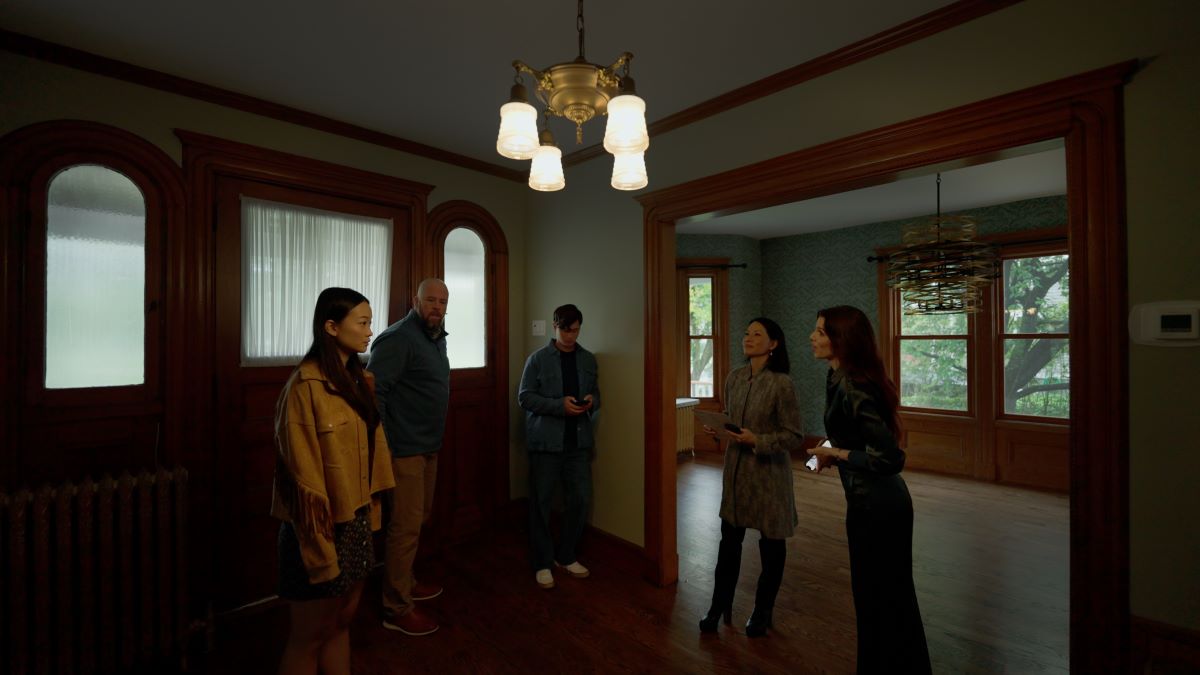
Still from “Presence” (Peter Andrews/The Spectral Spirit Company)
Leaning so heavily on visuals, especially when it comes to a single-location thriller about a family living through a haunting, means placing a great deal of trust in the cast. “Well, you better hope that you have actors that aren’t trying to win the scene, but understand that we all have to submit to what the story wants us to do,” he states boldly. “I’ve been lucky. I don’t feel like I’ve ever had to deal with an actor who was so focused on themselves and what they wanted to do in the scene, that it was distorting the creative ecosystem of the process and the piece itself. If you ask [George] Clooney about the Oceans movies, he would go, ‘Well, that was the easiest job in the world. All I did was hand scenes over to other people.’ And he was right, but he’s smart.”
Luckily, Soderbergh found a motley crew of juggernauts to aid him in his quest to demonstrate a new kind of campfire tale. “Lucy [Liu] is one of those people that’s been on my mental list for a long time,” notes the filmmaker. “She was such a treat. She’s so skilled and understands all of it, and has a great sense of humor, and brings a really positive energy to the set. For a director, she’s a real dream.” One scene in particular, when the family finds themselves posting up on the back porch after a frightening paranormal event pushes them out of their home, truly highlights the power of the ensemble that casting agent Carmen Cuba pulled together.
“One of my favorite scenes is after the presence has ripped the son’s room apart and they’re arguing on the back porch,” recalls Soderbergh. “The rhythm of that is a testament to David [Koepp]’s writing, but also, to their performances. There’s a lot of dialogue, and it has to come at a certain pace, and people are overlapping, and they have to use their intuitive sense of how that should feel. Unlike a lot of other scenes, I was locked, just staring at them. They didn’t have a lot of places they could go either, because they were in this frame, just looking into the house. So, in that case, I’m just really relying on their ability to hear how this should sound. And they were just all over it. They really understood it immediately. I thought, oh, we’re going to be here a while. This could take a few. And it didn’t. They just got it, and that’s fun. That’s exciting.”
An early pioneer of independent cinema, Soderbergh’s Palme d’Or winning directorial debut Sex, Lies, and Videotape cemented the multifaceted visionary early on as a movie making machine who dons many hats. To this day, the filmmaker still edits all of his own work, and in fact holds the role in such high regard that he proudly states how cutting his pictures together still remains his favorite part of the process. That’s why when he sees a film being poorly spliced, he tends to take it a little personally.

Still from “Presence” (Peter Andrews/The Spectral Spirit Company)
“I want to feel intention in everything,” he says, “I want there to be a reason for every shot and every cut. When I see cutting that I feel isn’t purposeful and is insecure, I get frustrated, because the power of the editing is so enormous. I never tire of it. I’m not going to say it was the thing about filmmaking that I understood first, but it was the first thing that I felt the tractor beam pulling me in. The editing is the reward for all of the effort that went into shooting. If I were to stop, it would be the thing I would miss the most.”
In Presence, every scene is a single take. Although the lengths of each sequence vary, the overall effect gives the audience a sense of unpredictable voyeurism that for certain individuals, can be surprisingly quite intense. Some viewers have found the experience to be so physical, that they actually had to leave the theater.
“I fully admit that part of what I hope is compelling about this film is that you feel like you’re seeing something that you’re not supposed to be seeing,” the director discloses. “The [audience] can’t look away. I mean, that sounds stupid in a sense, like, oh, yeah, they’re always looking at the screen. But when you edit, when you cut to something else, that’s a version of the audience looking away. What we saw at this first screening at Sundance last year, in that next-to-last scene, was people becoming very disturbed by the fact that they couldn’t look away, that the conceit of the film left them nowhere to go, and nowhere to look, except at what was happening in the center of the screen. Given what was happening, there were people that walked out — which I totally understand.”
Known for pushing the envelope in cinema, it’s no surprise that his latest endeavor is ruffling a few feathers. Director Soderbergh is endlessly curious. That’s his superpower. That’s why he’s always trying to invent new ways to film a scene. It’s not that he’s necessarily always trying to make a statement, he just possesses this childlike wonder at all of the possibilities in this medium of storytelling, and he’s excited to see which choice leads where. It’s what makes him one of our best living filmmakers, and it’s the type of ingenuity that elevates Presence as a one-of-a-kind ghost story in a sea of wannabe standouts. Plain and simple, making movies is hard. Directing brilliant blockbusters that stand the test of time is harder. Still, Soderbergh sees it as the best job in the world. “It’s like standing in the exhaust of a jet engine, but at the same time, when it reveals itself to you and you know what to do, your brain kind of lights up like a Christmas tree.” He continues, “So, I don’t know. I was just lucky that I found a thing that I was obsessed with early, and had supportive people around me.”
“Presence” will be released in theaters January 24.
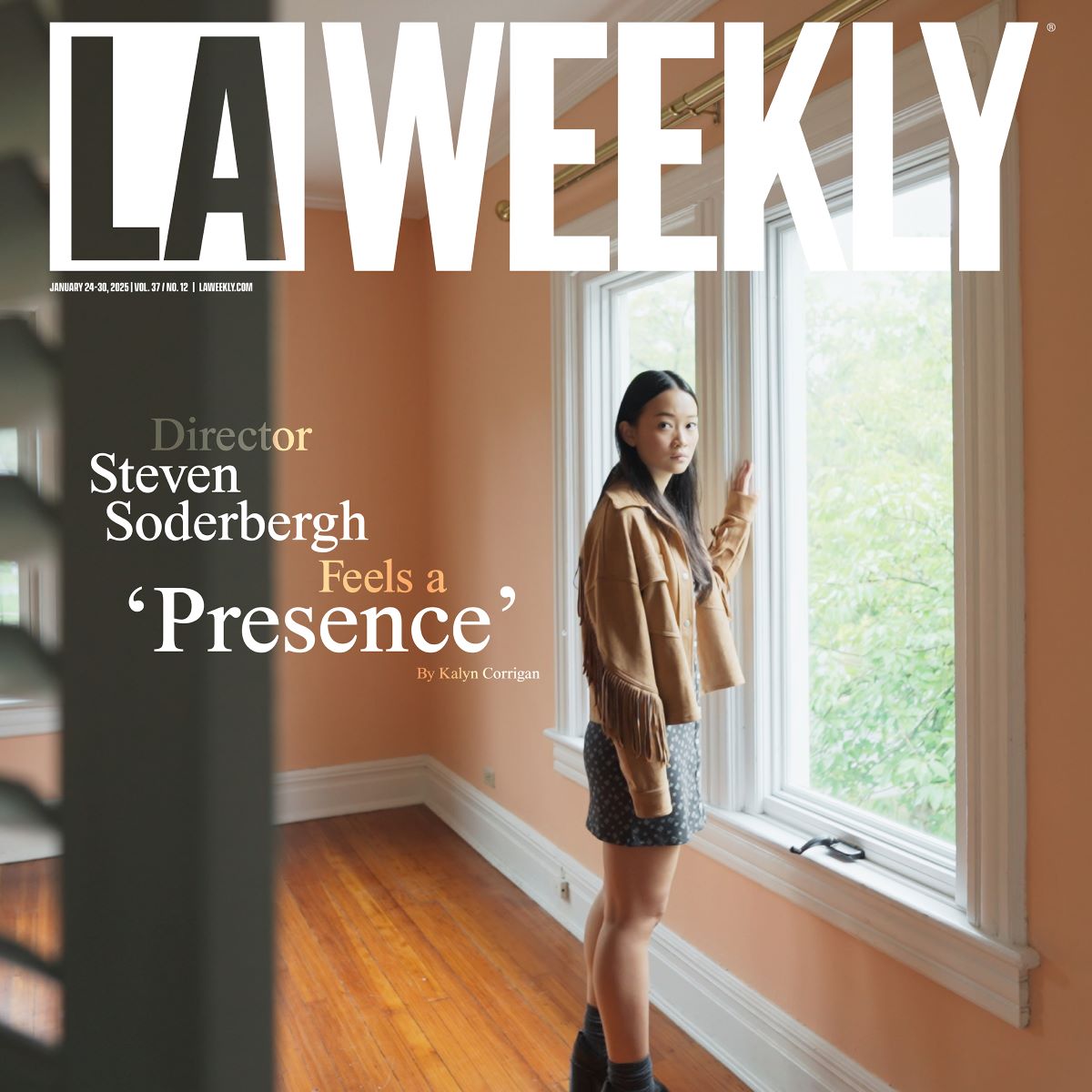
The Jan. 24, 2025 cover of LA Weekly. (Photo: Peter Andrews/The Spectral Spirit Company; Cover design: Jewel Baek)