
 Miguel La Torre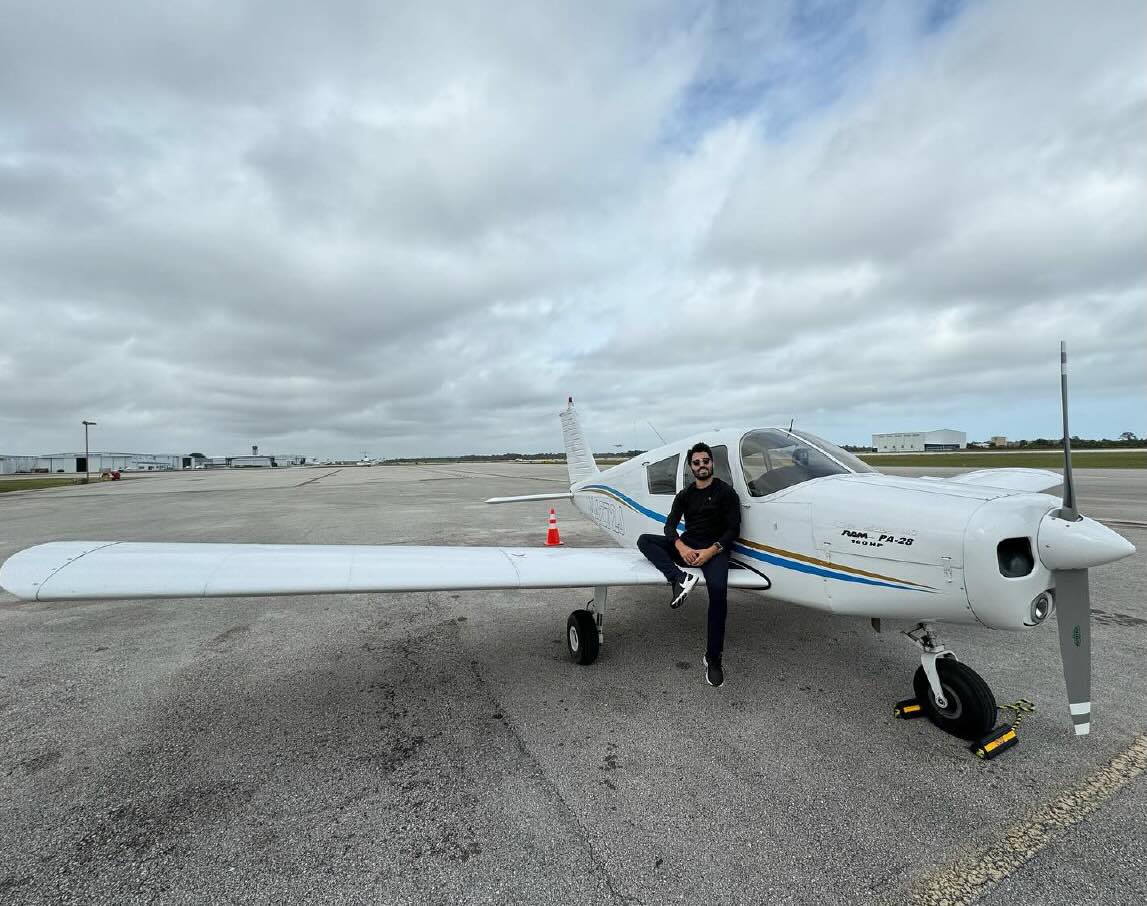
Photo courtesy of Nicolas Novoa Medina
“Every minute in the air is experience, responsibility, and liability — if you cannot prove it precisely, it almost doesn’t exist,” said Nicolas Novoa Medina, a Miami‑based chief pilot, instructor, and entrepreneur who has built his career around aviation’s quiet accountability problem. In an era when regulators and operators increasingly expect data-driven proof of competence, he argues that the humble pilot logbook is no longer a clerical relic, but a frontline safety instrument that must fully transition into the digital age.
Novoa Medina, who leads flight instruction as chief pilot at Skywagon Corporation and flies as a corporate pilot for Executive Air Services out of Opa‑locka Executive Airport, embodies a hybrid profile: active professional pilot, seasoned instructor, and founder of Nicologbook, a digital flight log designed for students, airline pilots, and instructors. His project resides within a fast-growing niche; the broader logbook software market across industries was valued at approximately $1.2 billion in 2022 and is projected to reach roughly $2.5 billion by 2030 as organizations migrate from paper to cloud-based systems.
From global training to cockpit data
Novoa Medina’s path into this space reflects a global education as much as technical ambition. He completed his high school studies in France and Colombia before earning a bachelor’s degree in international business administration and a Master of Science in Aeronautics, combining management training with the technical expertise of professional flying. Alongside these academic credentials, he obtained advanced pilot ratings, including Certified Flight Instructor and Airline Transport Pilot licenses, and began building a career in flight instruction.
Language has also been part of his toolkit: fluent in English, Spanish, French, and Portuguese, he has trained and flown with pilots shaped by different regulatory regimes and instructional cultures. “You see how the same flight hour can be recorded in four different ways depending on the country,” he said. “That fragmentation is a risk when careers, insurance, and safety depend on those numbers.”
Nicologbook and self‑calculating records
Nicologbook grew directly out of that instructional experience rather than from a software incubator. In a 2020 presentation, Novoa Medina described it as “the tool you need to keep your paper logbook digitally,” emphasizing that the platform performs calculations automatically so pilots no longer have to total columns by hand or cross‑reference scattered entries. The design enables users to customize aircraft, airports, and categories while maintaining a structure that aligns with regulatory expectations.
A central feature is the way Nicologbook organizes flight and ground instruction time to align with the Integrated Airman Certification and Rating Application (IACRA), the Federal Aviation Administration’s digital system for pilot certification. Instead of leaving future applicants to reconstruct hours for each requirement, the logbook accumulates those categories in real time, reducing the risk of miscalculations when pilots present evidence for check rides or ratings.
“The logbook should work for the pilot, not the other way around,” he said. “Once the core flight data is entered, the system ought to handle totals, currency, and the specific categories inspectors actually review.” That perspective aligns with a broader market shift toward cloud-based logbook software, which analysts expect to continue growing steadilythrough 2030 as mobile access, artificial intelligence, and integrated analytics transform static records into usable operational data.
Instructional excellence and communication reform
Novoa Medina’s authority in this domain rests partly on his record as an instructor. In May 2022, he received the Federal Aviation Administration’s Gold Seal designation for Certified Flight Instructors, awarded to instructors who hold advanced or instrument ground credentials and maintain high first‑attempt pass rates among students they recommend. The standard requires that at least ten applicants be endorsed within 24 months and that at least 80% pass on the first attempt; in this case, the pass rate stands at 100%.

That performance has informed both software development and pedagogy. “When all your students pass on their first attempt, you see clearly where they struggle and where systems fail them,” he said. “Confusion about records and about how to speak to air traffic control came up again and again.” To address the latter, he developed an “ATC Communications Guide,” a streamlined study aid that replaces the long, dense manuals that often leave students reciting phraseology without context.
Flight schools that adopted his communication approach, he reports, saw students shorten the path to their first solo from roughly three months to about two months, an efficiency he attributes to materials that map more directly onto real-world radio exchanges. “You cannot digitize muddled thinking,” he observed. “You first clarify what needs to be said and recorded, then you design tools that capture that clarity.”
A cautious embrace of digital logs
The broader aviation community has not uniformly embraced fully digital logbooks. Regulators in some jurisdictions, particularly under Europe’s FCL.050 framework, now certify digital pilot logbooks as official records, provided they meet strict standards for integrity, backup, and audit trails. Yet those same requirements fuel skepticism among instructors and pilots who worry about long‑term access, data migration, and dependence on proprietary platforms.
Novoa Medina accepts the caution but believes the trajectory is clear. “In a few years, applying for a rating with a handwritten log and a calculator will look as old‑fashioned as flying without GPS,” he said. “The real question is whether digital logbooks will be designed from the cockpit out or from the server room in.” For him, portability — across employers, borders, and aircraft types — is the defining test.
Toward 2030 and beyond
Analysts expect the ecosystem surrounding tools like Nicologbook to expand steadily through the end of the decade. One recent forecast projects the broader logbook software market on a path from approximately $1.2 billion in 2022 to $ 2.5 billion by 2030, driven by cloud adoption and demand for real-time collaboration and analytics. Separate research on electronic flight bags, which often integrate logbook functionality, projects global market values in the mid‑single‑digit billions by 2030, supported by commercial aviation growth and regulatory support for digital documentation.
For Novoa Medina, those numbers simply quantify a cultural shift that pilots already feel. “Behind every line in a logbook is a story — a lesson learned, a standard met, a risk managed,” he reflected. “If we can capture those stories more accurately and make them useful from the first student flight to the last check ride of a career, then we are not just changing how pilots keep records; we are changing how the profession remembers itself.”