
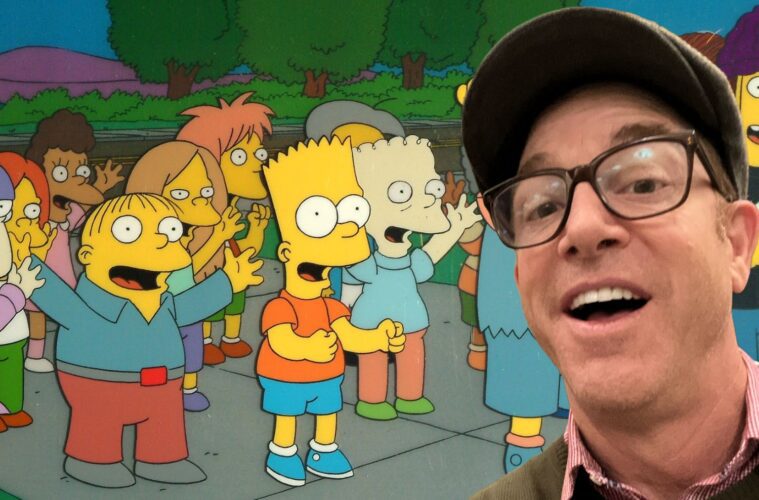
 Mark Stefanos
Brent Forrester boasts one of the most impressive pedigrees in TV, writing the cream of modern comedy. Born in Los Angeles, the Malibu surfer turned Columbia University grad scored his first Comedy Writing Emmy for “The Ben Stiller Show” at just 25. From there, he helped shape some of the most iconic sitcoms of the past three decades: penning classic “Simpsons” episodes like “Homerpalooza,” “Lemon of Troy,” and “Homer vs. Patty and Selma” during the show’s golden 90s era; served as head writer and executive producer of “King of the Hill”; was a writer, producer, and director on “The Office,” and wrote for “Mr. Show,” “Love,” “Space Force” and many more. He was also an intern at LA Weekly as a college undergrad.
He started teaching his renowned “Six Step System” for crafting killer scripts during the pandemic, available through his online TV Pilot and Joke Writing classes. (I’ve taken one, he’s excellent.)
But perhaps nothing has cemented Forrester’s place in pop-culture lore quite like those years on “The Simpsons.” The still-running animated juggernaut has earned a near-mythic reputation for “predicting” real-world events — everything from Donald Trump’s presidency (foreshadowed in the 2000 episode “Bart to the Future”) and the COVID-like pandemic vibes of “Marge in Chains” (1993), to Disney’s acquisition of Fox, smartwatches, video calling, and even curling gold medals at the Olympics. Whether it’s sharp satire hitting too close to home or the writers’ room simply having an eerily prescient finger on society’s pulse, the show’s track record has fans and skeptics alike marveling at its prophetic streak.

Brent Forrester at the Friars Club on September 10, 2007 in Beverly Hills. (Amanda Edwards/Getty Images)
This Saturday, Feb. 28, Forrester and fellow “Simpsons” writer Dan Greaney (who wrote “Bart to the Future”) will lead a panel, Simpsons Writers Predict the Future, at the Lyric Hyperion. The two will be joined by special guest “Simpsons” alumni Ian Maxtone-Graham, Dan Vebber, Jeff Martin, and Bill Oakley (appearing via video), to spill secrets from the legendary 90s writers’ room, dissect the show’s eerie foresight on politics and culture, and even venture bold new predictions about America’s future.
In the Q&A below, Forrester shares a bit of his origin story, some comedy writing gems, his take on how “Simpsons” writers were so prescient, and a fun anecdote about his time at LA Weekly:
What was your childhood like?
I spent my childhood in remote “West Malibu” near the LA/Ventura County line. There was nothing out there, no movie theaters, no malls, no internet in the 1970s, not even radio reception. And my Calvinistic New England mother would not allow TV in the house because she felt it “rotted the brain.” So my main form of entertainment was reading short stories. In eighth grade, I won 50 dollars in a short story contest and decided it was destiny to become a professional writer. It was only after I graduated college that I discovered there was zero money to be made in short story writing. At that point I pivoted to writing television “spec” scripts and trying to get a job in entertainment purely out of desperation.
Who are your comedy mentors?
I did not pursue a career in TV comedy because I was funny. No one ever said I was funny growing up. And it wasn’t a love of television, which I had never watched until after college graduation. But I happened to know one working TV comedy writer, the mother of a high school friend. Her name was Susan Harris, creator of “The Golden Girls.” She became my first mentor in comedy.
Susan is one of the greatest comedy dialogue writers of her generation, and she was kind enough to share with me the secret of her craft: “Write about what is difficult for you, even painful, and trust that it will come out funny.” It is still the most important insight into the art of comedy that I have ever gotten.
What was your first joke?
The first joke I ever got paid for was a monologue joke that I sold to “The Larry Sanders Show.” “During a spelling bee at an elementary school this week, Vice President Dan Quayle misspelled the word ‘potato.’ But he blames the White House staff who always give him the menu with the pictures and just let him point to what he wants.” I got 50 bucks for that.
What was your first job?
My first job as a staff writer was on a little-known sketch show on the fledgling Fox network called “The Ben Stiller Show.” The ratings were terrible, and the network executives hated the writing staff which was made up entirely of rebel comedians from the alt-comedy scene of late 90’s Los Angeles. The show was cancelled after 12 episodes, but was so original that we won the Emmy for best writing anyway. I was 25, had six months experience as a writer, and an Emmy.
With your background as a Malibu surfer dude, how has your LA upbringing influenced your writing?
I’m still influenced by my 1970s childhood where my role models were shaggy surfer dudes named “Buzz” and “Fro.” The counter-cultural vibe of that era made a permanent impression on me. The classic 70’s surfer was anti-materialist, anti-consumer, and above all anti-authoritarian. And so is comedy, which at its core is about mocking the powerful and defying the status quo.
What’s the best advice you’ve ever gotten about comedy?
When I was on “The Ben Stiller Show,” I met Judd Apatow, the self-taught comedy genius from Long Island. Decades later, when we were doing the indie-film-influenced comedy “Love” on Netflix, Judd kept urging me to make the scripts less jokey, to get comedy from what the characters were doing rather than saying. Suddenly he went to the wipe-off board in the writers’ room and wrote “Behavior over Banter” in giant red letters. It’s the key to his style and a priceless insight into comedy that I’ve never forgotten.

Forrester directing “The Office” (Chris Haston/NBCUniversal via Getty Images)
At “The Office” I worked for the brilliant Greg Daniels who influenced an entire generation of comedy writers on the countless shows he created (“King of the Hill” to “Parks and Rec,” “Space Force,” “Upload” and “The Paper.”) Greg taught me that you could alternate purely dramatic scenes with purely comic scenes to create a tone that was both sophisticated and unpredictable. He summed up his philosophy in a perfectly quotable axiom: “Comedy is a balance between the plausible and the absurd.”
“The Simpsons writers” have seemingly predicted the future a number of times — how were you so prescient?
When I was hired as a writer for “The Simpsons” in 1994, the staff was almost all white men from Harvard. As a white man from Columbia U., I was the diversity hire that year. Many of these writers were serious students of history, and I think that explains why “The Simpsons” predicted the future so effectively. People who are obsessed with the past are often obsessed with what’s to come. It’s also worth noting that we predicted a lot of things that did not come true, but those predictions don’t make it into the YouTube compilations.
Do you have a favorite “prediction” from your episodes?
In 1996, I wrote “Homerpalooza” in which the band Cypress Hill performs at a music festival with the London Symphony Orchestra. In 2024, Cypress Hill actually did perform with the London Symphony Orchestra at Albert Hall. Some have labeled this a psychic prediction. But I believe it was actually Cypress Hill getting high and saying “let’s make a cartoon come true.”
What do you get out of teaching comedy writing?
In “Man’s Search For Meaning,” the psychiatrist and holocaust survivor Viktor Frankl said the primary human drive is for purpose not pleasure. I think about that every time I teach a class. I get so much pleasure from writing comedy, but my sense of purpose comes from encouraging other writers and validating their belief in their own gifts. And I remember what it’s like to be a struggling artist, so my rule is I never charge more than a strip-mall Karate class.
You’ve written on some of the greatest TV comedies of all time — how do you feel about the future of comedy?
I’m really excited about it. When I came into the business, the goal was to “break in” and get hired on a show. Now every 14-year-old has a camera in their phone that’s better than the one Spielberg used to shoot Jaws, and YouTube gets more eyeballs than NBC. Any artist can make and platform their own material, and it’s resulting in a great democratization of the medium.
What do you remember from your time at LA Weekly?
When I was a college undergrad, I did a summer internship at the LA Weekly, answering the phone and summarizing the calls. One day, I got a call from an aspiring French cult leader named Rael, who claimed space aliens had chosen him to be the new Jesus. I wrote a mocking description of this goofy con-man, and to my delight, they published it in the paper. But my takedown was not entirely effective: Rael now has 130,000 devotees in 121 countries around the world.
Click here for tickets and information about the Simpsons Writers Predict the Future show at Lyric Hyperion. For Brent’s classes, visit brentforrester.com
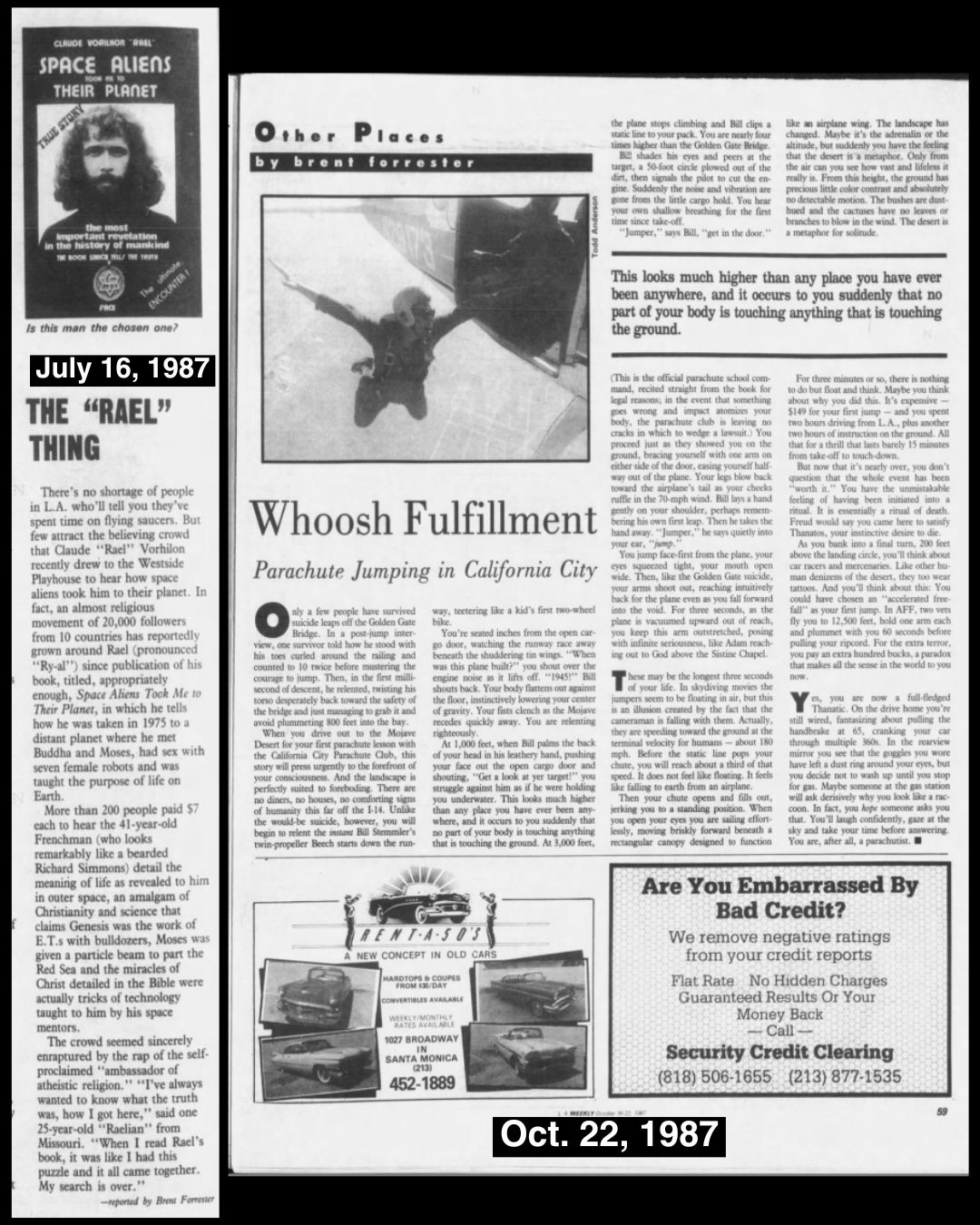
Forrester’s articles in LA Weekly, 1987 (LA Weekly archive, courtesy Randall Hinson, LA Public Library)