
 Will Jones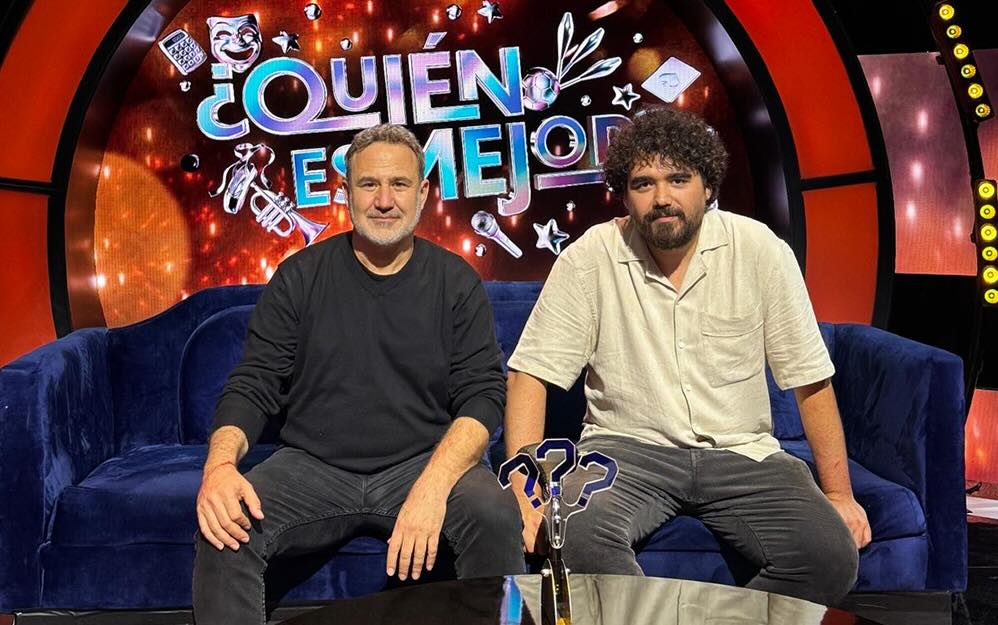
The TV producer and writer co-created ¿Quién es mejor?, a Sunday primetime show shaped for audiences in Mexico and the United States.
Sunday night television does not leave much room for uncertainty. The pace has to hold. The format has to make sense quickly. The audience has to feel the stakes without needing a manual. For Carlos N. Cerutti, co-creator and co-executive producer of TelevisaUnivision’s new talent competition format ¿Quién es mejor?, that pressure is exactly where original television becomes exciting.
“You cannot walk into Sunday primetime with half an idea,” Cerutti says. “The show has to move. It has to give people a reason to stay, and it has to feel like it belongs in that slot.”
¿Quién es mejor? premiered in Mexico on June 7 and is scheduled to arrive in the United States in August. Built as a Sunday night primetime show, the format gave Cerutti and the team a challenge that went beyond creating another competition series. They had to build a new original property for a major Spanish-speaking studio, then shape it for audiences across Mexico and the U.S.
For Cerutti, that is the kind of challenge worth taking on.
He has built a career across fiction and non-fiction television, moving between comedy, reality, documentary, and large-format entertainment. His recent work includes three original projects that went into production in the last two years: Mi Mundo, Carnada, and ¿Quién es mejor? The range matters because Cerutti does not see television as a narrow lane. He sees it as a living system of tone, rhythm, audience expectation, and production reality.
“I love having a comedy writer’s brain and a producer’s hustle,” he says. “One side of me is always looking for the human moment, the funny beat, the character. The other side is asking, how do we actually get this made?”
That balance became central to ¿Quién es mejor? In developing the show for TelevisaUnivision, Cerutti, together with co-creator Martin Halac, had to think about scale and accessibility at the same time. The format needed the energy of a major talent competition, but it also needed the immediacy of a panel environment and the reality appeal of contestants the audience could follow.
“The question was not only what the show is,” Cerutti says. “It was how the show should move. What is the pace? Where is the emotion? What keeps the audience leaning in before they even realize they are doing it?”
Cerutti’s support for original IP is direct. He understands why networks often lean toward adaptations or recognizable properties. Familiar material can look safer in a business built on expensive decisions. But he also sees that safety as partly imaginary. Every greenlight carries risk, whether a show comes from a known title or begins with a blank page.
“Recognizable brands can give people a false sense of security,” he says. “You are still taking a risk. So if risk is already part of the business, why not take it on something that can become its own world?”
That belief is not theoretical for him. ¿Quién es mejor? required the team to invent the rules rather than adapting them. That meant testing the shape of the show through the needs of the audience and the demands of the network. It also meant knowing when to protect the original idea and when to refine it.
Cerutti is comfortable in that middle space. He has roots in improv comedy and character-driven storytelling, but he has also spent years inside the practical machinery of production. He studied Audiovisual Communications in Argentina, later moved to Chicago to pursue an MFA at Columbia College Chicago, and became involved in the city’s sketch and improv community, including iO Theater. He also worked with the Chicago International Film Festival as a programming assistant and production assistant, later serving on the selection committee for multiple seasons.

That background helped develop his taste. Production work taught him something else: taste alone does not get a show on the air.
“Writers do not always understand what the network needs to feel confident,” Cerutti says. “Executives can become so focused on reducing risk that they accidentally squeeze the life out of a good idea. I like being the person who can translate between those rooms.”
That translation work is often invisible to viewers, but it shapes what reaches the screen. A producer has to understand budget, legal concerns, network notes, format mechanics, and schedule pressure. A creative has to protect tone, story, humor, and the emotional reason the show exists. Cerutti’s value comes from refusing to treat those responsibilities as enemies.
“The business side is not automatically the villain,” he says. “The job is to turn a note into a creative solution without losing the heart of the idea.”
That lesson took time. Cerutti says one of the biggest shifts in his own career was moving from being a pure creative into the machinery of network television. In independent filmmaking or comedy, control can feel close and personal. In a network environment, decisions pass through more rooms, and every idea has to survive more pressure.
Early on, he says, it was easy to feel defensive when notes came in. Over time, he learned to hear the concern behind the note and solve for it without giving away the piece of the idea that made it worth making.
“With an original format, everyone is trying to understand the thing at the same time,” Cerutti says. “That can be messy, but it can also be the best part. You are building the language of the show while you are building the show.”
That is why ¿Quién es mejor? represents more than another credit. For Cerutti, it is proof that original Spanish-language television can still cut through a crowded market when the idea is specific, the execution is sharp, and the team understands who the audience is.
The market may be crowded, but he does not buy the idea that television is finished. Platforms are changing. Viewing habits are shifting. Formats are being compressed, stretched, localized, and rebuilt for new screens, but the human impulse to fall in love with characters and stories remains familiar.
“People still want to sit down, laugh, react, and connect over a story or a show,” Cerutti says. “The screen may change. The need does not.”
For ¿Quién es mejor?, the screen is only part of the equation. The larger test is whether an original format can build its own place in the audience’s week. Cerutti believes it can, because he has seen how quickly an idea can become real when the right people commit to making it work.
“Nothing beats watching an audience respond to a format that did not exist a year ago,” he says. “That is the thrill. You start with an idea in a room, and suddenly it belongs to people.”
For Cerutti, that is still the promise of television: a made thing, built through pressure, care, argument, instinct, and execution, arriving in someone’s home at exactly the right time.