
 Jon Stojan
Last week, appellate justices in the California Court of Appeals left open the possibility to consider new evidence presented by OneTaste in support of its defamation claim against Netflix. This ruling comes in response to Netflix seeking to preclude that evidence on the grounds that OneTaste provided “neither a proper rationale nor a procedural avenue for adding any of these documents to the record on appeal.” The Court is expected to rule on reversing the successful SLAPP motion brought by Netflix this coming March 2025.
Image credit: Autymn Blanck
In November 2022, Netflix published a film under its True Crime category, called “Orgasm Inc: The Story Of OneTaste.” The film features multiple former staff and customers of OneTaste who allege the company, led by co-founder Nicole Daedone and its then head of sales Rachel Cherwitz, abused and exploited participants. OneTaste is a wellness and education company that offers classes in orgasmic meditation and training in empowerment, agency, and volition. Before the company shut its doors following a 2018 article in Bloomberg Businessweek alleging criminal misconduct within the organization, over 35,000 people had participated in in-person events. The company had major centers in San Francisco, Los Angeles, New York, London, and other affiliates around the country.
The Netflix film centers around the story of Ayries Blanck, a former OneTaste staff member. Her sister Autymn is shown on film purportedly reading aloud a set of Ayries’ personal journals which detail Ayries’ contemporaneous reflections of her experiences of rape and abuse by colleagues and customers of OneTaste while she was employed there. Autymn states on screen that the journals were written by Ayries shortly after the abuse took place in 2015.
In November 2023, OneTaste filed suit against Netflix for defamation resulting from the documentary. At the center of OneTaste’s claim is that the journals were created in 2022, not 2015 as purported. Defamation under the California statute is defined as a false statement that damages a person’s or entity’s reputation. In this case, the trial court was required to apply the actual malice standard for the defamation claim, to determine whether Netflix published false statements “with knowledge that it was false or with reckless disregard of whether it was false or not.”
Netflix successfully dismissed the suit with a SLAPP motion which alleged the documentary fell within Netflix’s rights to the First Amendment involving protected speech.
JUDICIARY NOTICE PROVIDES NEW EVIDENCE
In November 2024, OneTaste filed an appeal along with a Judicial Notice providing additional evidence to support its claim of defamation by Netflix. Ezra Landes, counsel on behalf of OneTaste, stated in his brief that Autymn, alongside documentary producers including Sarah Gibson, heavily edited the journals for the film, and that knowingly or recklessly using falsified or manipulated documents to support its narrative could be construed as “actual malice.”
According to Landes, the Netflix film presents the journals as Ayries’ authentic handwritten notes from 2015. Autymn claims she transcribed the pre-existing handwritten journals to a Google document in preparation for sharing the journals in the Netflix film. However, forensic analysis suggests a conflicting narrative. A report by forensic expert Jason Frankowitz revealed that the typed Google document journals were first written in 2022, in the months leading up to the Netflix film production. His report shows that the Google document writing underwent a series of edits by a team of editors including Gibson who were all shared on the Google document. Landes then cites that the handwritten journals actually match the finished writing product from this team of editors, rendering the Blanck sisters’ story impossible. Landes suggests the fact that the handwritten journals match the final edit of the progressively edited Google document proves that the handwritten journals were written after the Google document editing was fully completed in 2023, not before. As one example of the substantive changes made in the document, early typed versions state Ayries was eating “cream of wheat with butter,” while a later version claims she was eating “soup.”
Moreover, plaintiff OneTaste claims that unlike authenticated Ayries writing which features habitual grammatical and spelling errors, messy handwriting, and other idiosyncrasies, the journals read aloud in Netflix are perfectly spelled and grammaticized, written in a reflective tone of a practiced writer, and feature notably legible handwriting not similar to the authenticated writing samples.
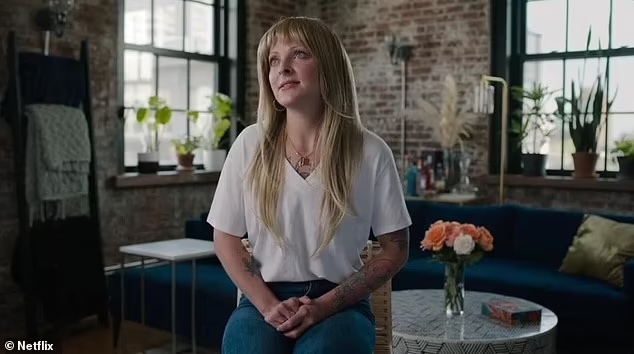
Image credit: Autymn Blanck
This evidence, combined with evidence provided in the original filing that Ayries’ journals mention that she was reading a book in 2015, that was not published until nearly four years later, in 2019, brings further credibility to the claim brought by OneTaste that these journals were not authentic and fraudulently created in 2022 for Netflix. According to Autymn’s deposition, Netflix paid her $25,000 for the use of the journals which were then selectively edited, shared with Netflix, and further edited.
CROSS-OVER TO CRIMINAL CASE

Image credit: Autymn Blanck
Industry observers have noted the unique circumstance of the OneTaste lawsuit against Netflix, given that the authenticity of these journals is being litigated simultaneously in Brooklyn federal criminal court. Both Daedone and Cherwitz were criminally indicted in June 2023, approximately six months after the Netflix film was published. Ayries is the star government witness for the prosecution, and court filings show the government intends to rely on her journals to convict Daedone and Cherwitz. Jennifer Bonjean, counsel for Daedone, filed a motion on December 2nd with evidence suggesting it would be impossible that Ayries wrote these journals in 2015.
“This new evidence also shows that the Journal Sets were the product of a group writing project which included Netflix filmmaker Sarah Gibson and underwent extensive edits over the course of 10 months before being shared with FBI Agent McGinnis on March 9, 2023.”
WHAT’S NEXT
Netflix has until March 2025 to file its reply to the OneTaste appeal, which will then be considered by The Los Angeles County Superior Court Of Appeal. In the Brooklyn federal criminal case, prosecutors are expected to file a response to the defense motion attacking the credibility of the journals this week.