
 Michele Stueven
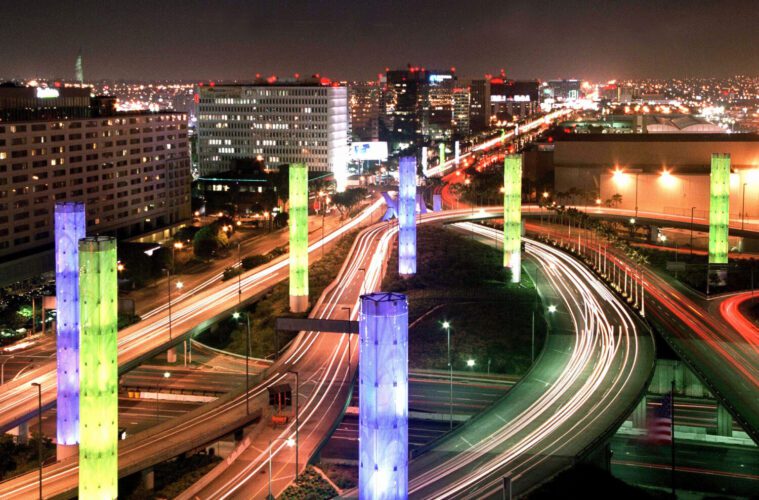
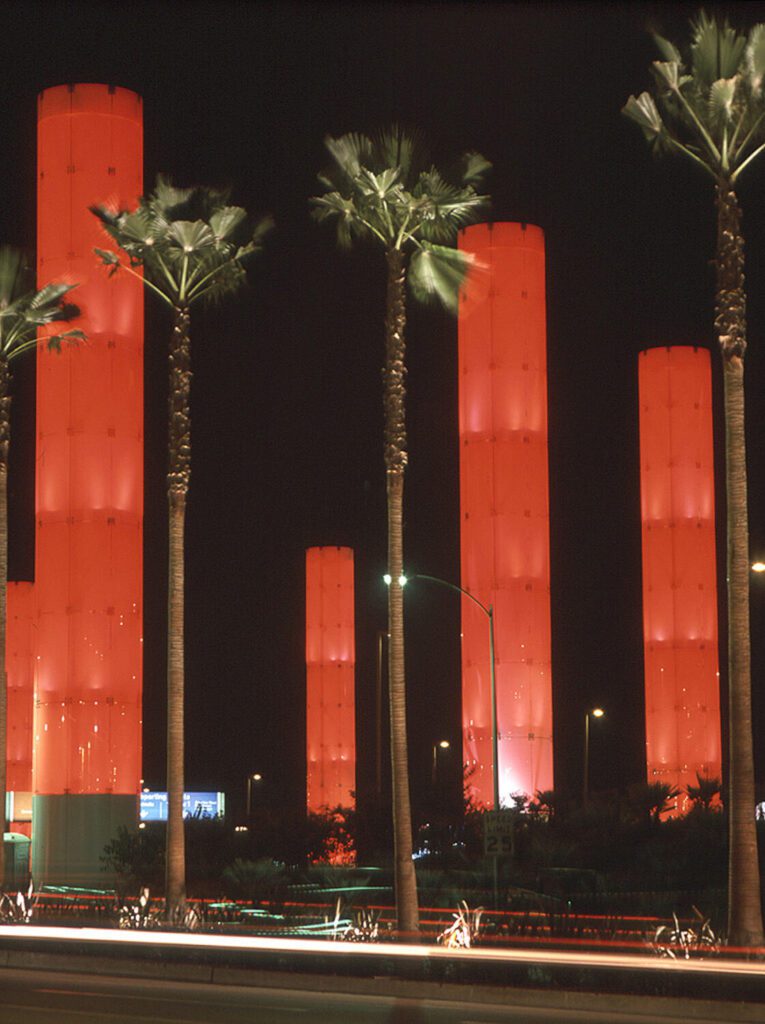
Installed around the Los Angeles International Airport in 2000, the pylons form a kinetic light installation of 26 translucent glass towers programmed to cycle through more than 30,000 colors over a three-hour sequence.
Often mistaken for decorative lighting or infrastructure, the work was conceived as a large-scale public artwork: a shifting field of color intended to reflect the diversity of Los Angeles and the planet, while also subtly calming the heightened emotional states associated with travel.
Over time, the installation has taken on a mythology of its own, often reduced to shifting colors tied to holidays or sporting events, obscuring its original conceptual intent. Despite being seen by millions, the work has remained largely misunderstood.

Artist Paul Tzanetopoulos (Alisa Banks Photography)
Now, 25 years later, artist Paul Tzanetopoulos is revisiting the pylons while also presenting a new installation at the Tom Bradley International Terminal that traces the process and history behind the work, offering a rare opportunity to understand the project from the artist’s perspective. Tzanetopoulos has spent more than 50 years working across video, sound, and light, including presenting one of the first video projections in a gallery in 1974, quietly shaping how Los Angeles feels as much as how it looks.
“Because I’m working on the new iteration of the pylons as we speak, I just got really tired of hearing misinformation about them,” Tzanetopoulos, who says the colors represent the diversity of Los Angeles and the planet, tells LA Weekly. “It’s been hard to tamp down my frustration. There was a flippant article in another Los Angeles newspaper about three or four months ago that was offensive and just plain not true. They did not mention that it was a public art installation, which is the reason the pylons are there. I thought it was pretty offensive to say they were installed to celebrate Christmas with red and green lights and purple and yellow for Laker games as opposed to celebrating the changing diversity of Los Angeles.”
The original pylons have been disassembled and torn down because of their construction. They couldn’t be reused because of the new roadways and revamping of the entire LAX environment, which includes changing all the access and egress. With all the significant changes, they had to be relocated anyway, so the 15 elements will be reimagined and replaced. The original design included six video screens, which the public never saw. The original vision wasn’t accomplished in 2000, but as of today, there will be a significant video component to the installation.
“The technology is infinitely better than it was 26 years ago,” says Tzanetopoulos. The new pylons will be more artful than the original ones because the light control technology has improved efficiency. The original installation utilized architectural lighting with filters from Denmark, which was beautiful, but they weren’t terribly efficient. In 2006, we converted to LED, and I had to redesign the show artwork because some of the colors weren’t achievable with LED, but we made it work, and 90 percent of it was still there, representing the fabric of Los Angeles. Currently, we’re going to use an advanced LED system that gives it a considerable amount of stability and fluidity in the choreography.
“I’d love for the installation to be appreciated by LA and the world as a public artwork and gateway that illustrates Los Angeles in a very deliberate way when we go lights up again for the 2028 LA Olympics.”
Original LAX pylons (Tom Paiva)