

 Michele Stueven
If you were ever a fourth-grader in California, you were force-fed the dusty and parched history of the California Gold Rush that droned on about the growth of the state as a cultural and industrial center, life in the mines, the impact on the environment and the evolution of technology.
It was a phenomenon that only lasted for seven years from 1848 to 1855 and brought about 300,000 people to California with the hope of becoming rich after gold was discovered by James W. Marshall at Sutter’s Mill.
Boomtowns in Nevada County like Grass Valley and Nevada City began popping up, bringing with them culture and theaters with historic figures like American writer and journalist Samuel Clemens, better known as Mark Twain and actress and courtesan Lola Montez from Europe. California went from a sleepy outback of Native Americans to a global magnet for commerce.
The Gold Rush accelerated the Native American population’s decline from disease, starvation and the California Genocide. Whole indigenous societies were attacked and pushed off their lands by the gold-seeking Forty-Niners, during the peak of immigration in 1849.
But as fast as it boomed, the Gold Country went bust, leaving behind crumbling ghost towns that either burned down or fell into disrepair and neglect in the years since.
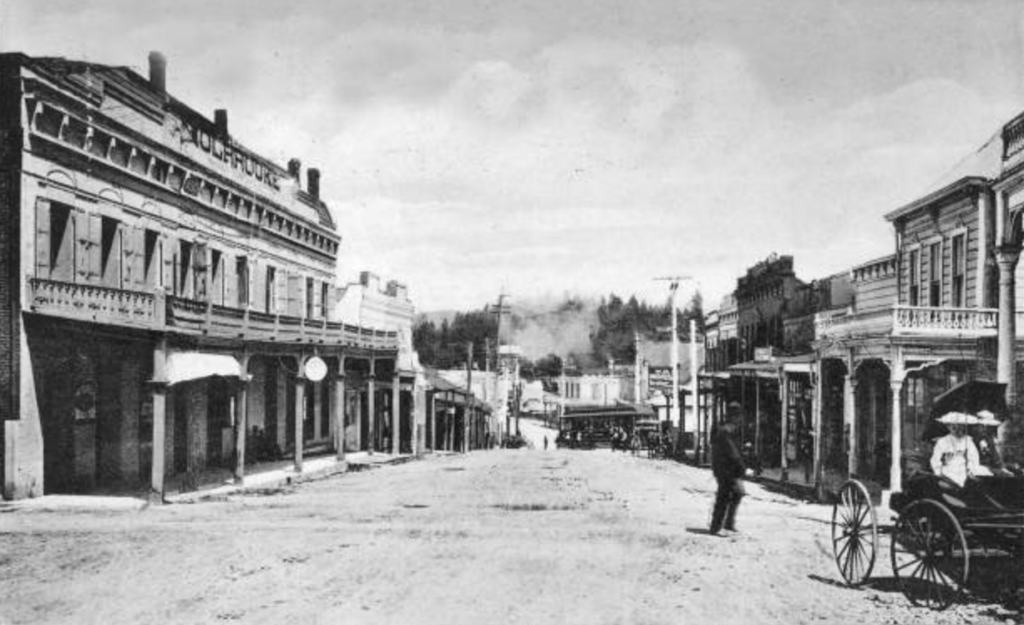
Courtesy Holbrooke Hotel
Practically on the verge of demolition shortly before the pandemic, Nevada County has seen a rebirth with the multimillion-dollar meticulous renovation of three of its historic gems — The National Exchange Hotel and Nevada Theater in Nevada City, and Holbrooke Hotel in Grass Valley. The beauty, adventure, romance and excitement that all went missing in those fourth-grade textbooks have come back to life.
Santa Barbara-based Acme Hospitality, which owns restaurants like The Lark, Loquita, and Helena Ave. Bakery, and hotels like the Azure Sky in Palm Springs, have come in and resurrected these landmarks to their original splendor.
“We’re honored to be stewards of historically and culturally significant properties and are grateful for the opportunity to lovingly restore them using talented local artists, designers, and craftspeople,” managing partner Sherry Villanueva tells L.A. Weekly.

Dining room and Golden Gate Saloon at the Holbrooke Hotel (Michele Stueven)
“We fell in love with the Sierra Foothills, not only for the region’s incredible natural beauty or the valuable role it plays in the history of California but also with the fascinating people who call this place home. We were excited at every discovery we made while initially exploring the area and wanted to share it with travelers far and wide who might otherwise have overlooked these gems. Grass Valley and Nevada City are only a few minutes apart but feel worlds away. Perfect examples of the beauty of small-town America, these diverse communities offer something for almost every type of traveler, from heritage-seeker baby boomers to adventure-hunting millennials. And, of course, we love bringing world-class food, wine and cocktail offerings to all our guests, where we can match the talent of our team with the abundant bounty of local farmers, ranchers, and producers.”
With a flight to Sacramento from Los Angeles in just under an hour or by the more scenic route with a six-hour drive time, Nevada County is a romantic destination full of California history with renewed respect given to the Native Americans as well.
After an extensive three-year, floor-to-rafter renovation, the 1850’s National Exchange Hotel has a new shine, cozy bar and first-class restaurant named after Montez, the illustrious queen of Grass Valley.

National Exchange Hotel (Michele Stueven)
The hotel opened on Aug. 26, 1856, at a major stagecoach stop for transient miners on Broad Street. The United States Post Office had its home here until 1942. As an ever-evolving community, the hotel adapted to the needs of the town. Buildings and balconies were added and taken away over the years, rooms were moved and walled off. Room 209, one of the most beautiful rooms off the veranda, was rediscovered behind walls during the renovations and a coffee shop replaced the more formal restaurant. Victorian furniture meticulously collected by the Acme team fills the rooms and common areas, including a settee used as a prop in Psycho that looms at the top of the staircase. And a heads-up on the subject of staircases — there’s no elevator in the three-story landmark building.
Lola’s Dining at the hotel is great for all-day brunch and dinner, and its historic tavern serves seasonal cocktails like the gin-based Diary of a Nobody and a perfect martini. For breakfast, try the short rib hash or mushroom scramble, made with locally farmed fungi. For dinner, go for the lamb shank, shrimp and grits, or fried chicken with kale kimchi and spring onion.
The California Arts Council has formally recognized the downtown area as a Cultural District, so there are many fun shops and restaurants with diverse cuisines that reflect Nevada City’s history, including Chinese.

Nevada Theater (Michele Stueven)
The real jewel in the crown of the town’s restoration is the Nevada Theater and Sarah Coleman’s captivating murals depicting California.
California’s oldest existing theater building, the Nevada Theater, opened in September of 1865, featuring regular performances by Clemens, Jack London and Montez. The stage closed in 1957 and reopened in 1968 when the town rallied and raised funds to resurrect the historic landmark.
During the pandemic in 2021, local artist and muralist Sarah Coleman was commissioned to create a large-scale mural spanning the entire auditorium of the theater, including the ceiling that breathed even more life into the community. The stunning work depicts the origins of California like Chinese lanterns blowing in the wind, imagery of a specific basket of the local Rancheria Nisenan Tribe, plus local Nevada City flora and fauna like oak leaves and acorns.
The 200-seat theater is in use year-round for both live performances and movies.
An admittedly absorbing stop on the 10-minute drive from Nevada City to Grass Valley that restored my original fourth-grade disinterest in the Gold Rush, was the Empire Mine State Historic Park. It’s the site of one of the oldest, deepest and richest gold mines in California.

Empire Mine State Historic Park / Bourn residence (Michele Stueven)
Gold was originally discovered at the location in 1850 and after years of decline, advances in mining technology and major pollution to the area, the mine closed in 1957. While the interactive tour of the mine itself is interesting, the idyllic surroundings on 856 acres of forested backcountry with 14 miles of trails are open daily and a tour of the original owner’s summer estate is a rare look into how the rich lived during the Gold Rush. The cottage contains all the original furnishings collected over the years by the William Bowers Bourn family that owned the mine.
The Holbrooke Hotel in Grass Valley, also lovingly restored by the Acme team, is a more rustic and masculine version of its sister project in Nevada City.
Game trophies line the walls of the dining room that leads into the Golden Gate Saloon, one of the longest operating barrooms west of the Mississippi River, serving classic and seasonal cocktails, regional and international wines, local beer, and live music nights. For breakfast, heal your hangover with the classic Holbrooke breakfast of two eggs, crispy potatoes, housemade sourdough or wheat toast, a choice of fruit, and bacon or pork sausage made from scratch in-house.

Golden Gate Saloon (Michele Stueven)
On Friday, Jan. 19, the underground Iron Door will reopen (legend has it served both brothel and speakeasy), which was recently reimagined with warm amber lighting on original stone walls, plush banquettes and a custom bar set against original metal doors that once led to a series of underground tunnels.
Originally built as the saloon in 1852, the Holbrooke has hosted famous guests over the years including U.S. Presidents Ulysses S. Grant, Grover Cleveland, Benjamin Harrison and James Garfield. Authors Clemens and Bret Harte spent time here, and rumor has it that the infamous highwayman Black Bart was a guest, sometime between stagecoach robberies and writing poems. Female entertainers like Montez, Lotta Crabtree and Emma Nevada sashayed regularly through the lobby.
For a rustic and restorative side trip for a picnic on your way back to the Sacramento Airport, take in the beauty of the spring wildflowers and covered bridge at the level and easy Buttermilk Bend Trail along the Yuba River.

Covered bridge in Grass Valley (Michele Stueven)