
 Nia Bowers
For most children, learning to write is messy but manageable. For children with dyslexia, it can feel disorienting. Strokes reverse. Letters drift. Corrections accumulate. What appears simple on the page can become spatially unstable in the hand.
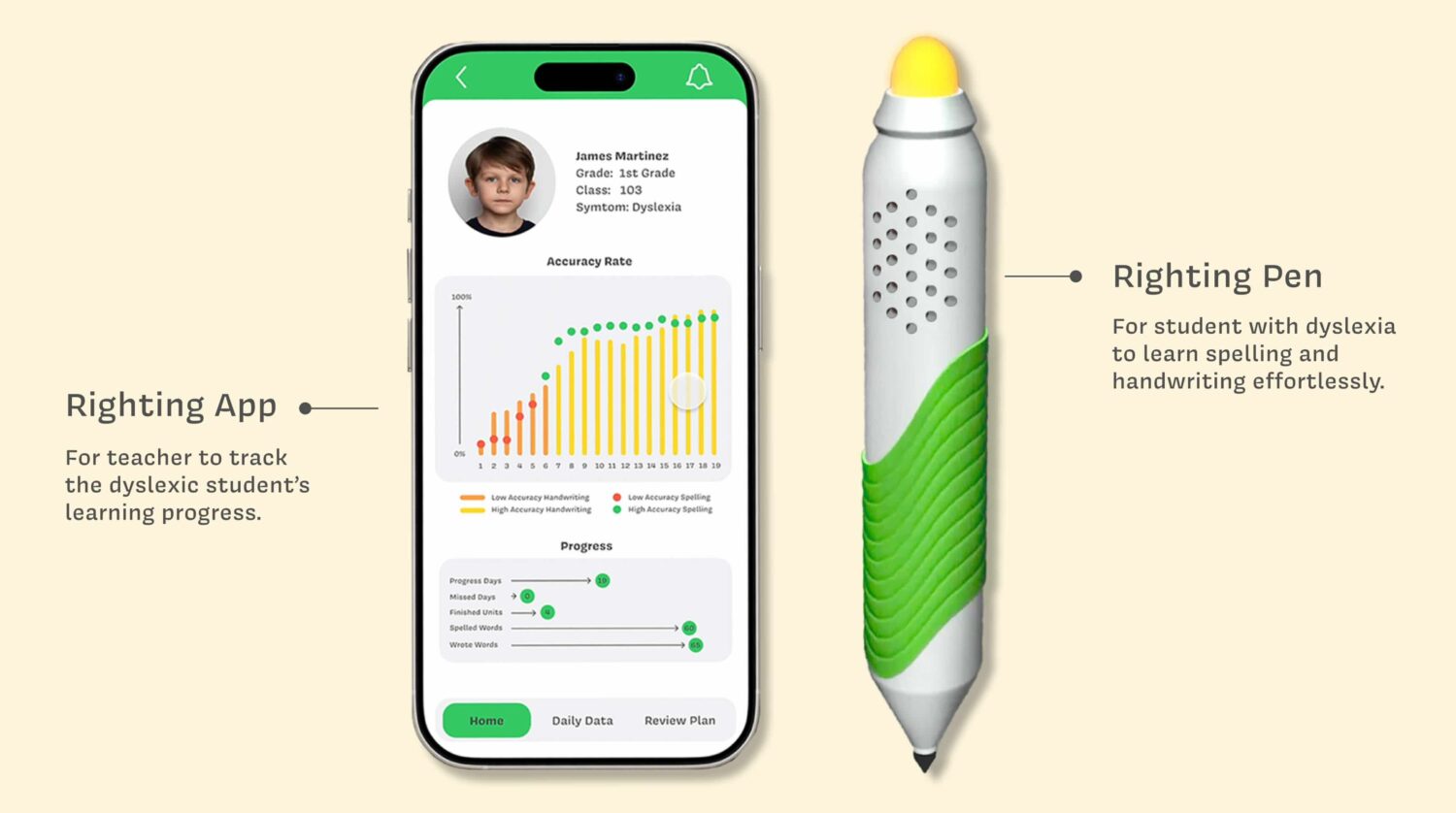
Jing-Ching Huang (Fiona Huang), a designer working at the intersection of visual systems and interactive technology, has developed a patented tool that approaches writing not as repetition, but as sensory coordination. Her invention, The Righting Tool, is engineered to guide neurodivergent learners through the physical mechanics of forming letters in real time.
Intelligence at the Tip
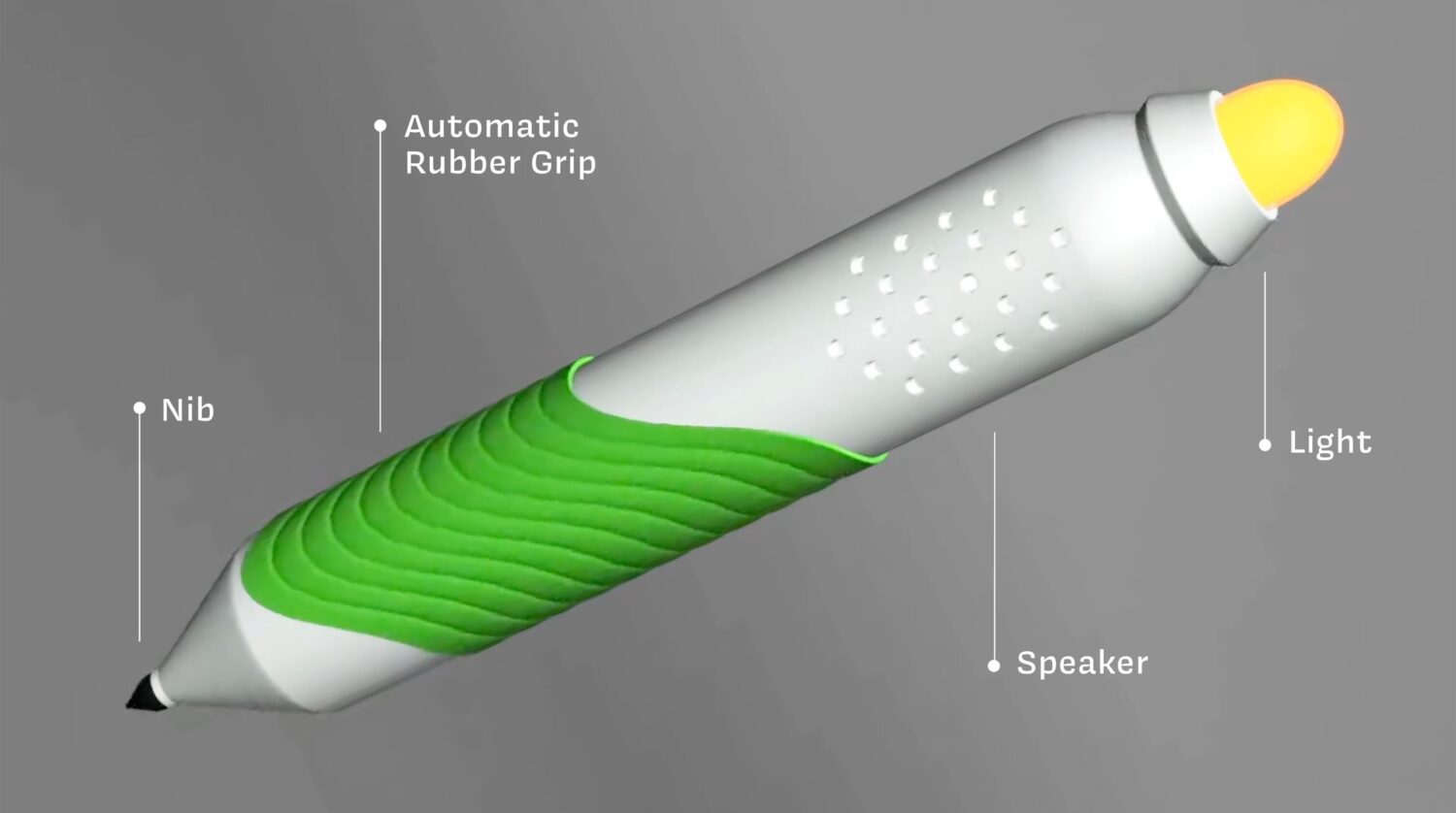
At a glance, The Righting Tool resembles a slightly thicker pen with a soft ergonomic grip. Internally, it operates as a motion-tracking feedback system.
An embedded Inertial Measurement Unit (IMU) captures angular velocity, acceleration, and stroke direction as the nib moves across paper. A processor compares this motion data to a predefined writing sequence.
When a stroke deviates from its intended direction:
- A small LED indicator turns red.
- A speaker delivers a brief corrective prompt.
When the stroke is executed correctly:
- The LED shifts to green.
- A short haptic vibration confirms completion.
The feedback loop exists entirely within the writing tool. There is no screen to consult, no animation to follow. Correction happens at the moment of movement.
A Multi-Sensory Approach
Many writing interventions rely heavily on visual instruction—animated diagrams or digital tracing systems. For some dyslexic learners, shifting attention between screen and paper increases cognitive load.
Huang’s approach embeds guidance directly into the object itself. Writing becomes a coordinated sensory process:
- Auditory: The tool speaks short instructions.
- Tactile: The hand feels confirmation through vibration.
- Visual: Color signals indicate accuracy.
The objective is not gamification. It is reinforcement of procedural memory—helping the body internalize stroke order and direction through supported repetition.
Adaptive Support
The Righting Tool can also connect to a companion application on a smartphone or tablet. The system analyzes recurring directional errors and hesitation patterns, allowing writing sequences to adjust to the learner’s pace.
Rather than replacing teachers, the tool functions as a consistent, responsive assistant during practice—offering immediate, neutral feedback without the social pressure that can accompany correction.
Redesigning a Familiar Object
In an era when education technology often means more screens, Huang’s invention moves in the opposite direction. The Righting Tool rethinks one of the most basic classroom instruments and asks what would happen if it could respond.
The device does not claim to solve dyslexia. It addresses a specific challenge within it: the spatial and motor complexity of handwriting. By embedding real-time guidance into the act itself, the tool reduces friction at a moment when frustration often takes hold.
Sometimes innovation doesn’t require a new platform.
Sometimes it requires redesigning the object already in a child’s hand.
About the Designer
Fiona Huang is a designer and inventor whose practice explores the relationship between visual systems and technology. She is currently pursuing graduate studies in Interactive Telecommunications at New York University and holds a BFA in Design from the School of Visual Arts. Her work has received international recognition, including a Red Dot Award in both Product and UX Design, a London Design Award Gold, and an IDSA Award finalist honor.