

 Kalyn Corrigan
Adapt or die. That’s been the motto of the hit AMC show Interview with the Vampire since its first season changed the landscape of the Anne Rice universe back in 2022. Now, with the upcoming third season in sight, that mantra rings truer than ever before. Taking inspiration from the renowned gothic fiction author’s source material, the latest iteration of showrunner Rolin Jones’s vision signals a changing of the guard. In the highly anticipated return to the delightfully messy drama — this time cheekily re-titled The Vampire Lestat — the protagonist switches perspective from the tormented, reserved New Orleans native Louis de Pointe du Lac (Jacob Anderson), who led us through the first two seasons, to the self-aggrandizing, life of the party, Parisian creature of the night Lestat de Lioncourt (Sam Reid) as he taps into his musical prowess. Despite the tonal whiplash, watching this golden-tressed chaos demon’s unbridled spirit ascend from immortal being to full-on, frilled-out rock star somehow feels fated — and Lestat’s got just the garb to prove it.
“The music is the starting point, and then everything else follows,” says costume department head Lex Wood about building Lestat’s rocker wardrobe for season three. “There was a line, I believe it’s in Queen of the Damned, about Lestat ‘trying on new glittering dream skins,’ which really stood out when I was in those early stages of trying to pinpoint how we approach this. He’s trying on different versions of what he wants to be. And that is reflected with the music as well, because there’s so many different musical influences that it allowed us to be quite inventive and not to feel too hemmed in by contemporary fashion.”
Wood joined the Interview team at the end of the show’s second season, and now, the stylist is spearheading Lestat’s look for season three. Taking the reins just as the series ups the ante, Wood understands that her work is crucial to both the character and the program’s progress. “There was very much a want to pull us forward from where we have been at the end of season two,” she remembers. “It was important to everyone to be able to bring us into a much more vivid world.”
Whereas most byronic romances opt for traditionally dark and dreary clothing, Wood felt that her revamped revenants would embrace a wider palette. “There was a big focus on color, especially for costumes,” she grins. “We wanted to avoid too much of the trope of having vampires always in black, which has been a theme throughout season one and two. Especially within the world of music, and rock, and glam, and punk, it really opened the door for us to be able to throw as much color at the piece as we could. That was definitely a big theme between the creative departments, but especially within my own department. Whenever we were shopping or finding fabric and clothing, it was always, ‘More color, more color!’ We really tried to punch up a little bit of modernity into it.”
Based on Rice’s 1985 novel of the same name, The Vampire Lestat follows the same basic structure as the book, while also pulling details from other entries in the literary series.
The first season bounces between three timelines: 1910 New Orleans, where the ancient vampire Lestat meets Louis and gives him the “dark gift” of immorality, 1973 in San Francisco, where twenty-something fresh faced journalist Daniel Molloy first attempts to interview Louis, and 2022, in which an elderly Molloy revisits the project that boyish youth prevented them from finishing, reunited with Louis in his penthouse in Dubai, where he recounts centuries of dangerous liaisons and toxic entanglements.
With the newfound love of his life at his side, whom he refers to as “Rashid” (and who is later revealed to be the vampire Armand, played by the ever-cunning Assad Zaman), present-day Louis recalls his human youth in Storyville (the red-light district of its time) as an entrepreneurial owner of a brothel. He talks about grieving his troubled brother, falling under Lestat’s thrall, being reborn as one of the lonely ones, and co-creating a fledgling of his own, Claudia (Bailey Bass), a dying teenager saved from a fire to serve as a band-aid for Louis and Lestat’s rocky marriage. Yet, like most temporary fixes, the child vampire fails to cover the cracks in the couple’s foundation, and after a series of increasingly intense betrayals, Claudia convinces Louis to help her kill Lestat and flee to Europe to begin their new lives.
Season two continues Louis’s recollection of events as he details his time spent with Claudia (recast as Delainey Harris) amidst the backdrop of Europe during World War II. On a quest to find old-world vampires, the duo lands in Paris, where they are seduced by a coven and ingratiated into their Théâtre des Vampires, led by the ancient vampire Armand.
Every night, the group acts out meta plays for the local mortals, pretending to be ‘vampires’ as they literally drain their victims on stage. Eventually, a mesmerized Claudia joins the production, and Louis falls in love with their leader. However, their plans are foiled when one of its members, Santiago (Ben Daniels), conspires with Armand to orchestrate a fatal trial, resulting in the loss of Claudia and her newly turned companion Madeline (Roxane Duran).
This season also unveils the survival of Lestat, who plays an integral role in the trial. Through his sessions with Molloy, Louis learns that Armand has been lying for years about saving Louis from the same fate as his fledgling. Armand took credit for controlling the minds of the mortal audience and forcing them to banish Louis instead of sentencing him to death, when in reality, it was actually Lestat. This revelation leads Louis to leave Armand, but not before making him swear not to harm the journalist for his big gotcha moment. Of course, Armand has lied again, and he immediately turns Daniel into a blood drinker.
The season ends with the reconciliation of Lestat and Louis in New Orleans, arms wrapped tightly around one another as a wicked hurricane rages wildly overhead, slowly tearing down the walls circling their embrace, decimating the home in which they reside. Meanwhile, Molloy makes the rounds at various news outlets, touting his freshly inked record breaker, Interview with the Vampire. Louis hears whispers on the wind from angry vampires who still believe their existence shouldn’t be revealed to humans, and he invites all who feel compelled to act on their fury to make good on their threats and bring the smoke to his front door.
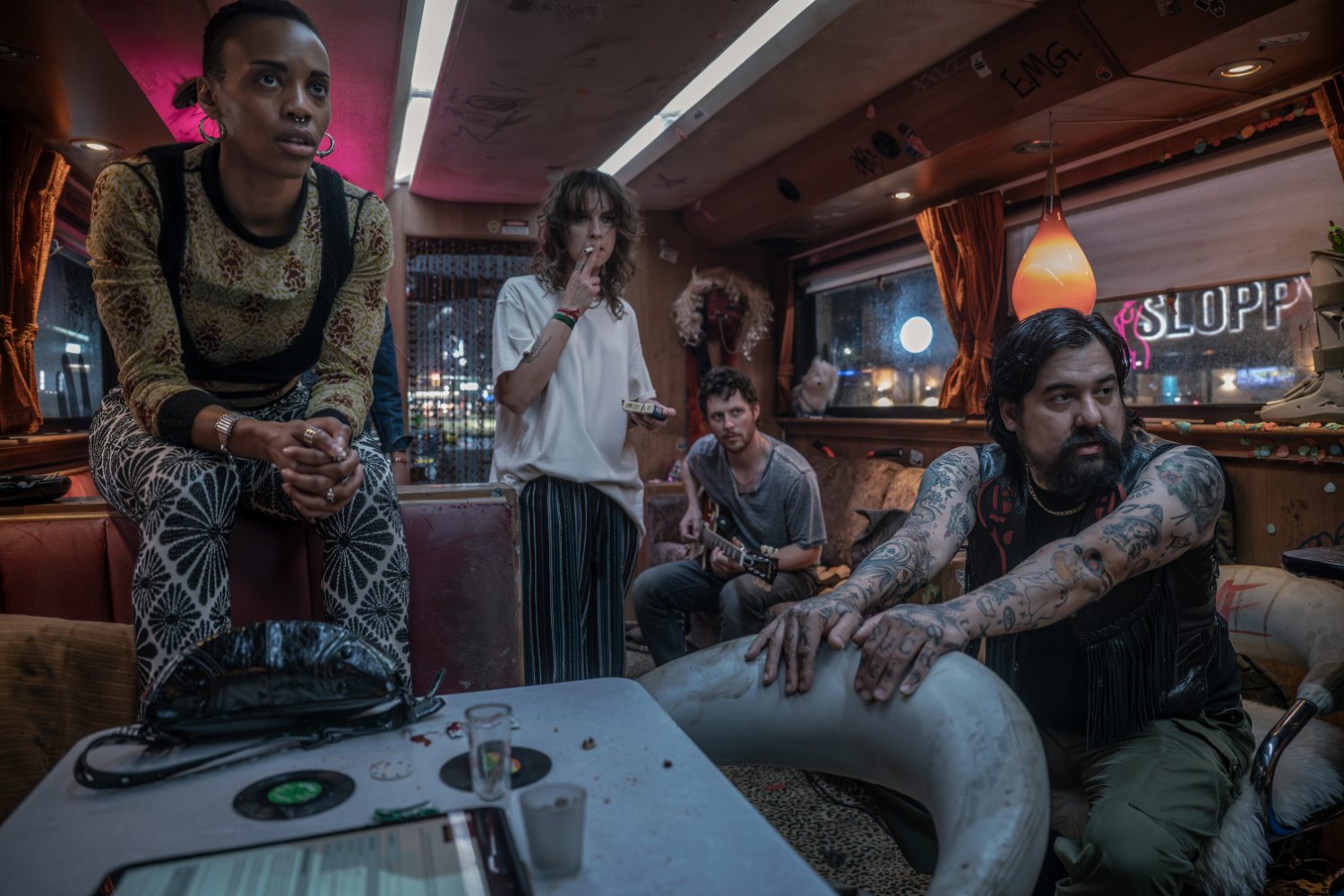
(Courtesy of AMC)
Subjective storytelling is a lot like an inanimate object in the center of the room: it changes perspective based on where you’re standing. In season three’s world, Lestat becomes a swaggering, hip-thrusting, bona fide rock star. News of Molloy’s bestselling text reaches Lestat, and naturally, Louis’s recognizance doesn’t paint the 265-year-old French blonde bloodsucker in the best light. Feeling betrayed by his lover’s harsh testimony, the rift between the couple that had briefly closed once again started to schism.
In truth, Lestat’s transformation into a rock god isn’t just an ode to changing with the seasons, it’s a response to everything that Louis said about him in the book’s hotly contested interview; a rewriting of the first two seasons’ narrative, and a reclamation of Lestat’s own autonomy. Plus, to be fair, he just looks damn good in those leather pants. “You should come to one before it’s over,” Lestat purrs at an old friend on his tour bus one evening, inviting him to one of the band’s shows. “I’m quite sexy.”
In a rare move, the show’s composer, Daniel Hart (previously known for his work on standouts like The Green Knight, A Ghost Story, and more recently, Mother Mary), had a large hand in the writing process. According to showrunner Jones, Hart even sat in the writer’s room, wherein he would occasionally rise, leave the room, write a song for Lestat, and quietly return.
“The best thing for me when we were in prep for season three was that Sam and Daniel Hart had been working for so long with the music that it was already such a part of the process,” recalls Wood. “The music could really lead where we were going.”
At one point in the show, Lestat’s band covers Billy Idol’s iconic banger “Dancing with Myself” and it’s hard not to notice a striking resemblance between Reid’s springloaded shuffle and the original instigator of such reverent reverberations. Wood explains how the costume department fought tirelessly to strike an appropriate balance between a flattering homage to the sonic gods they hope to immortalize, and bringing their own personal artistry to their interpretation of the vampire’s hardened persona.
“Sam and I spoke a lot about using the influence of the stalwarts of a musician’s wardrobe,” says the costume designer. “There are certain things that we are familiar with seeing, especially with Billy Idol, David Bowie, and Freddie Mercury. All these absolute idols of music have different styles within their own right, but we’ll often see them in a leather pant. We’ll often see them in a similar tank top. So we brought in quite a few things that we felt would be true to a musician. Then, within fittings, we would try different things together and see what felt true to Lestat. Some of that is playing around, and sometimes leaning into the trope of the musician, and other times, really pushing away from it.”
In the end, Hart wrote over twenty songs for his fictional rock band (also named “The Vampire Lestat,” because of course Lestat would name the band after himself). Reid, who proves to be just as gifted a musician as he is at performing, sings all of the songs himself. It was a truly collaborative effort of all of the departments coming together, and each specific song inspired different ideas for Wood and co.
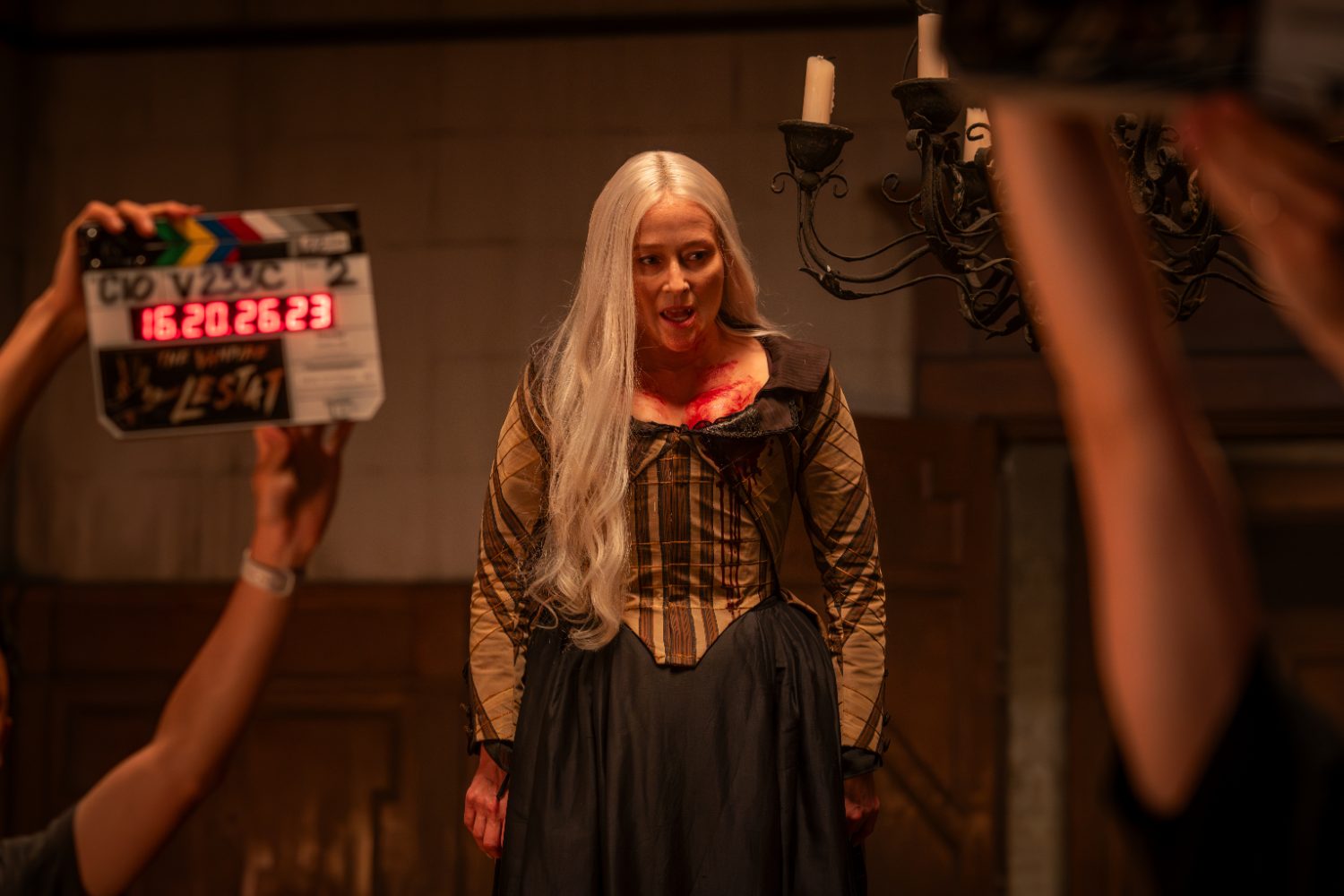
(Courtesy of AMC)
Regarding creating prominent distinctions between Lestat’s individual costumes, Wood shares how “some of that is down to the particular track that we knew he would be performing for that episode. Other times, it’s about the theme of what else is going on around the action of that concert, because we have separate concerts per episode.”
At one point, Lestat sings a song that he wrote for Armand, reciting the lyrics, “You’ve got a lot of rules for a theater kid,” and, “Only the big boss gets to decide who dies and who stays alive.”
While he sings the jaunty tune, Lestat dons bright baby blue eyeshadow and matching blue ribbons in his golden pigtails — a glaringly obvious nod to Claudia’s ensemble that she was forced to live in during her time onstage at the Théâtre des Vampires, performing the same maddening “My Baby Loves Windows” song on repeat every night for over five hundred shows in a row. Paired together, the vampire’s newly established music and the old school fit create a powerful humiliation ritual for Armand. The callback serves as the artist’s sharp retaliation to the cruel injustice bestowed upon his late daughter who was killed in season two by the vapid production company.
He tops off the baby doll drip with black and white pinstripe pants, not unlike the trousers he wore during the theatrical trial. “A really clever design theme for Lestat during season one that continued into the vision of him in season two, was that he’s often seen in a stripe,” interprets Wood, “because it’s like he’s being imprisoned into this world, this version of himself in the version that Louis is experiencing.”
She expands, “So by contrast, we wanted to try and break out from the stripes [in season three] and be a lot more inventive in terms of how we are showing that, so that we’ve got the visual representation of him being free, as well as the musical freedom that he’s experiencing.”
The first time that we see Lestat onstage in all of his rock star glory, a deliciously long, raven-black cashmere cape adorns his broad shoulders, the shawl held together by a thread over his freshly scarred breastbone. According to Wood, this particular outfit makes a statement in more ways than one. “We wanted to show a reference, and almost like Lestat is kind of poking fun at the trope of the vampire,” she says. As Lestat casts a spell over the crowd, it’s hard not to see echoes of Santiago from season two in his swagger, as he once again uses his clothes to mock the nest that he feels so deeply wronged him. “But again, it was something that stuck out from one of the Anne Rice quotes where early on, when the star is performing, he’s touching the black cloak, and he talks about how it feels in his hands. So, you’ll notice that there’s a lot of focus on Sam’s hands around the cloak at the time, which is our nod towards that very direct quote from the text.”
Wood elaborates, “We also wanted it to be a moment of breaking free.” As a creature who wore the costume of a day walker for centuries, the traditional ghoul getup and tongue-in-cheek bravado also represents a new era of unabashed vampire pride for Lestat, who, whether he admits it or not, feels emboldened by Louis’s recent actions to make his private persona become public knowledge to the world. “I mean, it’s not fantastically complicated,” downplays the humble stylist, “But it’s really fun when it’s understood, because so often, these things are small ideas that we have in small conversations, and suddenly, you’re doing it, and it’s big. We just hope that it will resonate with fans of the show.”
Just as Lestat allows the spotlight to morph him into a metal-headed shredder, so, too, does the actor who plays him change to embody the rocker vamp once he steps into his carefully curated costumery.
“A lot of it starts with shoes,” says Wood with a smile. “It’s a real grounding for an actor, and finding how the character walks, that I know has been a thing for Sam for season one and two. Actually, that was a big thing that we wanted to shift. We took him away from the refined boots that he had in the earlier seasons to give him a different gait, because he’s jumping all around the place. He’s kicking televisions, he’s doing all kinds of wild and crazy things — the elegant boot didn’t suit the star in this version quite so well,” she laughs. “It’s a joy to be able to move the character forward, and to bring it into this new version.”
Speaking of boots, one of the most exciting details in Wood’s repertoire is Lestat’s big chunky black stompers that he wears onstage, the bottoms of which read “Hate” on the underside of the right boot, and “Me” on the underside of the left. As Wood explains, the slow shot of the vampire’s quirky high-tops acts as both “a vehicle for using a new camera,” and a scarce opportunity for her team to show off their character’s highly coveted footwear.
“It was something that actually Rolin had asked if we could do. There was a particular camera that David Tattersall, our DP, had access to, and he has really focused on shoes, which is a joy for a costume team. Often, on television, you don’t see shoes, and we put so much energy into how the shoes feel for the character.” She beams, “There were quite a few different versions of what we could write on the bottom. Some were a lot ruder than what we chose in the end, but we thought that said the most, and it’s the brattiest version of what we were thinking. It felt true to Lestat’s bratty, laissez-faire vibe.”
The nautical script etched into the base of Lestat’s boots almost looks like tattoos that the vampire rock god might hand-pick to decorate his knuckles. Wood insightfully quips, “Which, you know, of course, vampires can’t really have, because it would regenerate the next day. Maybe that is his tattoo.”
More than once, the costume designer has witnessed Reid becoming Lestat through the sheer power of her designs. “Sam is just the best,” she coos. “He’s incredible to work with, and he’s so careful, and thinks about everything. It’s a real joy to work with him, and to work together, because, what more could you want than somebody who really is so passionate about the text as well as the character? I think that’s what gives the show a lot of its truth: its real heart is the care that all of our actors bring to their characters.”
She continues, “We also wanted to show that when we start at the beginning of season three, [“The Vampire Lestat” is] not a huge band,” says Wood. “[Lestat] has a following, but it’s quite spit and sawdust. It’s quite gritty, dirty. It’s not huge stadiums yet. We wanted to allow ourselves the arc, to be able to move up in scale.”
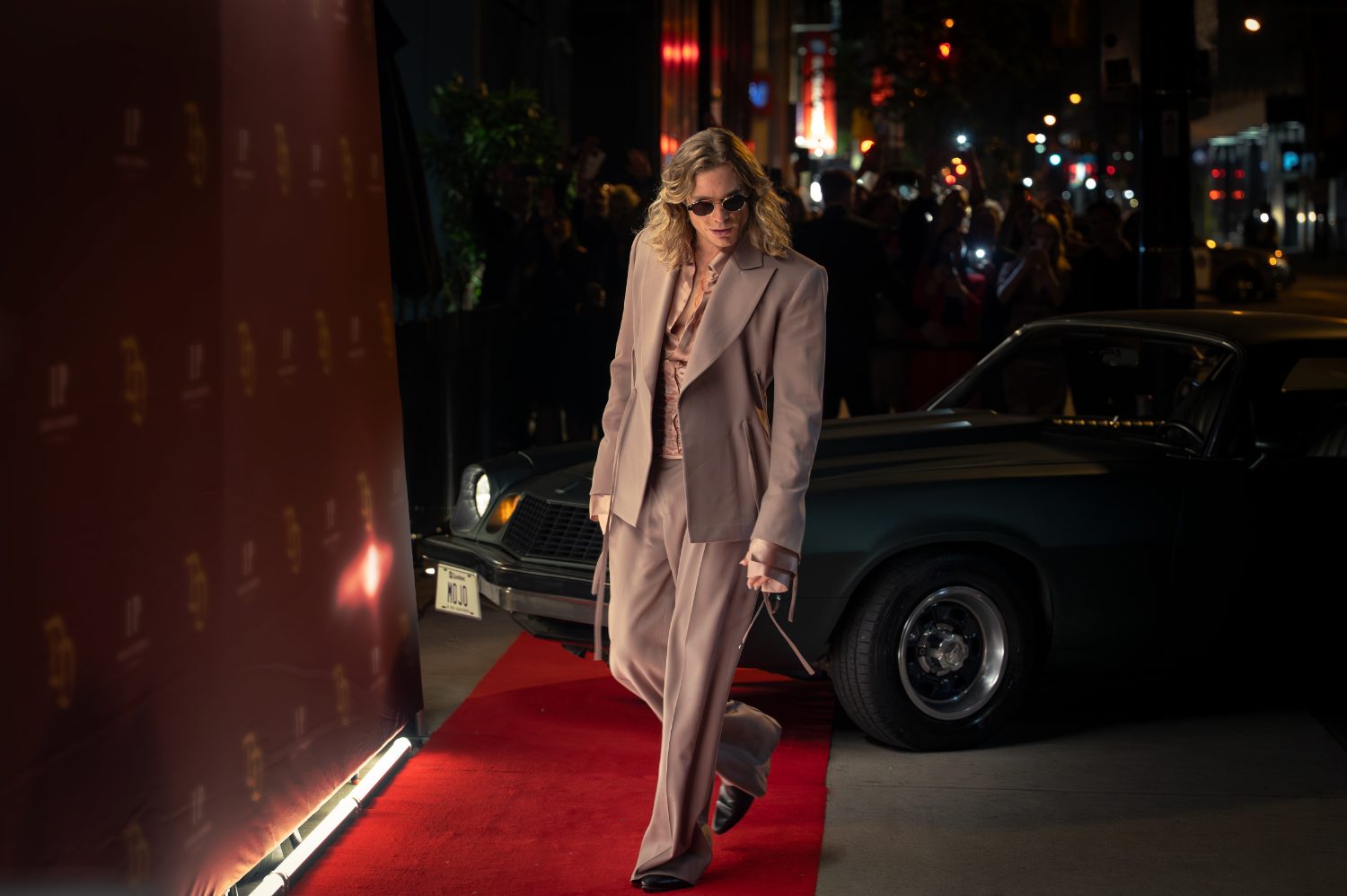
Lestat gives “the paps my pussycat.” (Courtesy of AMC)
That doesn’t necessarily mean that the costume department starts small, however. During an early episode, Lestat gives “the paps my pussycat,” as he puts it, or in layman’s terms, struts the red carpet like it’s going out of style. He wears a fuschia colored silk chiffon custom suit, complete with a tightly bound bodice that gives him an effervescent glow, especially once he strolls into the club to join his band. The imagery is so dazzling, it puts The Birth of Venus to shame.
“It was born from originally how Lestat would be appearing at that venue in the story,” says Wood. “We wanted it to feel like it was a birth. Like Lestat was arriving onto the scene. We also really wanted him to shine within the colored lights of the club, and really feel like he was the center of everything. Pink did seem like a bit of a risk at one point, but it was a really fun costume to play with. The journey of the costume is quite fun as well.”
Director Alfred Hitchcock used to say that he liked to cast blondes in his movies because the blood spatter looked better against their light hair. In a way, Wood and her colleagues toy with the same sinister scenario.
“We like fake blood,” Wood declares proudly. “Sometimes, it’s the most fun to destroy the most complicated costume. In general, I feel that when we’re watching television, it’s often the simplest costume on this person walking past — you know that person’s going to get shot, or run over, or you just know that the stunt’s going to happen to him. So, it’s really fun to flip that idea, and have the most complicated version get the most trashed with fake blood. We’re very lucky. We have the most incredible team, the most talented team working in Toronto. They do insane work. Everyone really enjoyed trying to make something, and it’s just as fun to see them enjoy it being trashed, too. As Sam said to me one day, ‘What a beautiful costume to trash.’”
“Anne Rice’s The Vampire Lestat” (season 3 of the “Interview with the Vampire” series) premieres on Sunday, June 7, on AMC and AMC+.
Follow Lex Wood on Instagram @its_lexwood.
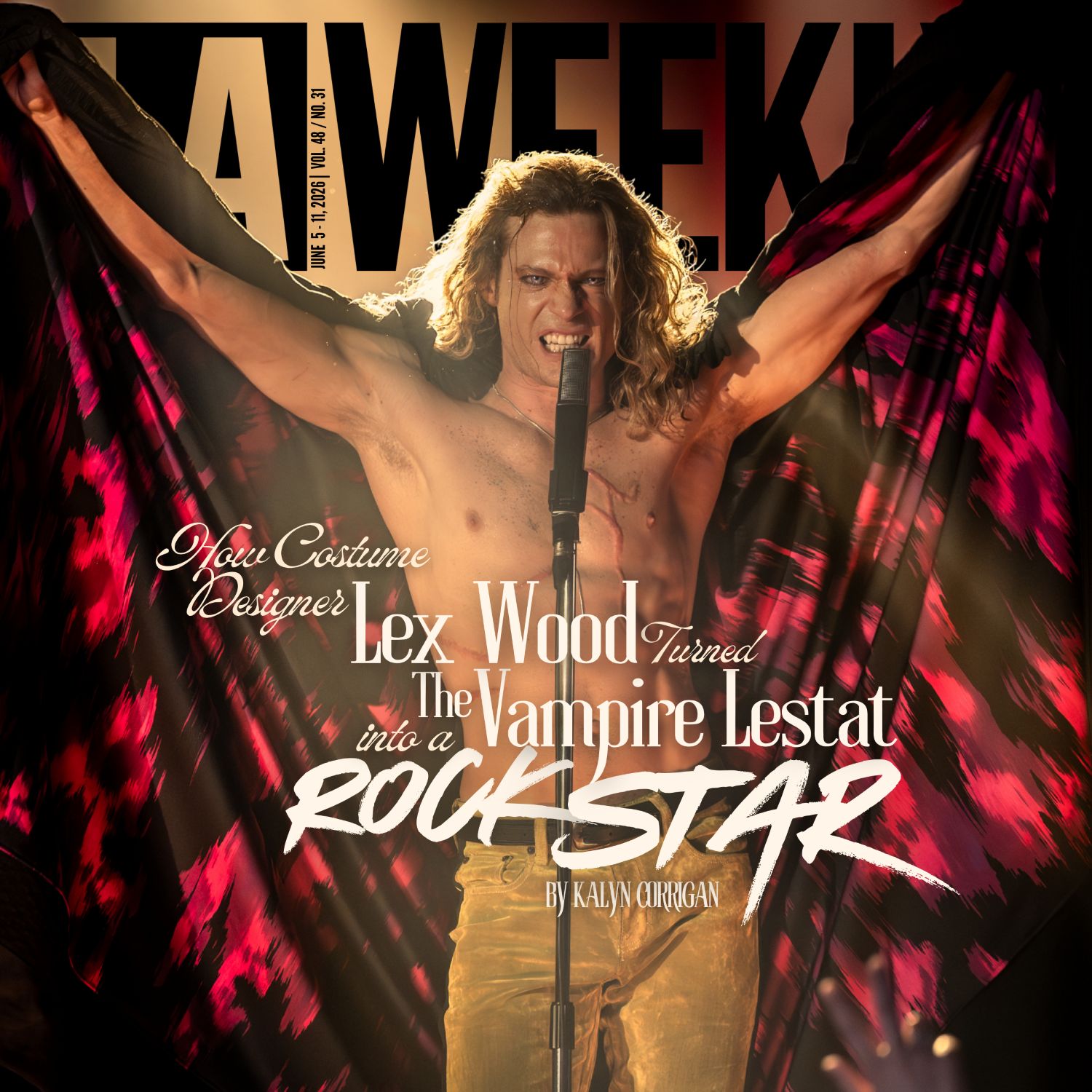
“The Vampire Lestat” on the June 5, 2026, cover of LA Weekly (Photo: Courtesy of AMC; cover design: Mark Stefanos)