
 Asher Luberto
 Roses are red, violets are blue, but what happens when the roses turn blue, as these Roses are known to do? In this comedic pairing of Marriage Story and Meet the Parents, a seemingly joyous marriage is joyously beaten to death like a piñata, as these characters’ darkest secrets become comedic candy for audiences to chew over with giddy smiles. The same way Michael Douglas and Kathleen Turner’s marriage became a wrecking derby of barbs in The War of the Roses, so does Benedict Cumberbatch and Olivia Coleman’s marriage become a wonky car crash in The Roses. In this wonderful marital comedy, it’s the fights that are most fun.
More a reimagining of Warren Adler’s novel than Danny DeVito’s sourly amusing film, The Roses pins two of England’s greatest actors against each other in a fight to the death (or just a fight to see who gets to keep their mansion). They’re certainly pushing the envelope on “til death do us part,” as literal murder attempts unravel and inevitably come crashing down in a bombastically overcrowded yet bemusingly entertaining final act.
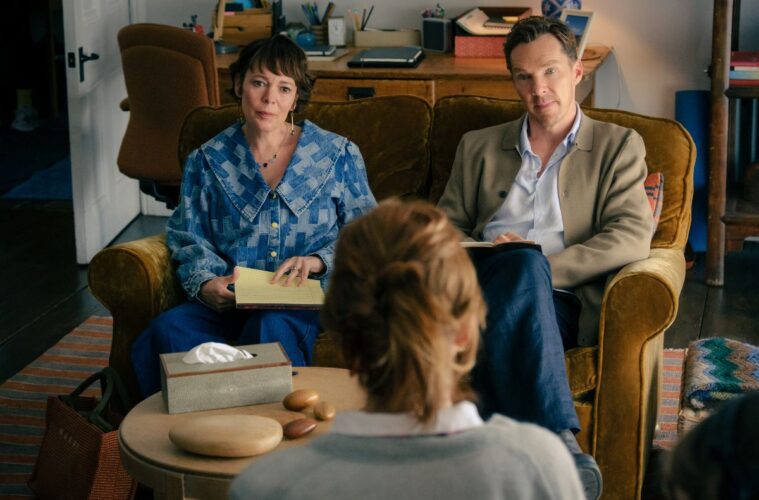
From the start, when Theo (Cumberbatch) and Ivy Rose (Coleman) are in a therapy session where they’re forced to say kind things about each other —which of course devolves into a series of backhanded compliments — you can tell these characters weren’t meant for each other. Even the therapist throws her hands in the air, exclaiming there’s no way the couple can save their relationship. Flashback 10 years and things seem great: Theo and Ivy meet cute in a restaurant, share a few laughs over a candlelight dinner, then share an impromptu moment in the kitchen fridge where sparks fly and frozen food flies off the shelf.

Benedict Cumberbatch, Ncuti Gatwa, Olivia Colman, Kate McKinnon, and Andy Samberg in “The Roses” (Photo by Jaap Buitendijk, Courtesy of Searchlight Pictures. © 2025 Searchlight Pictures All Rights Reserved.)
But thrust back to the present day, and they’re strangers in their own sterile home. Theo’s spectacular new museum is about to open, and to encourage Ivy to pursue her culinary talents, he buys her a cozy restaurant aptly named “We’ve Got Crabs.” He’s the breadwinner, she’s the bread maker, but the roles perilously flip when a storm obliterates Theo’s museum and a food critic is stranded in their idyllic town, forced to eat at Ivy’s restaurant. A rave review sets Ivy on a path to foodie stardom, while a viral video of Theo reacting to the demise of his architectural gem sends him on a path to unemployment. A star is born, a marriage is upended, and Theo’s ego is trampled, engulfed and demolished, leaving him in the role of house husband while Ivy jets off for lavish foodie events across the equator. For better and for worse, competition, aggressive zingers, and occasionally zesty, occasionally dreary gags are seasoned into this movie’s melting pot of misfortune.
Fittingly, Jay Roach has proven to be one of cinema’s greatest directors of household disasters (see: Meet the Parents), and he’s one of the great conductors of dinner table mishaps, finding unique ways of turning banal conversations into a simmering feast of snowballing disasters, which he does magnificently here when Theo and Ivy join their friends for dinner. Andy Samberg is a master at playing comedically bland losers, while Kate McKinnon continues to bring weird Barbie energy to the table, their mismatched personas are a fun contrast to the mismatched energy of Theo and Ivy, which makes for some hilarious dinner conversations throughout.
The script by Tony McNamara is deliciously crude, leaning more toward crassness than witticism. Some audiences might be aghast by Coleman spewing out obscenities, but those who have seen her artsier roles know she can deliver such crudities with meme-able aplomb.
The ending is unintentionally sloppy, however, devolving into a cinematic mess of tonal imbalances that undermines everything in the movie. We’re supposed to believe in Ivy and Theo’s initial spark, but their fighting escalates to achingly depressing, in a fatal sense. You start to wonder if these movie characters ever actually cared for each other, or why we’re supposed to root for them in the first place? Why remake a movie about the perils of chasing materialistic love when you aren’t going to explore that topic in the slightest, or find any other reason for their anguish other than to create some cringeworthy laughs?
I found myself searching for a meaning to The Roses that wasn’t there. Perhaps poetically, this Rose blooms fragrantly but withers pathetically in the dark.