
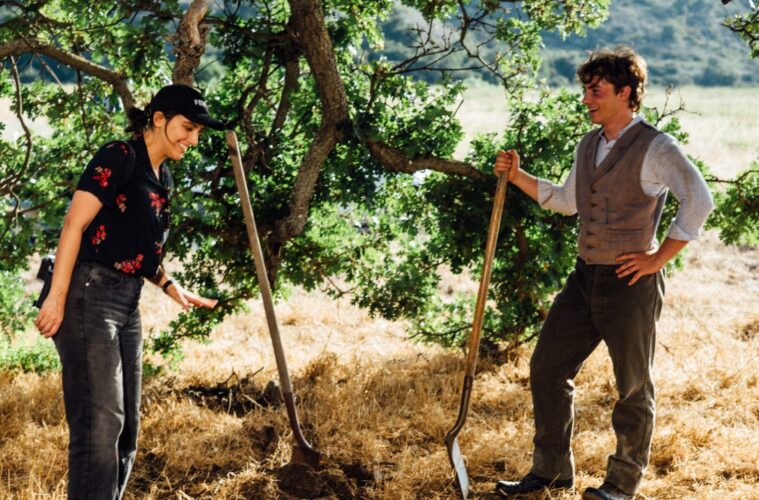
 Kalyn Corrigan
Abraham’s Boys, Natasha Kermani’s clever retelling of the classic Dracula tale, burns itself into the brain by way of bold narrative choices and Southern Gothic aesthetics. Based on a short story in author Joe Hill’s first published book, 20th Century Ghosts, the film opens in 1915’s Central Valley, California, a purposefully remote location where Abraham Van Helsing (Titus Welliver) has moved his two boys Maximilian (Brady Hepner) and Rudolph (Judah Mackey) in the hopes of outrunning their colorful past. Little do they know, the greatest threat facing this family already resides within the walls of their quaint new home.
“From the beginning, I’ve always looked at Van Helsing a little bit sidelong,” author Hill tells me about the inception of his original story. “I read a book in about 1983 called The Dracula Tapes by Fred Saberhagen, which tells the story from Dracula’s point of view, and it becomes clear that Van Helsing is a religious fanatic. He’s a crook who doesn’t understand vampires, doesn’t understand science, and leads a whole bunch of gullible Victorians on a murderous rampage. And then a couple years later, I read Stoker’s Dracula for the first time. When I read it, I thought, ‘This is all wrong. Lies and propaganda!’”
Feeling the spark of injustice, the author was inspired to recount his own interpretation of the text. Much in the same way that John Gardner’s 1971 novel Grendel serves as a rebuttal to the epic poem Beowulf, so, too, did Hill seek to strike his own stake in the popular vampire lore.
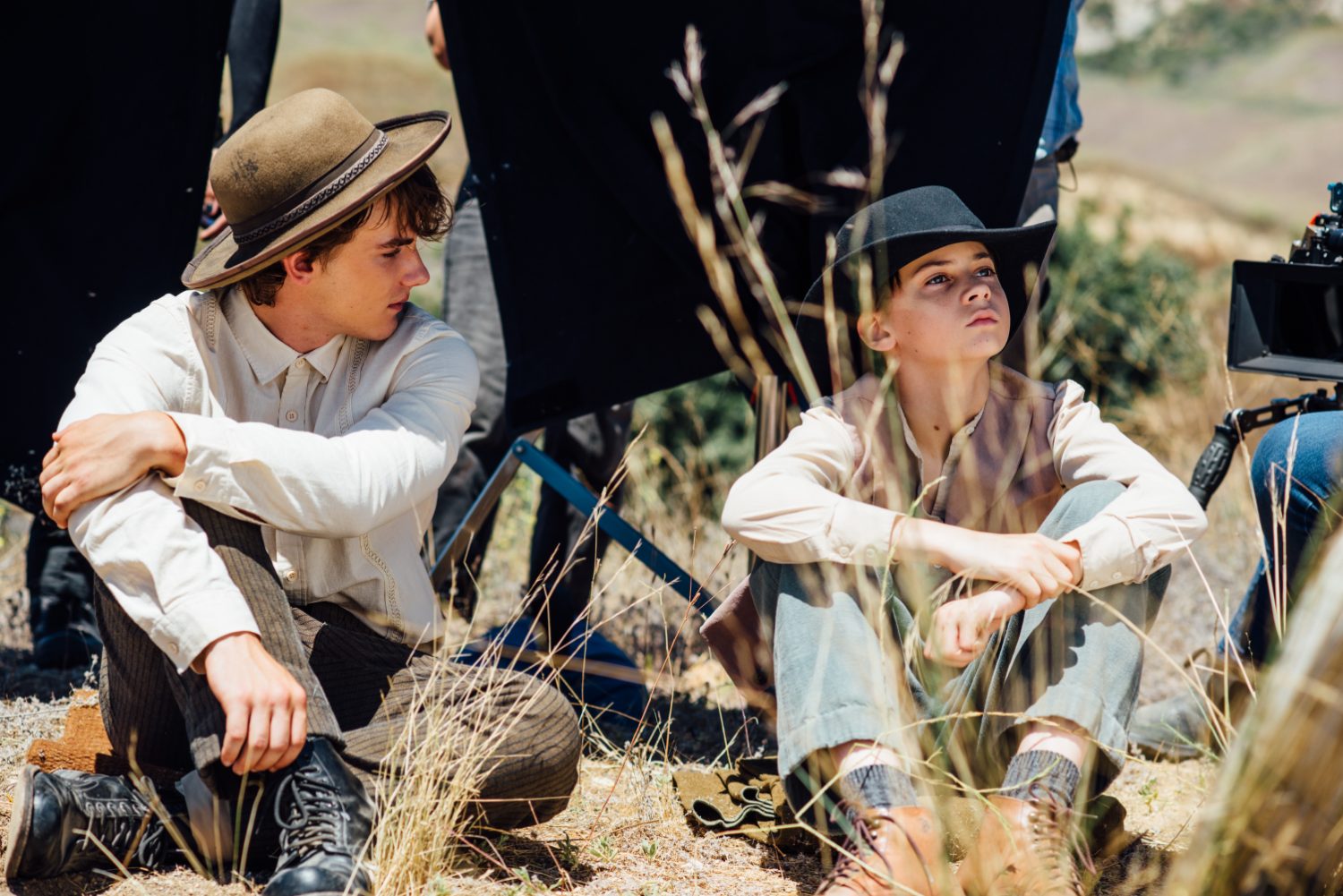
A behind the scenes shot from the filming of “Abraham’s Boys” (Gabriel de Urioste)
“This is a guy who spends his Friday night creeping around a cemetery, peeling off the lids off new coffins and hammering stakes through the heart of the young lady at rest there, then chopping off her head and stuffing a garlic bulb into her screaming mouth,” Hill says about the character of Van Helsing. “We know he’s a hero, because he told us so. We know vampires are bad. We heard it right from him. They’re infected and evil and have to be destroyed. Okay. But his Friday night sounds an awful lot like Ted Bundy’s Friday night.”
The author’s observations coalesce in a riveting tale of an overbearing father with paranoid ideations and questionable ethics. Van Helsing’s sons Max and Rudy are kept stashed away from the world in an isolated farmhouse nestled deep within the country, along with their ailing mother Mina, played by the transformative Jocelyn Donahue. Sequestered in an environment that abides by a strict moral code, the brothers are homeschooled, there’s no playing outside after sundown, and when Van Helsing delivers an order, it is to be carried out without question — no matter how ghastly the request.
“Bram Stoker doesn’t give us a biography for Van Helsing,” points out director Kermani. While rereading Dracula to prepare for her latest project, she was surprised to discover just how much she questioned the iconic hero’s virtue. “The main characters are frightened and confused. Something is attacking them and they don’t fully understand it, and in comes Van Helsing, this patriarchal figure who basically says, ‘I have the answers,’ right? ‘I will show you the monsters, and I will show you how to defeat them,’ and these young people fall right in line. They get behind him and they do really extreme things, including killing one of their own friends, because Abraham says, ‘Cut off her head, she’s a monster.’”
By approaching the original Stoker story from a different angle, Kermani developed a similar outlook on Van Helsing’s erratic behavior as the formidable Boys author. Yet despite this new insight, the filmmaker still finds it amusing how such a somber take on the classic subject matter could spill out of a man who genuinely radiates warmth and compassion.

Natasha Kermani (Michael Tullberg/Getty)
“It’s so interesting, because Joe himself is such a joyful guy,” says Kermani about Hill. “There’s a real lightness to him, and he’s a joy to be around. But I’ve always felt his work is so dark because what he’s really tapping into is the dreadful aspects of our human selves. He writes these monster stories, but really, it’s so personal, it’s so intimate, and it’s so inescapable in that way, because it’s people grappling with the gross, nasty parts of themselves.”
Known for her fascinating character studies and strikingly surreal worldbuilding in standouts like Lucky, Imitation Girl and V/H/S/85, when Kermani came on board to adapt Hill’s story, the author instantly got the sense that she was a filmmaker whom he could trust. Praising the director’s work as “stunning” and “extraordinary,” Hill goes on to say that she’s the kind of filmmaker with whom you meet and you “come away inspired,” adding that everyone who talks to her “starts to latch on to her combination of imagination, competence and clarity of vision. You just know she’s three pictures away from being asked to do a Marvel movie.”
Dripping with suspense, weaponizing empty spaces and wielding dark shadows like weapons, even author Hill believes Kermani’s movie plays like an Alfred Hitchcock film: “With the whole way it’s shot and constructed and the way scenes of suspense are engineered, it feels like Psycho or Vertigo.” By prioritizing suspense over scares and pushing claustrophobic environments to trigger pressure cooker scenarios, Kermani builds the tension in such a strategic manner, the late filmmaker would be proud.
“Van Helsing’s house out there on that hill in the middle of rattlesnake country could be the Bates Motel,” says Hill, his eyes shining. “But then, during the day, when we’re outside and Brady Hepner has his sleeves rolled up and he’s chopping wood, suddenly, it looks like a John Ford Western. The sunlight is pouring itself out across the California hills, and Brady could be a young Gregory Peck in some 1950s era film. I think that’s part of what makes it so satisfying and effective.”
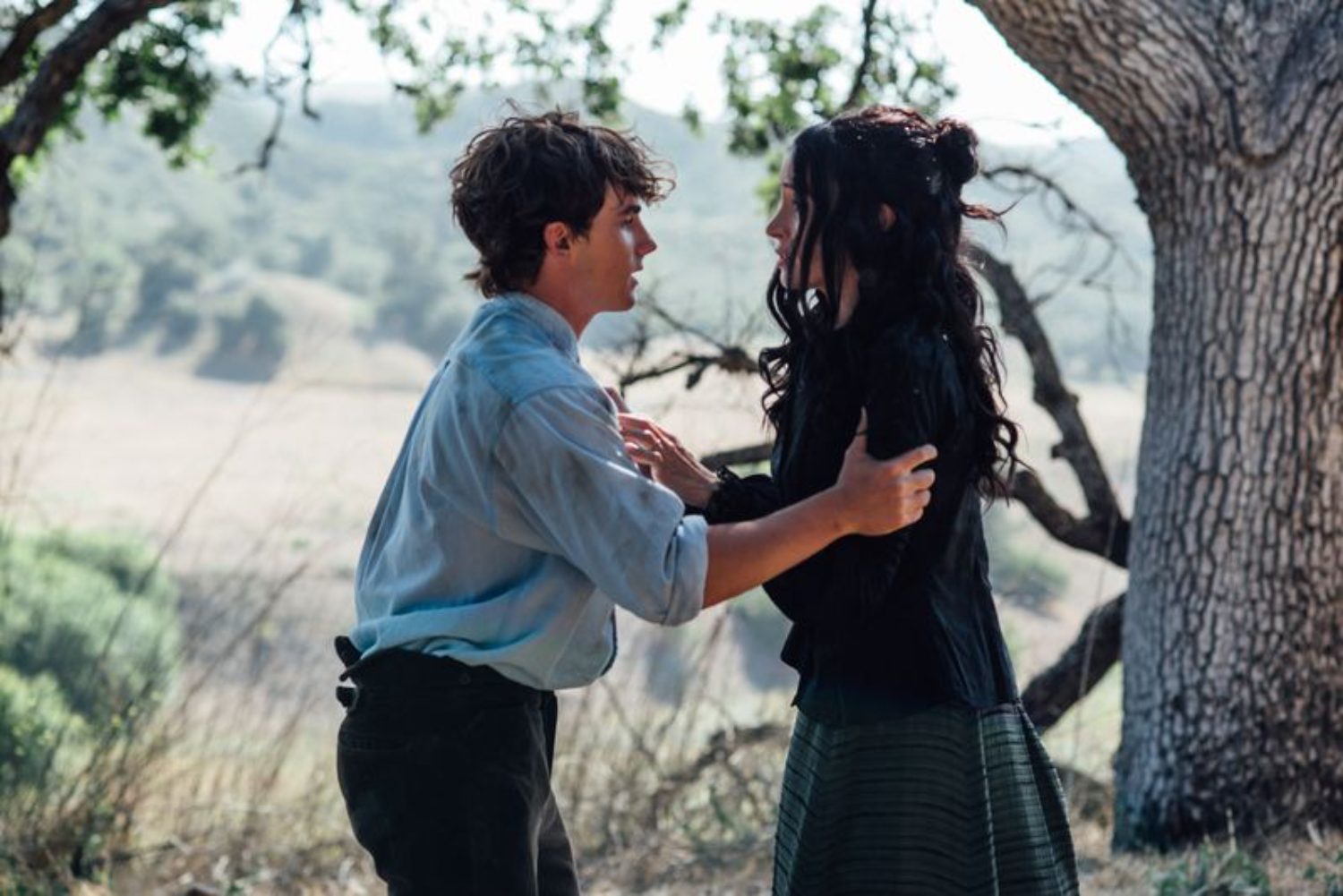
A still from “Abraham’s Boys” (Gabriel de Urioste)
Inadvertently capitalizing on one of Hitch’s lesser-known director traits, Kermani crafts a villain that is both deceptively charming and persuasive. Thanks in large part to a powerfully moving performance by Welliver as Van Helsing, his character, although morally ambiguous, remains sympathetic. With his full-bodied voice serving up fiery sermons like a preacher, and his projection of a steadfast family man masking his controlling tendencies, it’s not hard to understand why everyone around him tends to bend the knee.
When the vampire slayer presents an afflicted prisoner to his boys, declaring that this terrified person, whom he’s secretly trapped in his basement, is infected with the same disease that controlled Count Dracula, older brother Max begins to question his father’s intentions. But Rudy, the baby of the family, still finds his old man plausible and appealing.
“I really love Abraham,” smiles Kermani. “He’s one of my favorite characters that I’ve been able to develop for the screen. He’s not a villain and he’s not a hero, which is the case for every human being. There is no true evil. There’s no true good. We’re all sort of somewhere in the middle.”
By expanding Van Helsing’s biography and creating memories from his childhood, including his relationship with his own father, Kermani conjures up relatable moments for viewers that seek to identify his core trauma. “He’s a physician,” she explains, “At the time, doctors were not upper-class citizens, they were very much members of the working class. I thought all of those little details were very interesting, and started to build a glimpse of who this guy is, and why he’s so scared all the time. What is this fear that he can’t seem to shake, that is so extreme that he brings his family to this place? That he develops this incredible mythology around himself — of course, with himself in the center as the hero — and he builds this really complex story in order to help understand his own latent fears that he can’t seem to escape. I think he’s incredibly relatable. And I feel sorry for him, too.”
Author Joe Hill knows a thing or two about living up to one’s legacy. The son of acclaimed novelists Stephen King and Tabitha King, he describes how growing up, there was no question as to where his path might one day lead.
“It’s no secret that I have an extraordinary, one-of-a-kind American father,” says Hill. “I would come home from school and my mom would be in her office, and she had a tomato red IBM Selectric typewriter that shivered like it had palsy, and she’d be in there banging out pages. And I’d go up to my dad’s office, and he’d be sitting in front of his Wang Word processor with a black screen that had green letters on it, like the letters falling in The Matrix. You looked at that computer and it looked like the future. He’d be in there playing make-believe, cranking out pages. By the time I was 12 or 13, I just thought that’s what you were supposed to do with your day. I thought you get back from school, you make a cup of tea, and you sit in your room and you play make believe for a couple hours, and eventually someone will pay you a whole lot of money for it — which it turned out to be true.”
As an aspiring writer, Hill wrestled with the idea that his work might be judged on a different scale than his peers. When you’re raised by the man responsible for such titles as Carrie, The Shining, The Dead Zone, It, The Stand and Misery, it’s not unreasonable to fear that following suit might mean being praised for his name, and not necessarily his merit.
“When I was in college, I started to think, if I write as Joseph King and people know about who my dad is, there’s a chance that someone will publish me because they see a chance to make a quick buck in a famous last name, and regardless of quality,” remembers Hill. “But readers are pretty clever, and if you write something garbage and they read it and throw it down halfway through, they’re never gonna buy a book by you again. They’ll think, ‘He just got published because he’s got a famous father!’ I had a terror of that happening, and I needed to know, for my own self-worth, that when I got published, it was for the right reasons.”
As a precaution, Hill chose to publish his writing under the pen name “Joe Hill,” a pseudonym made from his real full name, Joseph Hillstrom King (his parents are big Joan Baez fans). Even after successfully achieving recognition on his own terms, the renowned author still uses his old alias today, despite his cover being blown pretty much the moment fans met him in person.

Joe Hill (Vivien Killilea/Stringer/Getty)
“The big clue that my dad might be Stephen King was my face,” Hill laughs. “I sold 20th Century Ghosts, out of which Abraham’s Boys comes, to a small press in England after it had been turned down everywhere else. Then the book came out, and I did what you’re supposed to do, which is you go out and try to sell the book. Right away, people started to suspect something was up. They looked at my face and said, ‘Hey, wait a minute.’”
Just as the Van Helsing boys feel the weight of their father’s expectations, so, too, was Hill born into a world of predetermined projections. Despite a loving home life, Hill knew his career trajectory would inevitably raise eyebrows in the literary world. Society loves to tout the positive aspects of nepotism, but few rarely discuss the pressure put upon young people to achieve towering standards set in place by authority figures who have garnered international influence. Still, the writer is the first to point out his privilege.
“I’m the luckiest guy I know,” Hill beams. “I’ve got a new book out in October, and one of the last things I wrote for it was an acknowledgments page. When I was working through my ‘thank yous’ at the end, I thanked my mom and dad for looking at an early draft of the manuscript and sharing their editorial thoughts with me. And then I stepped back and I thought, ‘Holy shit, I had Stephen King and Tabitha King read an early draft of this thing, and edit it page by page. Who has that? No one has that. What an amazing thing!’”
The apple doesn’t fall far from the tree, as Hill tends to explore family dynamics in a similar fashion to his kin. “One of my artistic preoccupations is the relationship between fathers and sons,” he says. “I always find myself looking at really unusual, extraordinary, one-of-a-kind men. And my question about them is never, ‘What would it be like to be him?’ My question is always, ‘What would it be like to be his son?’ I find myself always thinking that way. Certainly, when I looked at Abraham Van Helsing, and I was trying to find my way into the story, I thought, ‘What would it be like to be his kid?’ The conclusion I came to is, ‘Not too nice.’”
There’s a moment towards the end of the original short story where Max catches himself mimicking his father’s violence in real time. As Hill’s text reads, “He saw now he had always had it in him: his father’s brusque willingness to puncture flesh and toil in blood. He saw it clear, and with a kind of dismay.” An unflinching portrayal of bloodlines, the theme of cursed inheritance permeates much of Kermani’s adaptation.
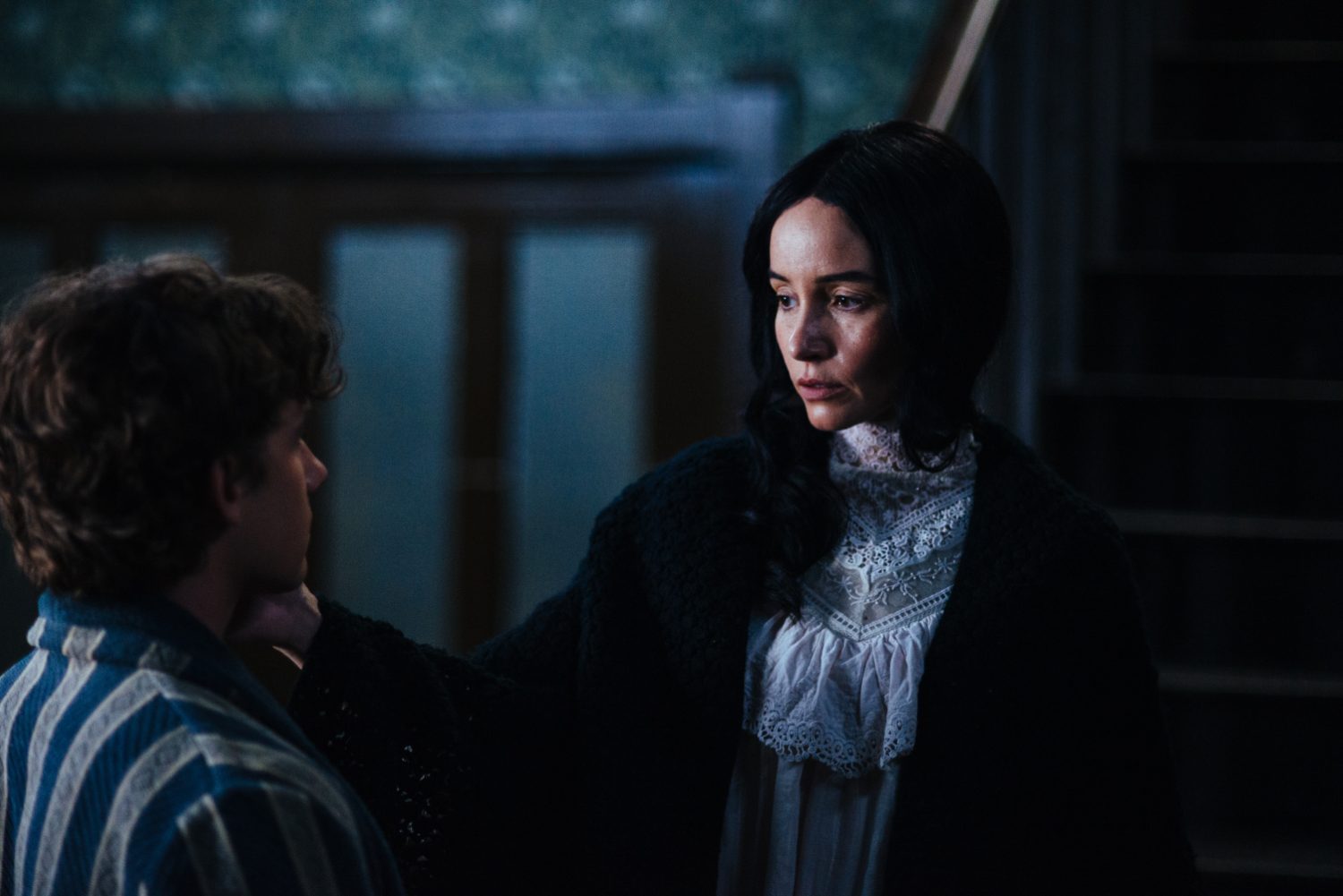
A still from “Abraham’s Boys” (Gabriel de Urioste)
“Even though Max does experience this coming of age, he’s still not quite able to escape the teachings of his father,” reflects Kermani. “He’s still behaving in accordance with Abraham’s tenets, which is: identify and destroy the monster, protect your loved ones and yourself.” Addressing the film’s looming sense of grim fate, she wonders, “Are we just doomed to follow in our parents’ footsteps? I don’t know the answer, but I know that it’s not an easy yes or no.”
One of the most startling departures Hill makes from Stoker’s source material is the addition of Mina as Van Helsing’s late wife. Unabashedly leaping into unknown territory, Hill’s decision to romanticize the relationship between Mina and Abraham cheekily teeters on the edge of forbidden love. Taking that notion one step further, director Kermani ups the ante by making Mina a constant presence in the movie, rather than a fading memory.
“I was fascinated by Joe’s decision to put Nina and Abraham together,” muses director Kermani. “To me, that was so wild, because Nina is so much with Jonathan Harker in Bram Stoker’s Dracula. What would drive Mina into Abraham’s arms? And away from her home, and cause her to leave behind her entire life?” Upon revisiting the 19th-century novel, the filmmaker discovered that Mina’s character might actually be the most pivotal. “Mina’s the one who’s targeted by Dracula. She’s the one who’s bitten by him. She’s the one who has this telepathic connection with him. And it’s Mina and Abraham who go off together in the end, and have their little adventure.”
Kermani believes Hill was instinctively tapping into something buried deep within the original text, and found herself thrilled at the chance to pull on those threads and discover who this woman might be nearly two decades later: “She has these open wounds from these events in 1897 that she’s never been able to fully heal. They’ve just been festering for 18 years while she’s been living this solitary life with this strange man. That felt so juicy. Just a great sandbox for a character to be developed in.”
Once Donahue came on board to play Mina, the character truly became real. “She was straight out of an Edgar Allan Poe poem,” says Kermani, “Beautiful and porcelain, and really representative of the old world, because the film is so much in California. Especially with the kids, to have Mina as this through line back to Dracula, I think really deepened the world.”
As studios struggle to interpret what it is precisely that audiences are craving, director Kermani argues that more often than not, companies are learning the wrong lessons from box office results. Although original stories are necessary and essential, perhaps now more than ever, it is crucial to learn the lessons of the past.
“There is this instinct in Hollywood to reinvent the wheel — and I don’t know about that,” ponders Kermani. “I think that there’s something really powerful about these classic pillars of storytelling that continue to bear fruit. It’s okay to go back to those mythologies and question them, and play with them, and live in that space. A lot of really modern ideas can come out of that exercise. And I think that’s something that I feel very pulled to, and that I really enjoyed with this piece in particular.”
She adds with a grin, “With that said, we all love monsters, and it’s super fun to show them, and have monster sequences — and I know Joe loves it just as much.”