
 Wyles Daniel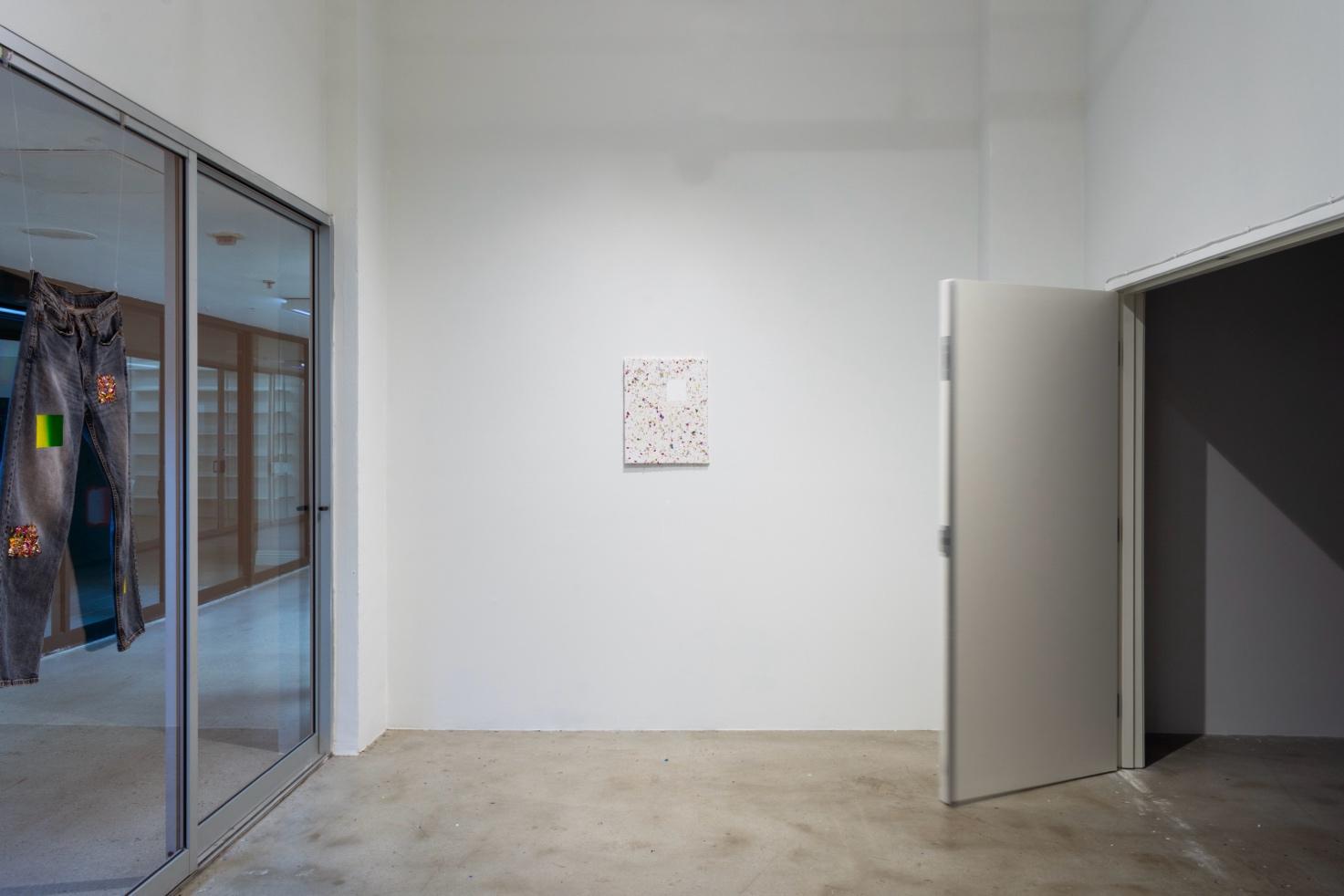
Exhibition View
In We Will Always Have Los Angeles, the interdisciplinary artist turns confetti, clothing and moving images into a meditation on desire, uncertainty and the memories that remain.
Confetti usually signals that the important moment has already arrived: the prize has been won, the countdown has ended, the celebration has begun. Earlier this summer, Zengjie Chai presented his solo exhibition We Will Always Have Los Angeles at The Reef in Downtown Los Angeles, however, confetti carries a more complicated charge. Scattered, embedded and released across painting, sculpture and video, it records pleasure at the very moment that pleasure threatens to disappear.
That tension gives the exhibition its emotional structure. Chai, a Los Angeles-based interdisciplinary artist, draws on autobiography to examine queer intimacy, memory and the uncertainty of remaining close to another person. His personal experiences are not presented as private confession alone. Instead, he translates them into images and objects that invite viewers to consider how attachment is formed under unstable conditions—and how a temporary experience can become part of a lasting identity.
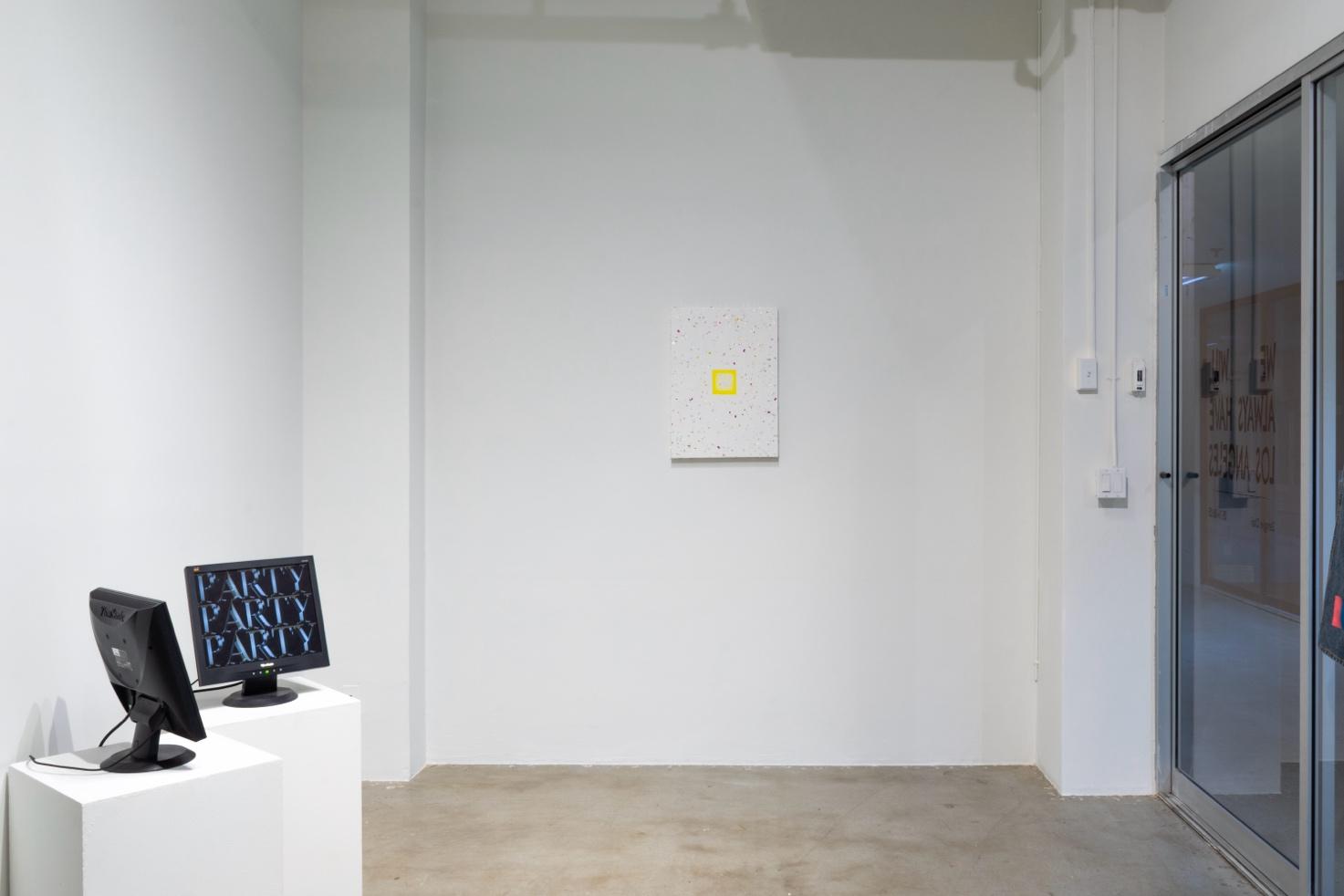
The four works occupy separate walls while answering one another through repeated forms. Two canvases, two video channels and two pairs of jeans establish pairing as both a visual device and a reference to Chai and his partner, to whom the exhibition is dedicated. The repetition prevents the show from settling into a simple narrative of romantic security. Here, intimacy is not a fixed state. It is something made and remade through attention, exposure and the willingness to remain present without knowing what comes next.
Exhibition View
In Can I Tell You How I Feel Before Spring Comes?, pieces of confetti are embedded in the surface of the work like remnants of an event that has ended. Their irregular distribution is interrupted by a rigid edge and a white square in the upper-right corner. The contrast between accident and geometry gives the painting its tension: celebration appears spontaneous, while the imposed structure suggests an effort to contain, order or preserve it.
Across the room, Oh, Be My Once In A Lifetime takes its title from a Lana Del Rey lyric, connecting Chai’s romantic vocabulary to a figure closely associated with Los Angeles and widely embraced within queer culture. Here the confetti is less dispersed, and an inward yellow gradient forms a luminous center. The image reads as hopeful without becoming uncomplicated. Its radiance is bounded, and its promise remains inseparable from the possibility of loss. Together, the two canvases use chance, color and control to make emotional uncertainty visible.
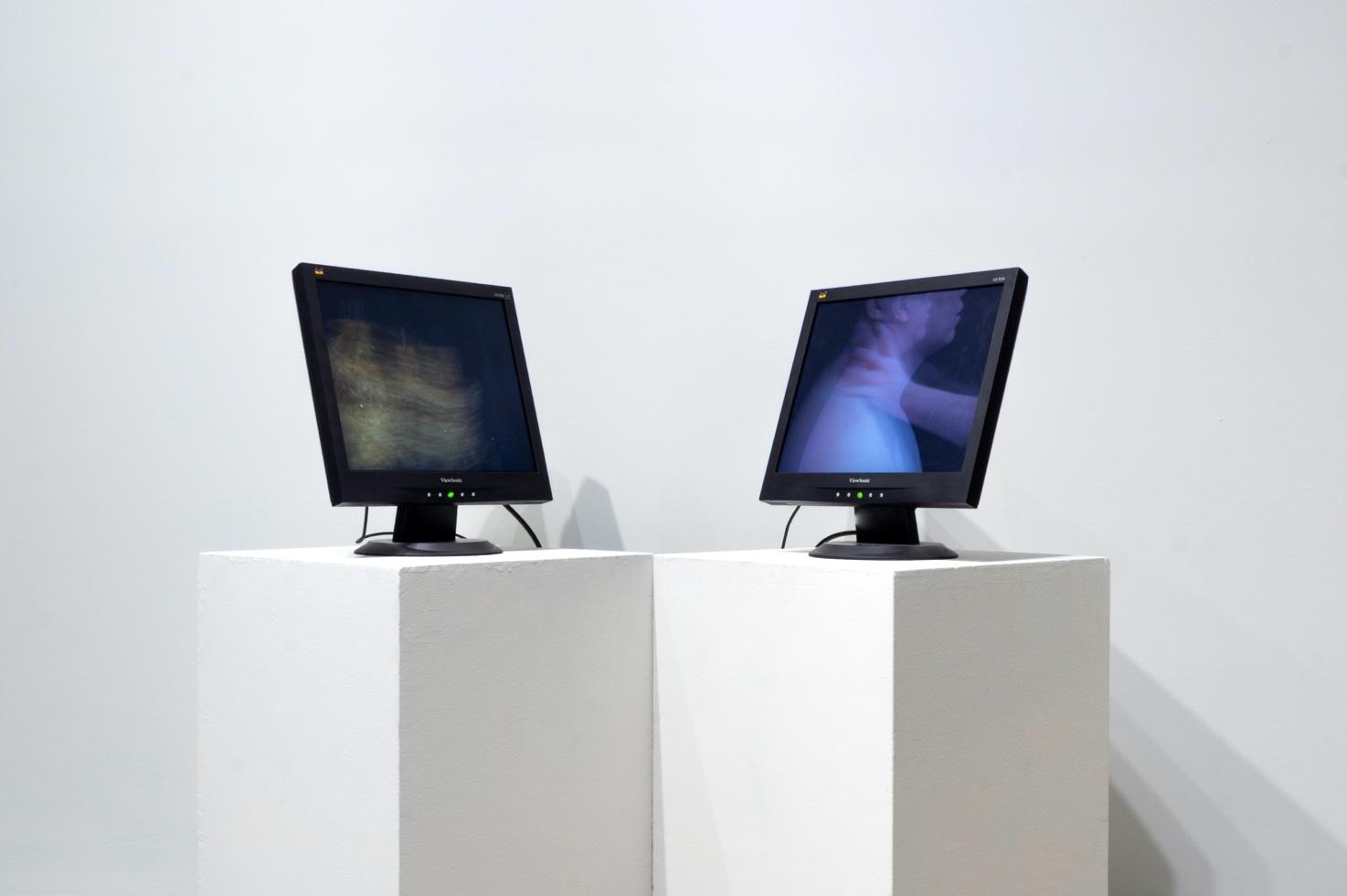
The exhibition’s most direct treatment of desire appears in PARTY PARTY PARTY, a two-channel video installation. One monitor shows Chai performing as the submissive partner in a sexual encounter; the other follows a piñata being struck until confetti bursts from it. The pairing is playful, but it is not merely a visual joke. By placing the body beside an object designed to be hit for the promise of a reward, Chai draws attention to the ways pleasure, endurance and violence can overlap within familiar rituals of entertainment and consumption.
PARTY PARTY PARTY
Both images depend on anticipation. The body and the piñata perform, withstand and yield; then the release arrives and immediately recedes. What remains is residue—the physical disorder after the celebration and the emotional aftermath of an encounter. In Chai’s visual language, confetti therefore operates in two directions at once. It embodies ecstatic presence, but it also measures how quickly a heightened moment becomes memory.
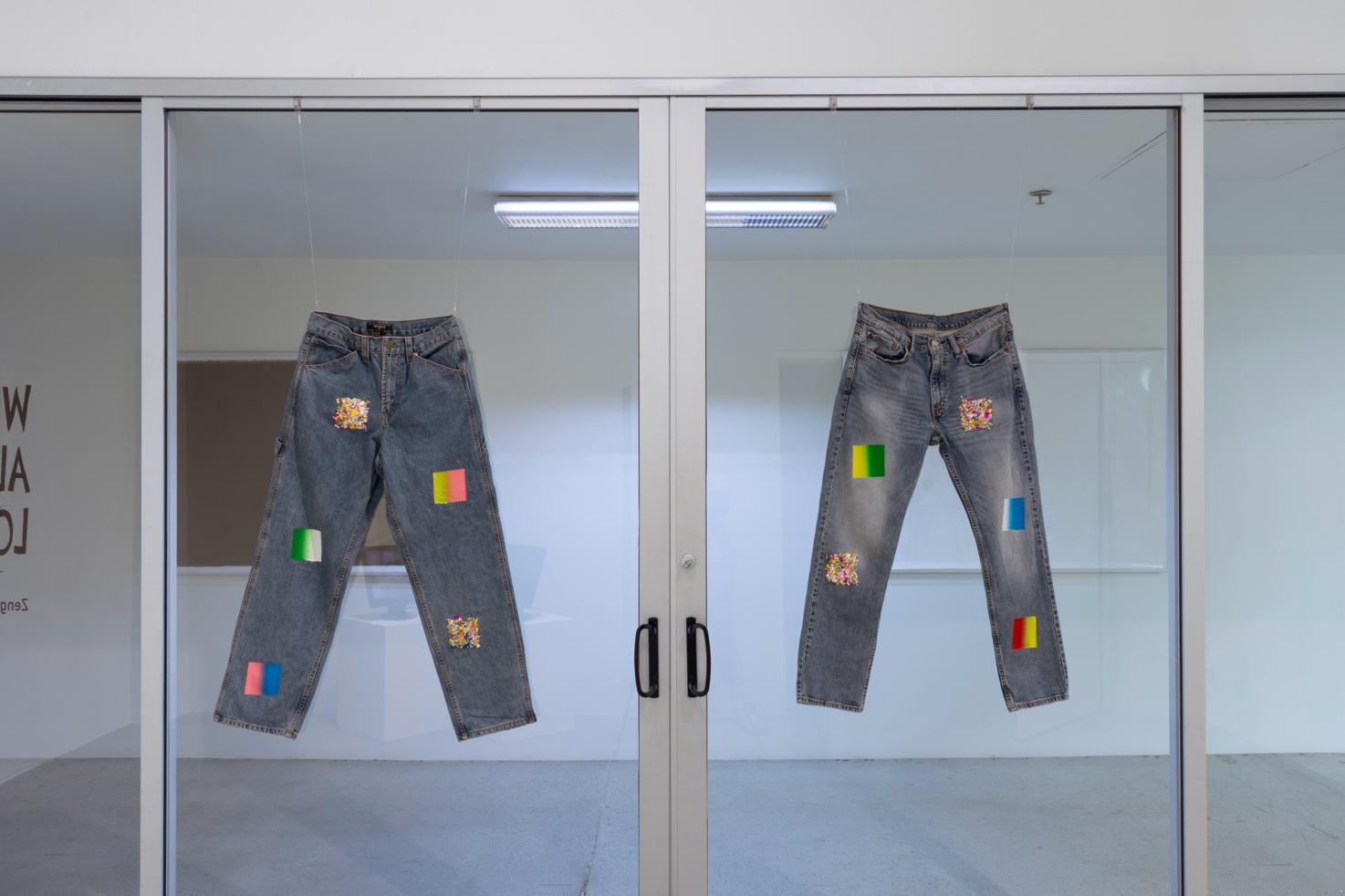
Where confetti records immediacy, Chai’s gradients suggest transition. They appear prominently in We Will Always Have Los Angeles, the installation that lends the exhibition its title. Suspended above the gallery’s glass-door entrance, two pairs of jeans are marked with gradient squares and confetti. Chai previously used the clothing to represent himself and his partner in Kiss Me In The Fucking Car. In the newer work, he returns to the motif with a quieter and more tender perspective.
The placement of the jeans makes their relationship dependent on the architecture around them. When the glass doors are open, the two garments appear separate under the public gaze. When the doors close, they move into proximity. A common article of clothing becomes a portrait without bodies, registering the difference between public distance and private closeness. The work distills one of Chai’s recurring strengths: his ability to give ordinary materials psychological weight without stripping them of their everyday familiarity.
We Will Always Have Los Angeles
The title We Will Always Have Los Angeles echoes the language of cinematic romance, but Chai does not offer the city as a permanent refuge. Los Angeles is presented as a relationship in its own right—one shaped by time, recollection and the knowledge that circumstances may change. The exhibition’s optimism lies not in denying that fragility, but in refusing to let it invalidate the present. Its works argue that an experience does not need to last forever in order to alter the people who lived it.
This approach extends across Chai’s broader practice, which moves among video, installation, painting and performance. Viewing lived experience through a queer diasporic lens, he considers how private memory is shaped by public space, cultural expectation and the body’s exposure to other people. His work has been exhibited or performed at the Getty Center, Torrance Art Museum, The Reef and Cevera Yoon Gallery in Los Angeles, and Beach Day is currently on view at Chapter 30 Studios in Oxnard.
In We Will Always Have Los Angeles, Chai brings those concerns into a concise conversation among four works. The exhibition is intimate without being closed off and sentimental without treating uncertainty as a problem to be solved. Confetti falls, doors open and close, and bodies leave traces behind. Chai’s achievement is to show that these fleeting gestures are not peripheral to a life. They are the material from which memory—and sometimes belonging—is made.