
 Matthew Kayser
Xuehao with colleague and advisor
From the Earth’s hidden turbulent currents to the delicate vortices shimmering around a fly’s beating wings, Xuehao Zang sees motion as nature’s most expressive system — one that governs how life moves, breathes, and sustains itself. His research, rooted in biofluid dynamics, connects fundamental physics with real-world challenges, revealing how the science of flow fuels both natural phenomena and technological innovation across vastly different scales.
A Curiosity Carved by Flow
“I’ve always been fascinated by how every flow phenomenon seems alive,” Xuehao reflects. “The way jellyfish glide, or how a coffee droplet dries into fractal rings — these are the fingerprints of physics and life blending together.”
That fascination soon became a calling. To him, fluid dynamics is not merely a field of equations — it is a framework that explains how the world functions, from the swirl of air around an insect’s wing to the heat plumes beneath the Earth’s surface and even the flow of blood through our veins.
In an age shaped by both climate and health challenges, Xuehao views biofluid mechanics as a foundation for sustainability. Whether studying how heat moves through the planet’s porous layers or developing miniature fluidic systems for healthcare, his goal is to harness the invisible dynamics of nature to build a more adaptive and resilient world.
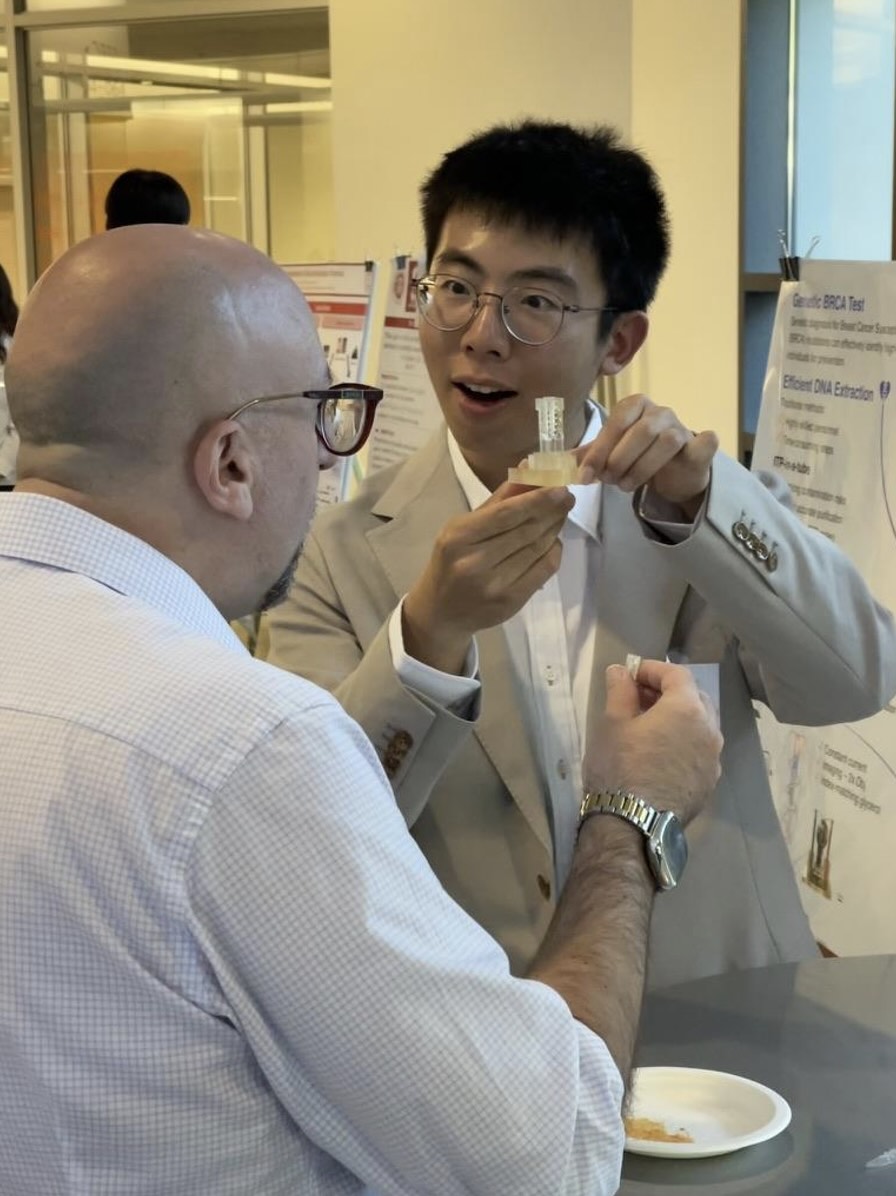
Xuehao demonstrating the new design of microfluidic channels at Stanford
Unveiling the Hidden Flow of Heat
Xuehao’s scientific journey began at Tsinghua University, where he joined Professor Chao Sun’s Multiphase Flow Lab to study how heat and fluid interact within porous materials — a process central to geothermal energy extraction and CO₂ storage.
Natural convection in porous media is one of the most common yet crucial processes in sustainable energy systems. Through independent computational studies, Xuehao explored how the microscopic structure of porous materials shapes large-scale heat transport. His findings revealed how fluid properties and geometry work together to regulate energy transfer — insights that can inform cleaner and more efficient energy technologies.
“It showed me how intricate flow dynamics can lead to meaningful, real-world understanding,” he says. That lesson became a cornerstone of his research philosophy: to view every flow — no matter its scale — as part of a larger, interconnected system.
Reimagining Microfluidics in Three Dimensions
If his earlier research captured the flows at large scale, his next chapter turned to the microscopic — the flow of life itself. Working with Professor Juan Santiago at Stanford University, Xuehao developed an innovative approach to molecular diagnostics, the foundation of modern disease detection.
Traditional genetic testing requires multiple steps — extraction, purification, and detection — across separate instruments. The idea of merging these processes into a single compact system was transformative. Starting from scratch, Xuehao fabricated and tested a three-dimensional microfluidic insert that fits directly into a standard PCR tube, turning a familiar lab tool into a self-contained “lab within a tube.”
“I still remember the first time I saw the spiral-shaped microchannel come into focus under the microscope,” he recalls. “It was like watching a new landscape form before my eyes.”
By expanding microfluidic design from flat chips to functional 3D architectures, the device showed how complex biochemical workflows could be simplified and miniaturized without sacrificing precision — a glimpse into a future where advanced medical testing is faster, more accessible, and more sustainable.
As part of Stanford’s ecosystem of biotech innovation, Xuehao’s work stood out for uniting precision with purpose — a breakthrough that reduces barriers, accelerates diagnosis, and advances global health equity.

Decoding the Aerodynamics of Life
Now pursuing his Ph.D. at Cornell University, Xuehao continues to explore the physics of motion — this time through the lens of insect flight. Working with Professor Itai Cohen, he investigates how fruit flies achieve remarkable agility and stability, performing maneuvers that still outpace any small robot.
Applying his expertise in fluid mechanics, Xuehao uses high-speed imaging and 3D reconstruction to uncover how each wingbeat generates intricate vortices and forces that maintain stability in flight. His analysis provides new insight into how evolution has engineered systems that are both robust and responsive — knowledge that is now informing the design of next-generation micro air vehicles and autonomous robots.
Through this work, Xuehao demonstrates how the principles of biofluid dynamics extend seamlessly from understanding living organisms to inspiring future technologies.
Flow as a Universal Language
Across these explorations — from heat transport and sustainable energy to molecular diagnostics and biological flight — Xuehao’s research converges on a single idea: flow is the structural foundation of life itself.
His approach combines imagination with analytical depth, seeking not merely to measure motion but to interpret its function and impact. Each project uncovers a different aspect of how living and engineered systems share the same dynamic logic — how understanding their motion can lead to smarter, more sustainable designs.
Looking ahead, Xuehao envisions a future where studying biological flows fuels innovation in energy, medicine, and robotics. “Fluid motion is the common language of life,” he says. “Once we learn to read it, we can design with it — to sustain, to innovate, and to inspire.”
Headshot