
 Will Jones
One night at Bonny Doon Beach, north of Santa Cruz, Markus Kager poured ink across a stack of paper, set it on the sand, and gave it space. Close enough to witness, far enough to let it work. He didn’t touch it again for hours. The wind did. The cold did. The coastal air, moving differently near the water’s edge, did. By the time he gathered the sheets and drove back to San Francisco, the landscape had made its mark — not as a subject to be painted, but as the artist itself.

Markus Kager at Bonny Doon Beach, Davenport, CA, 2021. Photo: Courtesy of the artist.
This is the radical proposition at the heart of Kager’s work: that a place, given the right conditions, will render itself.
Born in a small village outside Graz, Austria, Kager spent four years studying law before walking away from it — the decision of his life, he calls it. He retrained as an artist at the University of Art and Design Linz, and in 2017 enrolled in two classes at Stanford’s continuing studies program — photography with Randy Olson of National Geographic, and plein-air painting with artist Yvette Deas. It was there that the idea found him. Rather than rendering what he saw, he stayed with his subject — touching it, inhaling it, observing and analyzing it with a patience that had nothing to do with making a picture. Then he stacked pages, applied ink to the top layer, and let it seep through to the sheets beneath — giving the image the chance to articulate itself, to appear on its own terms, shaped by the place rather than by his hand. He has been doing it ever since, and the world has obliged him in some unlikely places. His practice is international — mountain ranges and forests in the Austrian Alps, orchards and cityscapes in Thailand, in the middle of New York’s frantic Times Square, dried-out salt lakes in Nevada with their dancing dust devils and wild horses — but the North American West Coast has become its center of gravity. Kager has traded the studio for the world itself — wherever a place has something to say.
What that requires, above all, is time. At Bonny Doon Beach, hours passed before anything resolved. His body temperature dropped to match the beach. The particular sound of each wave separated itself from the next. The light shifted in increments invisible to impatience. This is not a practice for the distracted. It is, in fact, a direct rebuke of distraction — an argument, made in ink and paper, that the world rewards those who stay.
Then comes the moment of return. Back in his San Francisco studio, Kager moves through what he calls ghost images — layer after layer taking shape — until the right one emerges. “Going through the layers is always a special moment,” he says. “It’s the first time I actually see the work. I’m looking for the image with the most contrast, the most saturation. The one the place actually made. Every piece is a fingerprint — of a specific space, a specific moment, a specific environment that will never exist in exactly that way again.”
The surprise, he adds, is that it always works. “Sometimes it’s not even me who makes the connection — someone else will look at an abstract piece and immediately recognize the place it came from.”
That the work communicates place without depicting it is not accidental. It is the whole point. “When I first worked on the West Coast I realized the landscape wasn’t a backdrop anymore. It had agency. It pushed back.”
Los Angeles is next. This summer, Kager plans to bring his practice to the city for the first time, working on a new body of site-specific work drawn from the LA landscape — its fault lines, its light, its particular tension between the urban and the elemental. “The place will call me. I don’t force it — I’ll be ready when the time is right, and the LA sun will do the rest.”
The late art critic and curator Jeff Kelley, who worked closely with Kager and would call his work “earthen work,” situated it at the intersection of German Romanticism, Freudian psychoanalysis, and what he termed Viennese Dada — European influences reframed, he argued, by the scale and force of the American West. “The forest fears and fairy tales of the Bavarian and Austrian Alps are landlocked in a child’s imagination,” Kelley wrote. “California, by contrast, is a region of great geological power — tectonic plates, fault lines, earthquakes, firestorms, and the Pacific Ocean pressing back against it all.” It is precisely that power that draws Kager in. After graduating in 2022, Kager began working with Kelley directly, eventually becoming studio director of the Hung Liu Estate — a collaboration that sharpened his understanding of what art could ask of a landscape, and what a landscape could ask of art.
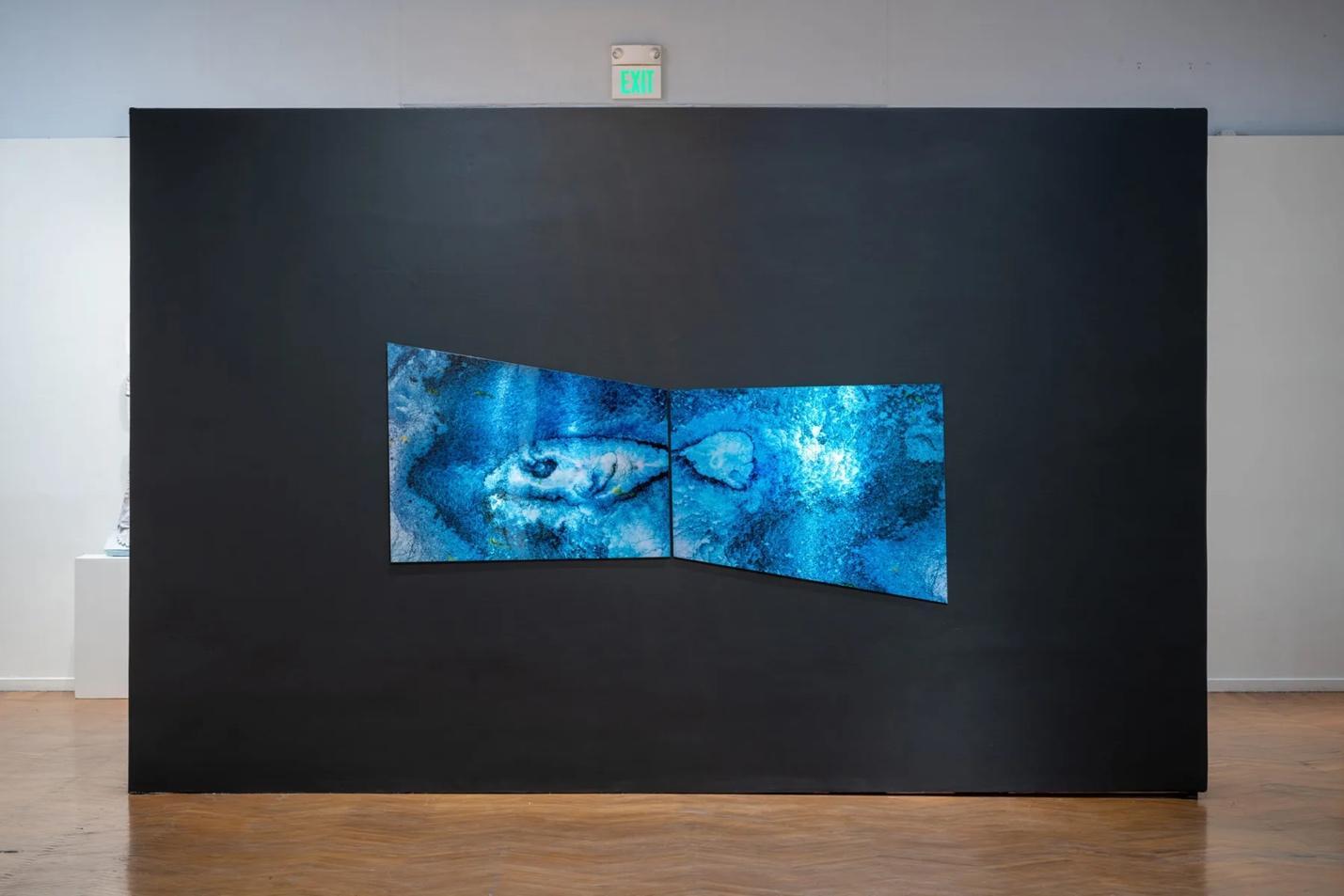
Installation view of Markus Kager’s work at Mills College Art Museum, Oakland, CA. Photo: Michael Halberstadt.
Two large-scale panels from his Bonny Doon Beach series, installed at the Mills College Art Museum for his 2022 MFA exhibition — their surfaces alive with deep blues and whites, traces of ink that seem to shift the longer you look.
Archival Material, Kager’s upcoming exhibition at Lee’s Launderette Community Hub & Cultural Center — a new experimental cultural space in San Francisco’s Mission District at 3151 16th Street — opens early December 2026. Another solo exhibition is planned for summer 2027: Generative Abstraction, an extensive body of work drawn from multiple sites along the North American West Coast, at Themes+Projects at the Minnesota Street Project, San Francisco.
But the work was never really about exhibitions. It was about what happens before them — on a beach in the middle of the night, or on a dried-out salt lake, or in the middle of Times Square, when an artist puts down his tools, steps back, and asks the world to speak for itself.