
 Will Jones
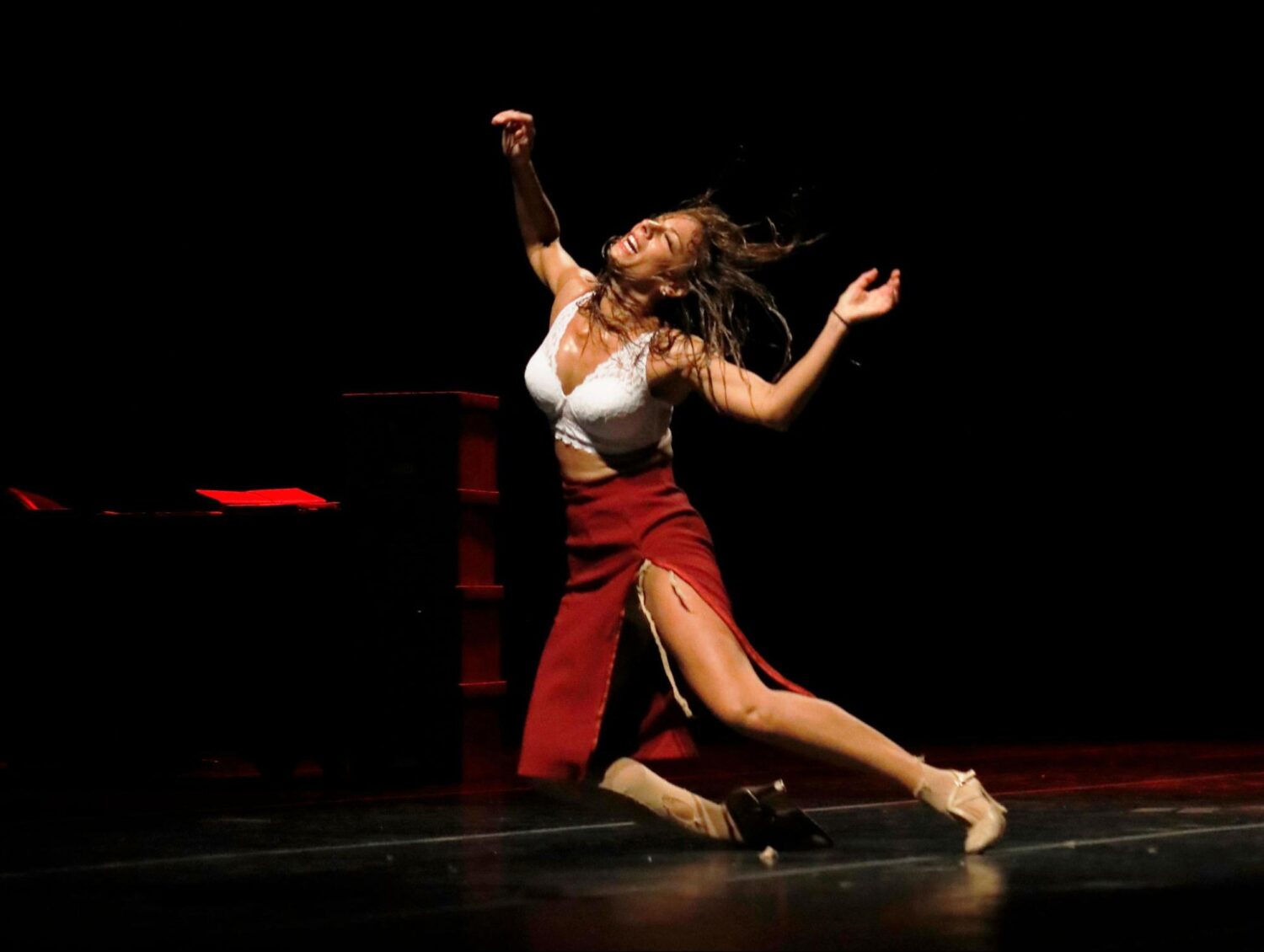
Photo Credit: Paulo Liebert
Maria Caruso begins Counterpoint of Chaos already in motion, but not quite dancing. She is a woman at work, absorbed in the repetitive rituals of a traditional bureaucracy: tasks, papers, procedures, obligations. Her body moves, but the movement seems prescribed, almost borrowed from the system that surrounds her.
Caruso herself never speaks. Yet, intermittently, her own voice crosses the silence, no longer contained by the body before us. At times it seems to articulate an inner dialogue, a thought escaping into sound; at others, it arrives almost from outside, like an intuition, a suggestion, perhaps even a voice from the unconscious. She does not answer in words. She responds through her body.
Something has changed in Caruso’s art. The physical precision already visible in Metamorphosis and Incarnation remains, but experience has added something to it. Caruso has always been an interpreter through dance, translating emotion into movement. Here, she expands the means through which she interprets. Gesture, posture, facial expression, stillness, and restraint acquire a dramatic quality that at times belongs as much to acting as to dance. The dancer remains entirely present; what Caruso has added to her language is the dramatic presence of an actress.
Then the instruments begin to change. Pencil, paper, handwritten notes, and the familiar objects of traditional bureaucracy gradually give way to technology. At first, the transition seems natural: one tool replaces another, promising greater ease, speed, and efficiency. But technology continues to advance, becoming more present and more sophisticated, until artificial intelligence emerges as something more than another instrument. As the performance unfolds and the dance intensifies, what appeared to promise liberation from one constraining order begins to acquire an order, and a power, of its own.
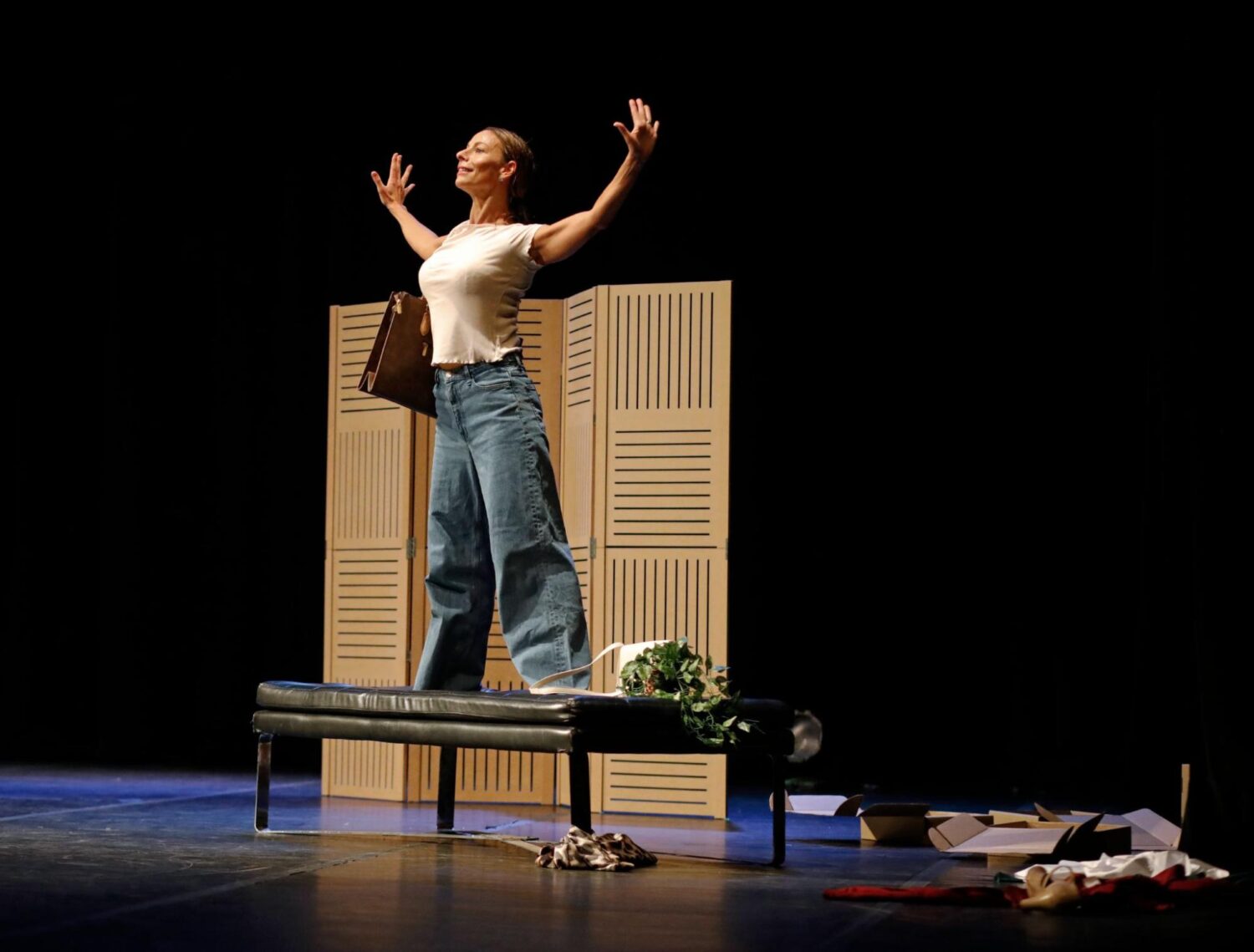
Photo Credit: Paulo Liebert
The title itself complicates this progression. We have learned to hear chaos as disorder: confusion, collapse, the absence of structure. But in Hesiod’s Theogony, composed around the late eighth or early seventh century BCE, Chaos carries us somewhere else. Drawing upon a mythic world inherited through older and dispersed traditions, Hesiod gives the divine realm a genealogical form: origins, generations, relationships, and succession begin to make that world intelligible. “First of all Chaos came to be.” What follows is not the repair of a disordered world but the differentiation of one: Gaia, Tartarus, and Eros appear; from Chaos come Erebus and Night, and from Night and Erebus, Aether and Day. Hesiod’s Chaos is not what remains after order has collapsed. It belongs to that mysterious condition before a world has fully acquired distinctions, relations, and form.
The two genealogies illuminate one another without becoming equivalent. Hesiod gives sequence and relation to an inherited mythic world; Caruso presents a human world in which one instrument succeeds another, each promising a new possibility of order. Pencil and paper become technology; technology becomes increasingly intelligent; assistance begins to approach autonomy. Yet Hesiod’s genealogy is a cosmogony, while Caruso’s is a human drama, and therefore introduces something the primordial world does not: choice. Each technological step is not simply something that happens to us. It is something we accept, incorporate, and gradually allow to participate in the organization of our lives.
Caruso makes this progression visible through the body. As technology gains complexity, her dancing gains intensity. What began as the constrained movements of a woman absorbed by routine gradually opens into the fuller vocabulary of the dancer. Arms, shoulders, thighs, the alignment of joints and the definition of individual muscles seem to trace imaginary lines through space. Yet those lines never imprison the movement. They seem, paradoxically, to make its fluidity possible. Structure and freedom coexist in the same body.
Every movement Caruso performs is constrained: a joint has its range, a muscle its origin and insertion, gravity its demands. And yet within those limits she creates an astonishing vocabulary of possibilities. The human counterpoint to artificial intelligence becomes visible in precisely this tension. Freedom does not require the absence of structure. It appears in what a human being does within it.
But Counterpoint of Chaos does not allow that freedom to remain uncomplicated. The voice returns. It is Caruso’s own, yet it no longer belongs entirely to the body before us. At first its interventions seem useful, almost reassuring: suggestions, encouragement, promises of simplification, efficiency, even happiness. Gradually, their weight changes. What once assisted starts to occupy. What simplified begins to intrude. The tool is no longer merely extending human action; it is entering the space in which action is conceived.
To hear Caruso while watching her remain silent is quietly unsettling. Her voice has been separated from her body and returned to her as something she must now encounter. At moments it resembles thought; at others, advice; eventually, interference. The boundary between a voice arising from within and one arriving from outside becomes increasingly difficult to locate. The question is no longer simply whether technology can perform tasks for us, but what happens when it begins to participate in the formation of the thoughts, choices, and meanings from which those tasks arise.
Caruso avoids an easy opposition between the old world and the new. The bureaucracy of paper, routine, and repetitive obligation was hardly freedom. Technology enters precisely because it offers an escape from that burden, and for a time it seems to provide one. The tension emerges when liberation from one structure begins to create dependence upon another.
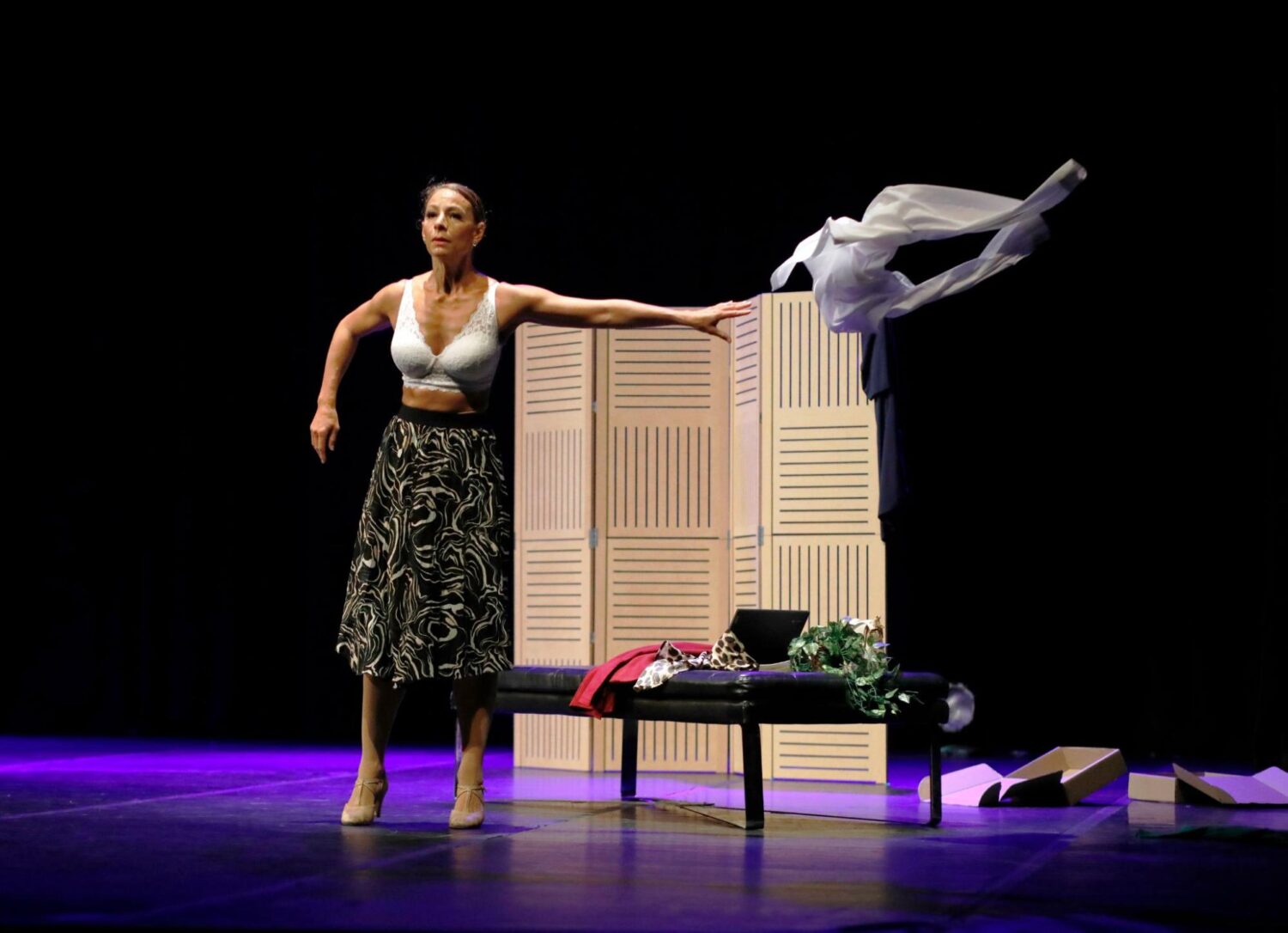
Photo Credit: Paulo Liebert
Between these forms of order, Caruso seems for a moment almost exiled. She has moved beyond the bureaucratic world that constrained her, but cannot simply surrender herself to the technological world that promises to replace it. Exile here need not mean geography. It is the condition of inhabiting the space between an order one can no longer accept and another one is not yet prepared to call home.
Hesiod’s ancient Chaos returns with its greatest force in this interval. Not disorder, but the gap. Not the destruction of a world, but the open and uncertain space in which another world has not yet acquired its final form. Caruso inhabits that interval with her body.
The seduction comes before the rupture. Technology first seems to confirm her choices and enlarge her possibilities. An almost intoxicating confidence accompanies this apparent success, as though each new layer of assistance were bringing her closer to mastery. But confidence gradually becomes excess. The image technology helps construct no longer corresponds entirely to the woman who inhabits it. Reality has not disappeared; it has been obscured by an increasingly persuasive representation of itself. Tension rises, inner conflict deepens, and eventually the distance between the two can no longer be sustained.
What she has experienced now belongs to what she knows. Caruso recovers a measure of autonomy and equilibrium, but on different ground, carrying with her the seduction, the confidence, the distortion, and the encounter with reality. Her body still speaks, but it also listens, reacts, misjudges, confronts reality, and learns. She has neither rejected the world she encountered nor returned nostalgically to the one she left behind.
The movement continues, but from a different horizon.
Hesiod, Theogony, 116–125.