
 Matt Emma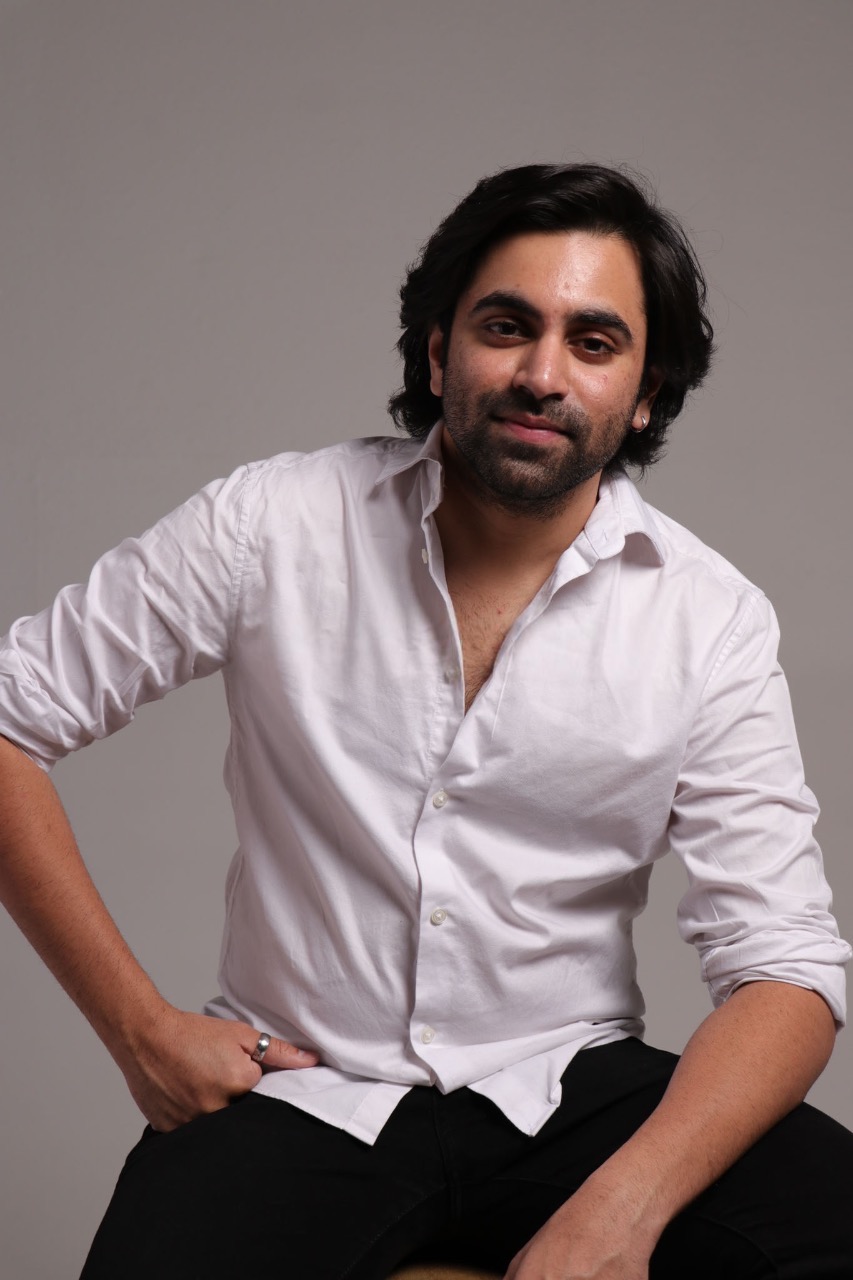
His performances are never about disappearing—they’re about anchoring the story
The first thing you notice about Kranthi Nag is not the résumé. It is the way he talks about the raw materials of cinema, about cans of film and the silver pulled from them like treasure. He grew up between Hyderabad and London in a world where celluloid was not an idea but a physical object feeding both his father’s business and his own imagination. “I was just waking up to something about movies every day,” he says. “That was the background noise of my childhood.”
Kranthi explains that his father extracted silver from processed film stock. Old films meant miles of physical footage. “That is literally why it is called the silver screen,” he says, half amused that a phrase so many people use casually comes from a process he watched up close.
His father also financed movies in the Telugu film industry, which meant summers were spent wandering around productions, watching directors call for quiet and crews reset lights. “I was seeing both sides, behind the camera and on it,” he recalls. “Finance meetings, script talks, actors working. It never felt mystical. It felt like work I respected.”
That perspective is still visible in how he talks about the industry today. He is clear-eyed about risk, about the cost of each frame, about the fact that there is always someone counting.
At twelve, he stepped into that world as an actor in “Current (2009)”, a Telugu feature film produced by Annapurna Studios. It was his first time being part of a professional project that would go out into the world, and it gave him an early sense of what it meant to belong on a set rather than just visit it.
He moved to London, where his relationship with performance deepened in a different direction. British theatre and the West End pulled him in, offering long rehearsals, Shakespeare, and the discipline of live performance, all of which contrasted with the commercial engine of the Telugu sets he knew. “I was obsessed with Shakespeare and theatres and the West End,” he says. “The UK gave me structure around something that started as instinct.”
If there is a theme in his story, it is that the desire to act never left, no matter how many practical steps he took around it. The decision to commit fully brought him to Los Angeles and into the Lee Strasberg Theatre and Film Institute. He earned a scholarship to study at a school whose alumni include Marilyn Monroe and Al Pacino. “The best of the best went there, and I got a scholarship,” he says. “It felt like the universe saying, if you are going to do this, do it properly.”
From that point, momentum built through work rather than hype. He gravitated toward lead roles that required him to carry stories, not just color them. “Chop Chop (2024),” written and directed by Rohit Relan became a key turning point, with Kranthi in the lead. The film screened at multiple festivals and picked up honors including Best Acting, Best Screenplay, Best of Fest at the 3×5 Film Festival in Los Angeles, and inclusion at the Jagran Film Festival in India.
Then his film “Comet Orphan” was selected for the Marché du Film at the Cannes International Film Festival. He notes it almost casually. The film’s presence within the Cannes Film Festival connected him to an international ecosystem that made sense given his own background: born in India, shaped in London, working in Los Angeles.
Parts in digital series across DramaBox, GoodShort, AltaTV, and DramaLet, with titles like “One Fateful Night with My Boss,” “Uncle Richard Is My Baby Daddy,” and “Punch Me Baby,” demanded that he stretch his craft over episodic arcs and fast production schedules. He views that work as a laboratory for consistency. “You have to show up with the same depth on day one and day fifteen,” he says. “The camera does not care that you are tired.”
What might be most revealing about Kranthi, though, is how he talks about what kind of actor he wants to be. “I was never interested in fitting into a character that existed before me,” he says. “I always felt I could provide more to the character than just trying to disappear into it.”
He laughs when he admits that almost everything he has done has been written around him. “Ninety-eight or ninety-nine percent of the time, the characters were written for me,” he says. “It was never, here is a role, can you squeeze in?”
That pattern led him to a clear conclusion. “I want to establish myself as a movie star, not just an actor,” he says. “Not out of bravado, but because I see myself bringing a certain presence that stories can be built around.”
The ambition is not about being everywhere; it is about building something that lasts. He talks often about continuity, about careers shaped by intention and restraint rather than constant reinvention.
His moves reflect his philosophy that consistency is more important than intensity. He relocated to Los Angeles knowing it would mean starting again without the comfort of his earlier contacts, treating training, self-study, and selective role choices as investments in longevity.
“I am interested in how performance, story, and the reality of making a living can coexist without flattening everything,” he says. “The industry keeps blurring lines between formats. Someone has to show there is a way to navigate that with integrity.”
When he talks about the future, the language shifts again from opportunity to stewardship. He imagines himself working with filmmakers who challenge him, supporting projects that value strong writing and nuanced performances, and quietly influencing which films get made. “My interest is in stewardship rather than spotlight,” he says. “If my body of work, decades from now, reflects consistency, courage, and relevance, that is the success I care about.”
Right now, he is focused on his next feature. “Poof!” starring Kranthi Nag is produced by KODA Entertainment and written and directed by Rohit Relan, a Student Emmy Award Nominee. The Director of Photography is Simran Sawhney, a student Emmy Award Winner. Relan and Sawhney had both their movies played at Academy and BAFTA qualifying film festivals around the world, including AFI Fest.
Nag is not chasing a moment, he is building a body of work that can hold its own long after the credits roll.
To find out more about Kranthi Nag, visit his website.