
 Will Jones
How a Retired Patent Attorney Uncovered the Soul of New Orleans
Temple of the Sun: In Search of the Lost Caribbean Ghosts
There is a line in an academic text that “Charles Dean Domingue” cannot stop thinking about. Two scholars wrote it in the introduction to The Road to Louisiana, a collection of papers on the Saint-Domingue refugee migration: “Despite their significance, the refugees have attracted remarkably little scholarly attention.”

Domingue, a retired patent attorney from Louisiana, read that sentence and felt something between outrage and responsibility. So he told the story himself.
“Temple of the Sun: In Search of the Lost Caribbean Ghosts”
is a 61-chapter historical novel braiding together the Haitian Revolution, Vodou mysticism, Caribbean privateering, and the mass exodus that gave New Orleans its soul. It began, improbably, as a modest pirate story written during COVID while his wife underwent chemotherapy and radiation.
“It was going to be a kid from the Canary Islands who gets shipwrecked, meets a beautiful girl — kind of a normal pirate thing,” Domingue laughs. “But when I got to Saint-Domingue around 1790, I found the slave revolution, then the British invasion, then Napoleon sending 50,000 soldiers — and losing. I just kept getting deeper and deeper into it.”
The novel follows three interlocking lives. Justine Chante is an enslaved woman on a Saint-Domingue sugar plantation who endures brutal exploitation while secretly studying Vodou, eventually becoming a powerful manbo — priestess — who faces Napoleon’s soldiers with a crown of thorns on her scalp, refusing to break. Beouf Baptiste is a fifteen-year-old enslaved field worker who transforms over decades into a fearless privateer. And Angelo Hernandez is the Canary Islander — the outsider whose seafaring journey stitches the whole world together. “These three people became allies in this huge, ugly, violent world,” Domingue says, “and they symbolise the 10,000 refugees.”
That figure — 10,000 — is the book’s historical anchor. Following Napoleon’s failed expedition, thousands fled Saint-Domingue, most first to Cuba and then to the Orleans Territory. Their arrival more than doubled the number of French speakers in New Orleans. The food, the music, and the spiritual traditions of the city trace directly back to those refugees. “That’s what gives New Orleans and Louisiana its Creole flavour,” Domingue says, with the certainty of a man who has done the research.
The subtitle’s “ghosts” are not what they first appear. Domingue was raised in rural Louisiana, speaking French and English — his grandmother spoke nothing else. “In French, the word for ghost is esprit — spirit,” he explains. “I’m not talking about a physical manifestation of a dead person. I’m talking about a spiritual being.” The central spirit of the novel, Ezili Danto — a Vodou lwa depicted as a scarred mother protecting her child — is said to have appeared at the Bois-Caïman ceremony in mid-August 1791, the spiritual catalyst for the Haitian Revolution. Domingue notes, almost casually, that mid-August has marked the Feast of the Assumption of Mary since the second century. “You can call it coincidence,” he says. “But you can’t deny the spirit of those people.”
One of the book’s most striking threads involves Nostradamus quatrains that Domingue believes have never been linked to Saint-Domingue. When a standard English translation rendered the French word farouche as “savage,” his Louisiana ear caught the error immediately. “Down here, farouche means untameable — like a wild horse. Not savage.” He reread the quatrain through that lens and saw Toussaint L’Ouverture: the untameable leader tricked by Napoleon, shackled in a French dungeon. “The prophecy read: the wild and untamed one, hung by his hands and feet. It’s the exact picture drawn of Toussaint in his cell.” He used these quatrains not as prophecy but as poetry — a metaphorical frame for atrocities that resist ordinary narration.
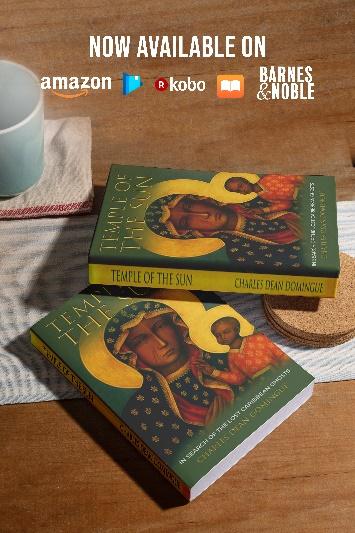
Perhaps the book’s most remarkable historical discovery involves the cover art: the Black Madonna of Częstochowa. Napoleon brought roughly 500 Polish soldiers to Saint-Domingue; many defected after witnessing the island’s brutality and fought alongside the Haitians, carrying their sacred dark-skinned Madonna icon. “When the Haitian people saw her, she became Ezili Danto,” Domingue says quietly. “And Ezili Danto — a dark mother protecting her child — had already been their spirit for years before the Polish soldiers ever arrived. You can call that coincidence too.”
Domingue studied fiction under the great Ernest Gaines in 1983, then spent 35 years as a patent attorney before COVID and his wife’s illness brought him back to the page. He is already writing a sequel — following the same refugees into Louisiana alongside the pirates and smugglers, Jean Lafitte among them, who made the same journey.
“I really do feel it’s a story that’s never been told before,” he says. “I wanted to show their resiliency, their spiritual strength. I wanted to show that they made it through.”
Follow the author’s journey, explore the history behind the novel, and order your copy through the links below.
Website: authordeandomingue.com
Instagram: @creoletemplespirit
Amazon: amazon.com — Temple of the Sun
Barnes & Noble: barnesandnoble.com — Temple of the Sun
Rakuten Kobo: kobo.com — Temple of the Sun