
 Matt Emma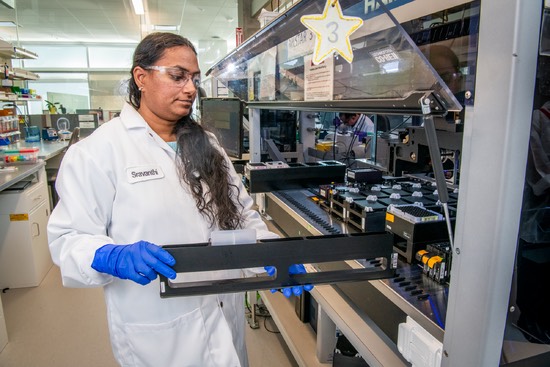
Sravanthi Tejomurthula’s journey through academia, a national laboratory, and industry exemplifies the evolving role of the translational scientist in today’s life sciences. As a Senior Research Associate at Lawrence Berkeley National Laboratory, she draws upon a foundation formed at Stanford University and Gilead Sciences, integrating rigorous academic principles with practical, scalable applications in genomics and drug discovery.
Her expertise includes next-generation sequencing (NGS), robotics-driven workflow optimization, and protocol development, with published research in respected journals such as Nature and New Phytologist. Tejomurthula’s cross-sector experience is increasingly vital as the demand grows for scientists who can transform foundational discoveries into technologies and medical interventions.
Industry trends point toward an urgent need to bridge the gap from research to application—whether through developing high-throughput genomic platforms or designing assays that directly inform patient care. In this context, her career provides a lens into how translational research can be harnessed for real-world impact, aligning technical innovation with advancements in health, energy, and environmental solutions.
Motivation for crossing sectors
Tejomurthula’s decision to move from academia to national laboratories and later the pharmaceutical industry was driven by a deliberate quest for impact across the full research pipeline. “My motivation to move across academia, a national lab, and the pharmaceutical industry stems from a desire to pursue impact-driven science across the entire innovation continuum,” she explains.
Each environment offered distinct vantage points. Academia provided foundational rigor and mechanistic inquiry, national labs brought focus on scalability and process innovation, and industry sharpened the emphasis on precision, reproducibility, and regulated outcomes relevant to patient impact.
“This integrated perspective is what I now bring to my editorial roles and research leadership, where judging the potential and rigor of science requires an appreciation for its entire lifecycle—from fundamental insight to applied impact,” she adds. Such agility parallels a broader industry movement toward multi-sector translational expertise, critical in fields such as biomedical AI, where the Bridge2AI program seeks to connect basic science with impactful applications and interoperable data sets.
Academic mindset in applied research
Academic training at institutions like Stanford has fundamentally shaped Tejomurthula’s approach to applied research. “It instilled a mindset of first-principles inquiry and deep mechanistic validation that I carry into every industrial or national lab project,” she emphasizes. By breaking down complex biological systems into testable hypotheses, her academic rigor informs the design, validation, and troubleshooting of high-throughput workflows and assays.
“Academia taught me that application without understanding is fragile. Whether I’m scaling a process at a national lab or validating a lead compound in pharma, my academic foundation ensures that the applied work is built on a solid mechanistic understanding,” she notes. This perspective is critical as new advances in translational research rely heavily on connecting underlying biological insight with scalable, reproducible methods in genomics and pharmacology.
Keeping discovery aligned to the application
Ensuring that fundamental genomic advances remain relevant to societal needs is central to Tejomurthula’s work at Lawrence Berkeley National Laboratory. She describes a three-principle system: “Alignment with Department of Energy Mission Goals, engineering for scalability and reproducibility from the outset, and active collaboration across the innovation pipeline.” Every experimental design and protocol is evaluated for its downstream utility.
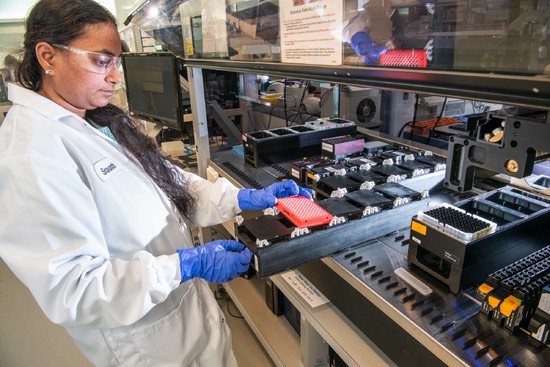
“By developing robotic, standardized protocols that increased throughput by 30% and reduced costs by 15%, I transformed a bespoke laboratory method into a robust, core facility service,” she recounts. These efforts echo the necessity for harmonizing NGS data and workflows to maximize practical outcomes—a priority reflected by recent developments in both cancer research and large-scale consortium studies.
Defining scientific success across sectors
Tejomurthula notes a fundamental shift in the definition of scientific success between academia and pharmaceutical R&D. “In academia, success is primarily measured by the generation of novel knowledge and mechanistic insight, validated through publication in high-impact, peer-reviewed journals,” she explains. In the pharmaceutical industry, by contrast, success is measured by the ability to deliver decision-quality, predictable data that drive clinical development.
“Here, the scientific method is applied not for open-ended discovery but as a disciplined tool for efficient resource allocation and translational progress,” she reflects. This reorientation toward actionable, outcome-driven research aligns with the need for rapid, cost-effective molecular screening—advancing drug candidates with reliable, scalable evidence.
Bringing academic training to industry outcomes
Tejomurthula provides a clear example of her academic-to-industry impact: “A direct example is my work on high-throughput in vitro ADME screening at Gilead Sciences, which was fundamentally built upon my academic training in protein biochemistry and heterologous expression.” She reformulated assay buffers, implemented quality control checkpoints, and automated systems to ensure protein stability and improve reproducibility.
“My academic training provided the mechanistic understanding to re-engineer an industrial process at a molecular level, transforming it from a variable screening tool into a reliable, decision-driving platform,” she explains. These approaches align with the application of machine learning for ADMET prediction, illustrating how foundational scientific acumen is converted into scalable processes for early-stage drug discovery.
Adapting approaches across environments
Transitioning between basic discovery and real-world application requires distinct shifts in objectives and risk management strategies. “I adapt my thinking by toggling between a mode of expansive questioning and a mode of convergent engineering,” Tejomurthula observes. In academia, success is measured by knowledge generation; in industry, the focus is on reliability and scalability.
“My thinking must expand beyond the technical answer to encompass user adoption, documentation, training, and long-term maintenance—seeing the solution as a system, not just a finding.” This mindset is increasingly reflected in translational research, where the introduction of informatics tools and implementation frameworksallows discoveries to be rapidly integrated into clinical practice and technology platforms.
Translating complex data for diverse teams
The translation of complex biological information across functional boundaries is a prominent challenge in collaborative science. “The central challenge in translating complex biological data for cross-functional teams lies not in the science itself, but in bridging fundamental gaps in language, objectives, and time,” Tejomurthula notes. She addresses these gaps by translating findings into actionable, operational language and framing communications around clearly defined decision points.
“My approach is threefold: pre-translate findings for each audience, combat data overwhelm by leading with action-oriented recommendations, and align timelines by defining decision points upfront,” she says. The focus on actionable insight reflects wider adoption of impact evaluation models in translational science, which seek to ensure data is both accessible and decision-relevant for multi-disciplinary teams.
Envisioning the future translational scientist
Looking forward, Tejomurthula sees her role evolving beyond bridging science and application to architecting integrated research frameworks that blur these boundaries. “My goal is to design and lead research frameworks where the distinction between discovery and translation is intentionally blurred, creating a continuous, iterative loop from mechanistic insight to validated utility.” She aims to combine experimental biology, AI-driven modeling, and collaborative data systems.
“A critical part of my evolving role will be mentoring the next generation of scientists in the translational mindset,” she adds. This ambition reflects industry trends toward mentorship for hybrid, cross-disciplinary scientists and stakeholder engagement strategies that help align innovation with practical needs.
Tejomurthula’s career reflects the changing landscape of modern life sciences, where translation is both the goal and the process. By integrating deep academic rigor with real-world application, she demonstrates the value of navigating between foundational discovery and practical solutions—a capability shared by a new generation of scientists working to advance health, energy, and environmental outcomes through seamless, cross-sector collaboration.